
The Japanese Sport Bike That Still Has What It Takes To Scare Modern Superbikes
Superbike development rarely stands still. Ducati, BMW, Honda, and Kawasaki keep finding ways to squeeze more power, electronics, aerodynamics, and increasingly serious hardware into their flagship sport bikes. Against that relentless march, anything based on a decade-old platform should look ancient. Yet one Japanese superbike has spent years being refined rather than reinvented, and its combination of explosive power, sophisticated electronics, and race-focused chassis hardware means it still demands respect.
Liter-Class Superbikes Have Leveled Up In The Past Decade

Today’s fastest production superbikes regularly claim more than 200 horsepower, lean heavily on aerodynamic downforce, and use six-axis inertial measurement units to manage everything from wheelies to braking. Some have variable valve timing, semi-active suspension, elaborate ride modes, and electronics refined through racing programs. The result is a segment where even small gains matter, and manufacturers are continually chasing fractions of seconds rather than merely building faster road motorcycles.

That makes longevity particularly unusual. Most machines eventually need a wholesale redesign simply to stay relevant, but outright specification doesn’t tell the complete story of a superbike. How the engine delivers its performance, how predictable the chassis remains near its limits, and how effectively its electronics allow a rider to use all that power can matter just as much.
Japanese Superbikes Have Fallen Behind Their European Rivals

Part of the gap comes down to where manufacturers have chosen to spend their money. European manufacturers such as Ducati and BMW have continued treating superbikes as technological flagships, pouring development into engines, electronics, aerodynamics, and increasingly sophisticated chassis hardware. Japan’s manufacturers haven’t stopped building fast motorcycles, but the business case for constantly reinventing expensive liter-class sport bikes has become harder to justify as buyers have shifted to more versatile machines.

Nevertheless, one Japanese superbike continues to stay relevant and go toe-to-toe with some of the best superbikes from Europe. It stands apart from the crop of Japanese liter-class sport bikes because of its unique engine configuration, modern technology, and impressive performance.
The Yamaha YZF-R1M Is Still Very Much In The Fight

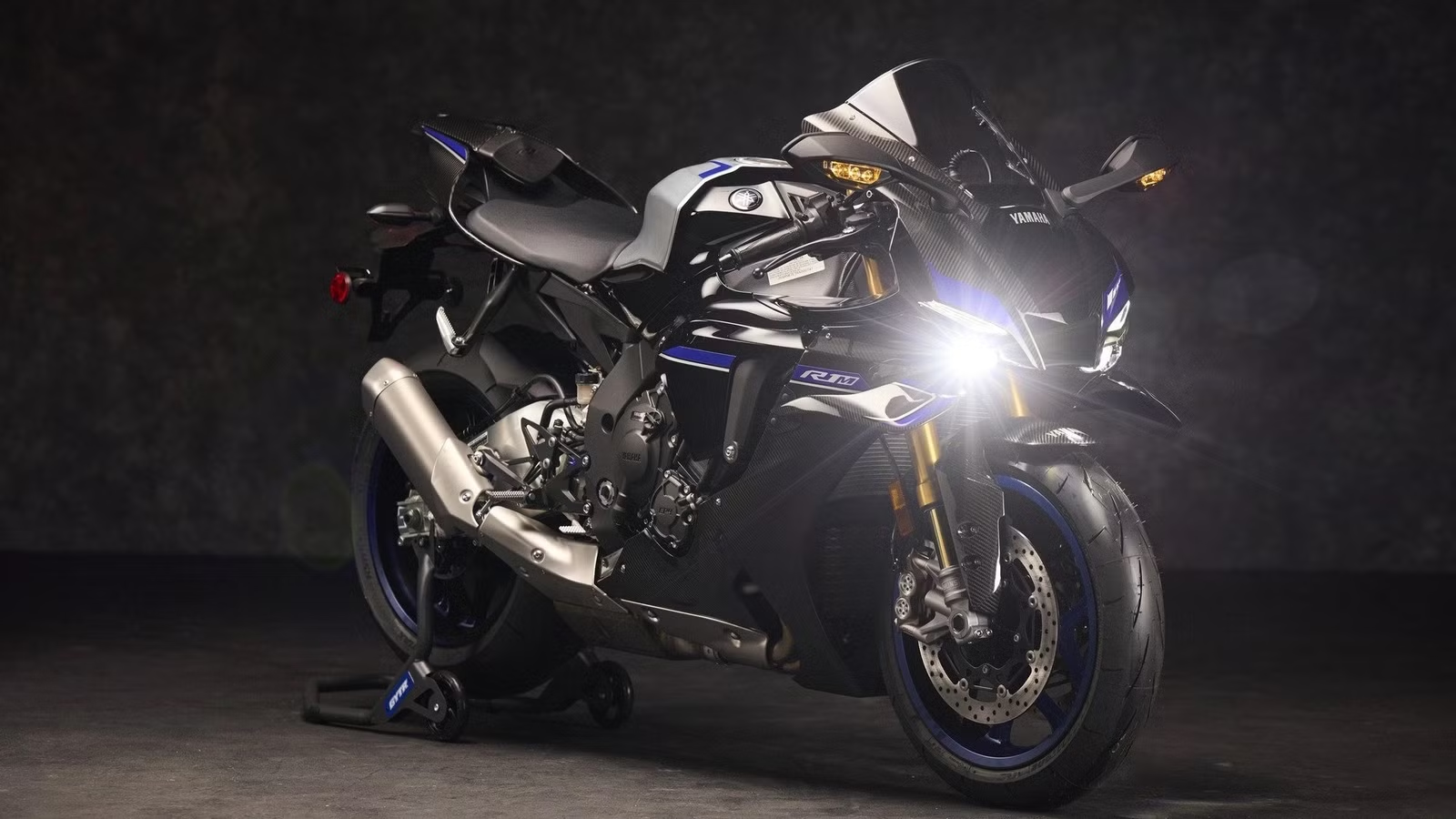
That motorcycle is none other than the Yamaha YZF-R1M, the highest-specification version of Yamaha’s liter-class superbike and a machine whose current architecture traces back to the radically redesigned R1 launched for 2015. More than a decade later, its fundamentals remain formidable. The R1M combines a 998cc crossplane inline-four with an aluminum Deltabox chassis, magnesium wheels, extensive carbon-fiber bodywork, electronic Öhlins suspension, and one of Yamaha’s most comprehensive electronics packages.
For 2026, the R1M carries an MSRP of $27,899, putting it firmly in premium superbike territory. It weighs 452 pounds wet, has a 33.9-inch seat height, a compact 55.3-inch wheelbase, 24 degrees of rake, and 4.0 inches of trail. Yamaha also gives it a 4.5-gallon fuel tank and estimates fuel economy at 33 mpg, although maximizing range probably isn’t the first thing on the mind of anyone shopping for its most serious R-series motorcycle.
The Crossplane Four Remains The Heart Of The R1M

The 998cc liquid-cooled DOHC inline-four uses a 79.0mm bore, 50.9mm stroke, four valves per cylinder, and a 13.0:1 compression ratio. Output sits at approximately 197 horsepower at 13,500 rpm and 83.6 pound-feet at 11,500 rpm. A close-ratio six-speed transmission, assist-and-slipper clutch, and chain final drive complete the drivetrain.
Its crossplane crankshaft remains the defining ingredient. Rather than chasing the conventional high-pitched character associated with most inline-fours, Yamaha uses an uneven firing sequence intended to produce more linear torque delivery and a clearer connection between the throttle and rear tire. Titanium connecting rods and intake valves, forged pistons, variable-length intake funnels, and a titanium muffler underline just how seriously Yamaha continues to treat an engine that first established the current R1 generation more than 10 years ago.
Yamaha Hasn’t Simply Left The R1M Frozen In Time

Longevity hasn’t meant standing still. The latest R1M wears carbon-fiber aerodynamic winglets developed through simulation and track testing to increase front-end load under braking and through fast corners. They’re incorporated into carbon-fiber bodywork that also includes the front fender, fairing panels, windscreen fairing, and tail section. A polished aluminum swingarm and individually numbered R1M badge further distinguish it from the standard YZF-R1.
The chassis itself remains compact and competition-focused, built around an aluminum Deltabox frame and lightweight magnesium wheels. Bridgestone Battlax Racing Street RS11 rubber comes in a 120/70ZR17 size up front and a particularly substantial 200/55ZR17 at the rear. That rear tire is wider than the standard R1’s 190-section unit and helps underline the R1M’s emphasis on maximizing drive and grip rather than making concessions for everyday practicality.
Electronic Öhlins Suspension Gives The R1M Its Biggest Chassis Advantage

At the front is a fully adjustable 43mm Öhlins NPX gas-charged electronic fork offering 4.7 inches of travel, paired with a fully adjustable Öhlins electronic rear shock with the same travel. The system works with the motorcycle’s sensors to alter damping as conditions change under braking, acceleration, and cornering. That’s the sort of hardware that keeps the R1M relevant even as newer superbikes have arrived with increasingly sophisticated semi-active setups of their own.
Braking comes from dual 320mm front discs with radial-mount four-piston calipers, braided stainless-steel lines, and lean-sensitive ABS. A 220mm disc handles braking duties at the rear. The package received renewed attention as Yamaha refined the latest R1 generation, and combined with the electronic suspension and magnesium wheels, it gives the R1M hardware that still reads like a serious superbike specification sheet rather than something being kept alive purely because of nostalgia.
Its Electronics Still Cover Nearly Everything You’d Expect
The R1M’s electronics revolve around a six-axis IMU feeding information to its rider-assistance systems. It gets lean-sensitive traction control, slide control, wheelie control, launch control, adjustable engine braking, multiple power-delivery settings, cornering-sensitive braking intervention, and a bidirectional quick shifter with three settings. Ride-by-wire throttle control ties everything together, allowing the electronics to manage torque rather than simply reacting after the rear tire has already gotten itself into trouble.
There’s also a communication control unit with GPS-based lap timing and data recording. Information from the IMU, ECU, and GPS can be logged for analysis, while setup parameters can be adjusted through a connected smartphone or tablet. A full-color TFT instrument display handles information on the bike itself, accompanied by full LED lighting. In other words, the R1M may come from an older underlying design than several of its rivals, but it isn’t short on the electronic tools expected from a modern premium superbike.
Raw Numbers Don’t Explain Why The R1M Still Matters

There are now superbikes with more horsepower, newer engines, more elaborate aerodynamics, and fresher chassis designs. That’s unavoidable after more than a decade of development elsewhere in the segment. Yet nearly 200 horsepower in a 452-pound motorcycle was never going to become slow simply because competitors found additional performance. The R1M still combines an extremely powerful engine with race-grade suspension, sophisticated electronics, serious brakes, lightweight wheels, and an aerodynamic package specifically aimed at making that performance usable.
Perhaps more importantly, Yamaha has spent years refining the same basic platform rather than throwing it away every few model cycles. The result isn’t the newest interpretation of the superbike formula, but a thoroughly developed one. At $27,899, the R1M certainly isn’t cheap, and buyers can find rivals with more impressive numbers on paper. But when the road or racetrack opens up, this decade-old Japanese superbike still has enough performance to make virtually anything sharing the pavement pay attention.
Source: Yamaha

Related posts



Latest Post


No Comments