
The Cruiser With Yamaha Reliability And Big-Twin Road Presence
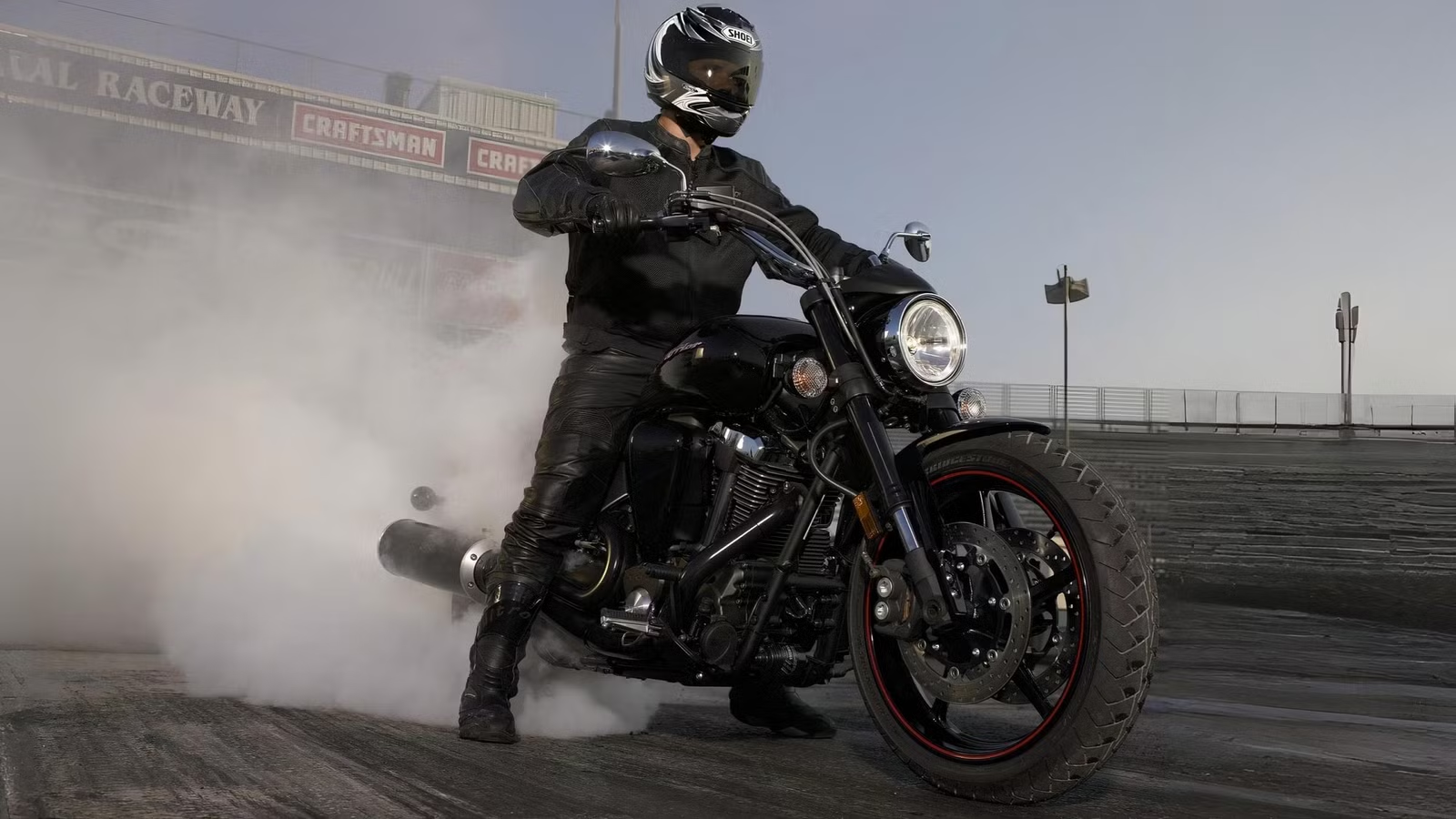
Big cruisers age differently from most other forms of motorcycles. The styling mostly ages with time, and performance numbers matter much less because their mechanical simplicity becomes more valuable as the bike ages. The catch is that age also exposes neglected maintenance, awkward service requirements, and scarce parts, let alone anything proprietary. A used heavyweight cruiser therefore needs more than just chrome and displacement.

It needs a drivetrain that can tolerate the miles year after year; it needs to have sensible upkeep needs, and enough character to justify owning something built before smartphones existed. Yamaha was actually synonymous with power cruisers a couple of decades ago, and one of its examples still fits the bill remarkably well. It combines the pulse and visual mass of a large air-cooled V-twin with engineering choices that make long-term ownership considerably less intimidating two decades on.
Big-Twin Character Is Easy To Find, Low-Fuss Ownership Isn’t
The early-2000s cruiser boom produced plenty of huge engines, long wheelbases, and fat rear tires. The usual all-American Harley-Davidson and Indian motorcycles aside, the Japanese Big Four, Honda, Kawasaki, Suzuki, and Yamaha, all chased riders with their own iterations of a big-twin cruiser. The cruiser market flourished with options for various types of cruisers, and riders could find precisely what they wanted, in some cases, even under the same roof of a single brand’s showroom floor.


Yamaha could sell you a Royal Star Venture, a full-dress luxury touring cruiser. It could even sell you the badass V-Max bruiser if you so desired. But the hit of nostalgia aside, there are important factors to consider when contemplating a used purchase of these beautifully iconic motorcycles today. Two decades later, the better used buys are separated less by cubic inches than by what they demand from their owners.

Valve servicing, fuel delivery, cooling systems, final-drive maintenance, and parts support now matter more than outright performance. Mechanical simplicity helps matters, but only if the underlying engineering was durable enough to survive years of use and, occasionally, questionable previous ownership. But thankfully, Japanese engineering is famous for producing unkillable machines.

Japanese cruisers in particular often blended traditional aesthetic layouts with modern tech like fuel injection, hydraulic valve adjustment, and low-maintenance final drives. One such Yamaha pushed that logic further, pairing an old-school engine with unusually ambitious cruiser chassis technology, and you could lay your hands on a used one for under $5,000 today.
The Yamaha Road Star Warrior Was Built As A Performance Cruiser

Introduced in 2002 and sold in the U.S. through 2009, the Yamaha Road Star Warrior was the hot-rod branch of the Road Star family. Sure, the V-Max had its place too, but it was a whole different beast in comparison, packing a V4 in a similar cubic capacity. Yamaha, instead, focused on the more traditionally styled Road Star cruiser, reworked its 48-degree pushrod V-twin, enlarged it to 1670cc, added fuel injection, and plonked it in the first aluminum double-cradle frame used on a production cruiser. Yamaha called it a performance cruiser from the outset, so the Warrior was never just a Road Star with meaner bodywork.
Its Engine’s Highlight Was Its Reliability

The 1670cc air-cooled V-twin uses four valves per cylinder, twin spark plugs, forged pistons, ceramic-composite-plated cylinders, and fuel injection. Yamaha also revised the heads, cams, rocker arms, and cooling, claiming roughly 40 percent more power than the more laid-back Road Star while improving heat dissipation and durability.
More important for a used buyer, the valve train uses hydraulic lifters, removing the need for routine valve-clearance adjustments from the normal maintenance schedule. The belt final drive avoids chain cleaning and lubrication, while air cooling means there is no radiator to unclog, coolant to replace, or aging water pump issues to deal with. Fuel injection also eliminates carburetor synchronization and jetting headaches after a long storage period.

The engine was not highly stressed either by modern standards. Independent testing showed that it developed roughly 76-80 rear-wheel horsepower and around 97-104 pound-feet of torque, depending on the test bike. That output came from a long-stroke, low-compression twin making strong torque at modest RPMs; thus, the running was always easy-going despite the power-cruiser tag.
Early Bikes Need One Important Check

There is one major caveat to consider when buying used. Certain 2002 and 2003 Warriors were included in a Yamaha recall campaign because of improperly machined second- and third-gear components that could wear and potentially break a retaining circlip. In the worst case, the transmission and rear wheel could lock up. Yamaha’s recall replaced the affected gears and shafts, but due to the potentially disastrous outcome, it would be prudent to check the maintenance history to determine if the fix was carried out on the model you’re considering. The 2002 model also had a separate fuel-tank-related recall involving the tank bracket washer and damper.
It Still Has The Road Presence A Big Twin Should

The Warrior never looked like reliability was its only priority. Its 65.6-inch wheelbase, 200-section rear tire, exposed black and chrome-clad cylinders, long tank, and large two-into-one exhaust give it an authentic heavyweight-cruiser presence that wouldn’t look out of place next to Harleys and Indians. Yet the 2009 model weighed about 650 pounds wet, keeping it lighter than many traditional big cruisers. This was also attributed to the seemingly overengineered frame underneath.

Yamaha replaced the Road Star’s steel frame with a cast-aluminum double-cradle chassis, cutting weight while giving the bike a much stiffer foundation for the more powerful engine. The Road Star Warrior even boasted a 41 mm KYB inverted fork, adjustable rear shock, dual 298 mm front discs, and radial tires. These were more sport bike-oriented components for the time, thus naturally, its cornering stability and braking were top-notch, so it could be ridden with considerably more commitment than its size and look would have you believe. It remains a large motorcycle, but one engineered to do more than point and squirt runs and rumble through the neighborhood.
Used Prices Make The Reliability Story Even Better

The Road Star Warrior launched in the U.S. at $11,999 for 2002. By its final 2009 model year, MSRP had risen to $13,190. Today, most asking prices sit far below these figures. Current listings commonly fall around $3,500 to $5,500. Recent Cycle Trader examples have appeared between roughly $3,500 and $5,000. Exceptionally clean, low-mileage machines can approach $8,000, but they are not representative of the broader market.
At these prices, the bike’s condition should outweigh the model year. Paying more for an unmodified bike with verified recall work, clean fueling, fresh consumables, and documented maintenance is usually smarter than rescuing a $3,000 project. The basic motorcycle is inexpensive enough that there is little reason to buy someone else’s neglect.

The Road Star Warrior is in an unusually attractive place today. It has the size, character, and mechanical theater of a proper muscle cruiser, yet much of its engineering was designed to reduce routine ownership fuss. A good example will deliver a proper big-twin experience, turn heads while at it, and keep the ride worry-free, backed by Yamaha’s durability.
Source: Yamaha

Related posts

Latest Post


No Comments