
The New BMW i3 Sedan Is The EV Set To Steal Tesla’s Thunder
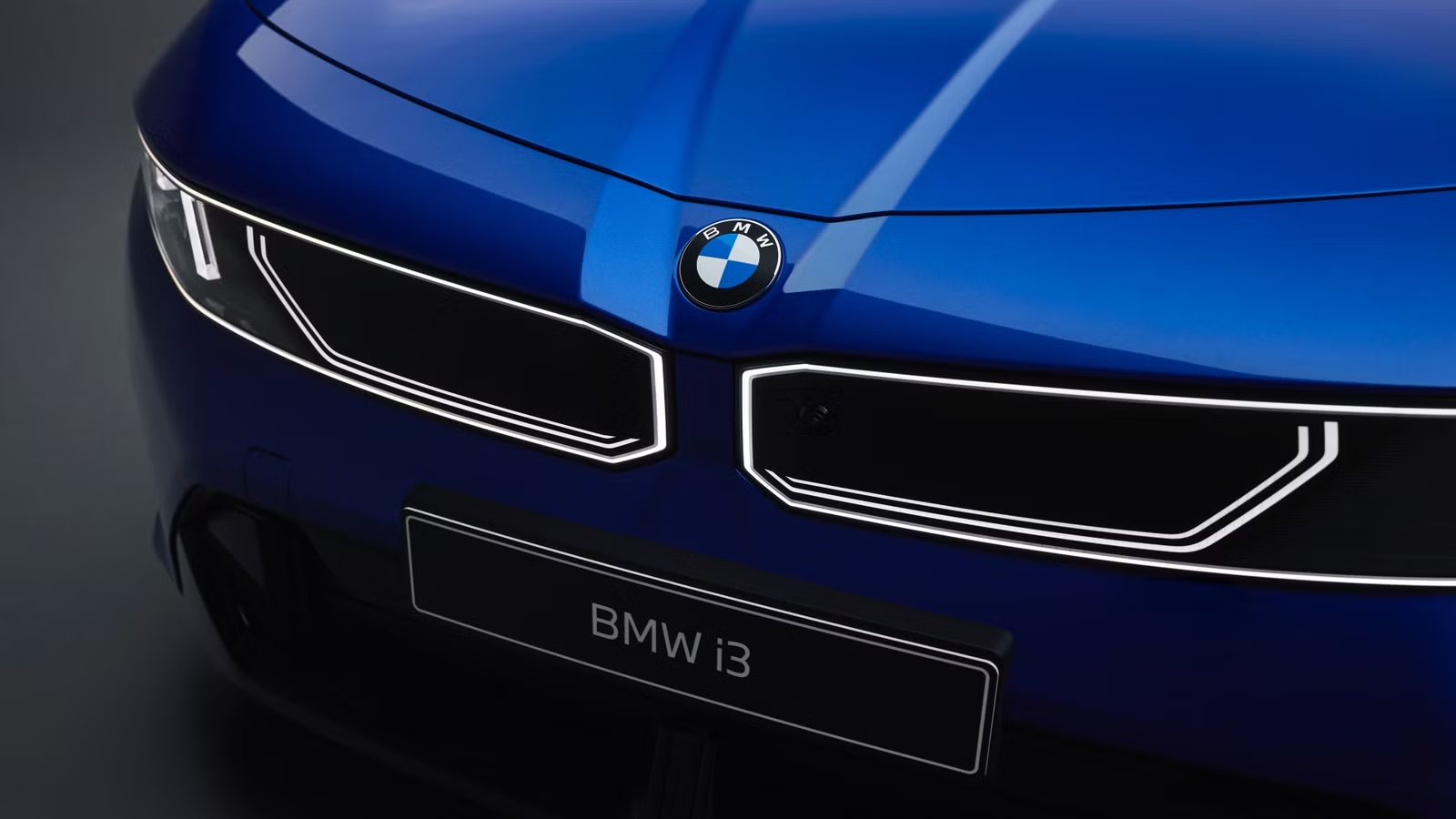
For nearly a decade, the Tesla Model 3 has been the default answer whenever someone asks which electric sedan to buy. It built Tesla’s reputation as the EV market leader, won over tech-minded buyers with its minimalist cabin and Supercharger network, and turned the idea of an affordable, long-range electric sedan into the norm rather than the exception. But the segment Tesla created is no longer Tesla’s alone.

BMW has just revealed the new i3 sedan, the second model built on its all-new Neue Klasse architecture, and it arrives with credentials serious enough to make Model 3 shoppers pause before signing. With 463 hp, a claimed range of up to 440 miles, 400 kW charging, and a chassis shaped by the same engineers responsible for the 3 Series’ decades-long reputation as the benchmark sports sedan, the i3 is not a defensive reaction to Tesla. It is a calculated, technically serious challenger built for buyers who want EV performance without giving up the premium feel that drew them to BMW in the first place.
Why The BMW i3 Sedan Arrives At The Perfect Time To Challenge Tesla’s Dominance
For nearly ten years, Tesla had the electric sedan conversation almost entirely to itself. The Model 3 arrived in 2017 promising long range, quick charging, and a tech-forward ownership experience, and it largely delivered on that promise while traditional luxury brands were still working out their EV strategies. That head start built a loyal following, but it also left a gap for buyers who wanted Tesla’s performance without Tesla’s minimalist, software-first philosophy. The current Model 3 lineup, which spans the $36,990 Standard RWD to the $54,990 Performance, still offers genuine EV credentials, but the platform underpinning it traces back almost a decade, and competitors have spent that time catching up on range, charging speed, and interior quality.


BMW’s timing with the Neue Klasse i3 is no accident. The iX3, the first Neue Klasse model, has already picked up World Car of the Year and World Electric Vehicle honors for 2026, signaling that BMW’s new EV architecture is being taken seriously by an industry that spent years dismissing legacy automakers’ electric efforts as compliance cars. The i3 sedan lands directly in Model 3 territory: a similarly sized four-door sedan, dual-motor all-wheel drive as standard, and a starting specification that already exceeds what Tesla offers at a comparable price point. For shoppers who have watched the EV market mature and now want more than a tech gadget on wheels, a BMW with genuine range, fast charging, and decades of 3 Series engineering behind it is arriving at exactly the moment buyers are ready to consider it.
The Small BMW SUV Most Buyers Don’t Consider
The BMW X1 may not have the fame of its bigger siblings, but it embodies much of what makes the brand desirable.
How BMW’s 3 Series DNA Shapes The i3 Into A True Driver’s EV

BMW has been explicit that the i3 is built to carry 3 Series character into the electric era, and the engineering choices back that up. The i3 sits on the Neue Klasse NAx platform with a 114.1-inch wheelbase, stretching to 187.4 inches overall, making it longer, wider, and taller than the outgoing 3 Series while still previewing the design of the next, eighth-generation combustion-engined model. BMW calls it a 2.5-box design, with a long wheelbase and short overhangs that echo the proportions sports sedan buyers have associated with the 3 Series for decades.

The launch model, the i3 50 xDrive, pairs a rear-mounted externally-excited synchronous motor with a front AC induction motor for a combined 463 hp and 476 lb-ft of torque. The dual-motor system is calibrated to favor the rear motor for efficiency, only calling on the front motor when extra traction or performance is needed, a very different philosophy from simply running both motors continuously. BMW hasn’t confirmed an official 0-60 mph time yet, but the mechanically related iX3 50 xDrive needs just 4.9 seconds to reach 62 mph, so the lighter, more aerodynamic i3 should match or slightly beat that.
The real differentiator, though, is the “Heart of Joy”, a centralized high-performance computer that processes driving dynamics functions roughly ten times faster than BMW’s previous systems, working alongside BMW Dynamic Performance Control software to coordinate throttle, torque distribution, and stability in real time. Tesla built its reputation on software-defined infotainment and driver assistance; BMW is making the same software-defined argument for chassis dynamics and steering feel, the areas where the brand has always claimed an emotional edge over its EV rivals.
The Most Reliable BMWs You Can Buy In 2025
J.D. Power’s 2025 consumer ratings show that BMW still offers several models with strong dependability records.
Neue Klasse Technology, Range Ambitions, And Fast Charging

The numbers behind the i3’s range and charging claims are where Neue Klasse genuinely separates itself from both the outgoing 3 Series and Tesla’s current offering. The i3 uses a 108.7 kWh NMC battery built on BMW’s sixth-generation 800-volt eDrive architecture, with cylindrical cells that BMW says deliver meaningfully higher energy density than the prismatic cells used in its outgoing EVs. BMW’s official European claim is roughly 560 miles on the more generous WLTP test cycle, with early estimates suggesting a more realistic 440 miles under EPA-equivalent testing for the US market, putting it ahead of the iX3’s already class-leading 500-mile WLTP figure thanks to the sedan’s superior aerodynamics.

Charging is just as aggressive. The i3 supports DC fast charging at up to 400 kW, with BMW claiming a 10-minute stop can add around 250 miles of range. For context, Tesla’s Model 3 tops out at roughly 250 kW on Supercharger hardware in real-world use, adding closer to 100 miles in 12 minutes, according to independent testing. On paper, BMW’s charging curve and 800-volt architecture give it a meaningful edge in pure charging speed, even if Tesla’s Supercharger network remains far more extensive nationwide.
BMW has also built in bidirectional charging, turning the i3 into a mobile power bank capable of vehicle-to-home or vehicle-to-grid energy supply, a feature Tesla owners have been requesting for years without success. Inside, the new BMW Panoramic iDrive system runs on BMW Operating System X, built on the Android Open Source Project for proper software-defined-vehicle flexibility and over-the-air updates. Four high-performance computers handle everything from the 17.9-inch central touchscreen to the windshield-spanning Panoramic Vision display and the optional 3D Head-Up Display, giving BMW a genuinely modern answer to Tesla’s screen-led interior approach.
2027 BMW 7 Series Interior And Exterior Picture Gallery
The 2027 BMW 7 Series debuts Neue Klasse tech, Panoramic iDrive, a 536-hp i7 flagship, and a 350+ mile electric range across four launch variants.
A Premium Cabin, Established Dealer Support, And BMW Heritage Create A Different Luxury EV Experience

Where Tesla built its identity on minimalism and a direct-to-consumer model with no traditional dealer network, BMW is leaning into the opposite approach, and that contrast is likely to matter to a specific kind of luxury buyer. The i3’s cabin retains a physical sense of occasion that the Model 3’s stripped-back interior deliberately avoids: a free-cut digital display positioned near the steering wheel for ergonomic reach, a multifunction wheel with Shy Tech controls that stay hidden until needed, and the kind of material quality and badge prestige that comes from a brand with more than a century of premium car manufacturing at its Munich home plant, where i3 production begins this August.
That heritage extends to ownership. BMW’s established dealer network gives buyers physical showrooms, dedicated service departments, and a trade-in process that mirrors how most premium car buyers already shop, rather than Tesla’s app-based ordering and service-center model that some buyers still find unfamiliar or impersonal. For someone cross-shopping a Model 3 Premium against an i3 50 xDrive, the choice increasingly comes down to whether they want a tech company’s idea of a luxury car or a luxury car company’s idea of an EV.

BMW is also signaling long-term intent rather than a one-off halo product. M Performance and full M versions of both the electric i3 and the combustion 3 Series are already planned, something Tesla’s Model 3 Performance variant can’t match in terms of motorsport pedigree or brand storytelling. For BMW loyalists who have been waiting for an electric car that still feels like a BMW, rather than a software platform wearing a roundel, the i3 is the clearest answer the brand has produced yet.
Can The BMW i3 Steal Tesla’s Thunder?

None of this means Tesla is suddenly vulnerable. The Model 3 still starts at $36,990, undercutting where BMW’s i3 is expected to land once US pricing is confirmed, and Tesla’s Supercharger network remains the most extensive and reliable fast-charging infrastructure of any EV maker, a genuine advantage on long road trips regardless of how fast the i3 can charge in isolation. Tesla’s advanced driver assistance software also continues to be a major draw for buyers who see the car primarily as a tech product, and a decade of production experience means Tesla’s build quality and software reliability have matured considerably since the Model 3’s early years.

BMW’s challenge now is pricing and availability. The i3 won’t reach customers until this fall, with production starting at Munich in August, and BMW hasn’t confirmed final certified range figures or US pricing, meaning some of its headline range and charging claims remain provisional until certification is complete. If BMW prices the i3 50 xDrive significantly above the Model 3’s price range, much of its technical advantage risks becoming a luxury-tier argument rather than a true head-to-head challenge for mainstream EV buyers.
Even so, the case for the i3 as a legitimate Tesla alternative is stronger than anything BMW has offered before. It out-ranges the Model 3, charges faster on paper, drives with a software-defined chassis system built specifically to preserve BMW’s handling reputation, and wraps all of it in a cabin and ownership experience that feels distinctly more traditional and premium. The BMW i3 Sedan may not dethrone Tesla overnight, and for budget-focused or tech-first buyers, the Model 3 will likely remain the default choice. But for luxury EV shoppers who have been waiting for a credible alternative that still drives, feels, and lives like a proper BMW, the i3 finally gives them a reason to look beyond the Model 3.
Sources: BMW U.S. & CarBuzz

Related posts






Latest Post


No Comments