
Nissan Built This Car To Embarrass Porsche, And It’s Still Cheaper
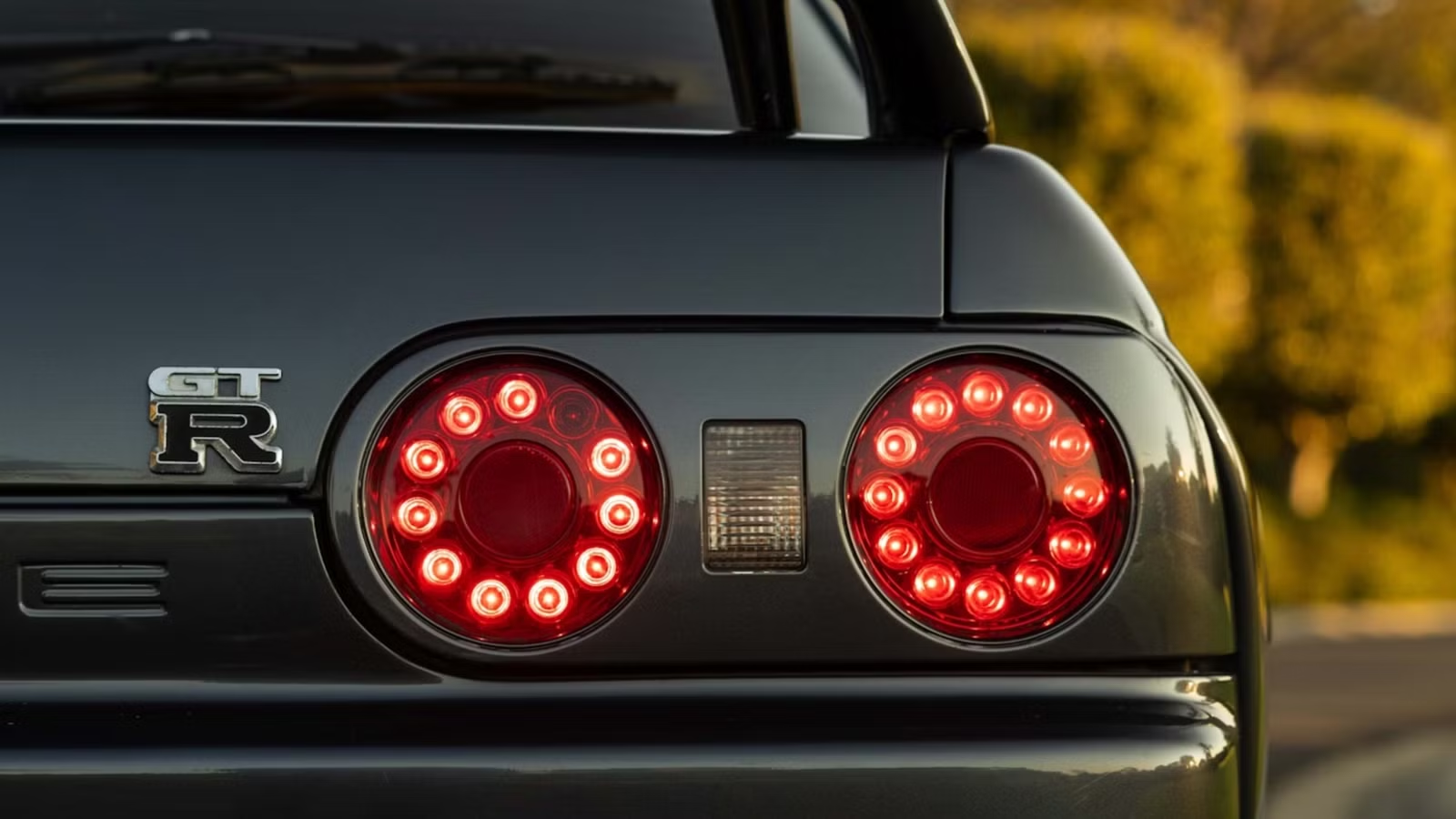
By the late 1980s, Nissan wanted a car that could dominate not just on the road but on the track, too. It set its sights on Group A Touring Car racing, and the car that it created would not just become one of the most successful sports cars of its era, but a far more technologically advanced performance bargain than many of Porsche’s road cars. And it was a fraction of the price.
Japan’s Performance Boom Created The Perfect Rival To Europe

Japan had built a reputation for making affordable, reliable, practical cars during the 1970s and early 1980s, as its automotive industry focused on scale and efficiency. Some models, like the Datsun 240Z and the Mazda RX-7, had proved Japan was capable of making performance cars, but the country’s image was still largely defined by dependable vehicles. But as Japan entered the economic boom of the late 1980s, manufacturers increasingly looked away from the cars that had built their reputations and towards cars that would redefine them.
Cars like the Nissan Sunny, the Toyota Corolla, and the Honda Civic had been firm favorites around the world but, with an increasingly affluent consumer market, weren’t going to set pulses racing. Manufacturers competed to make more exciting cars, releasing things like the Nissan 300ZX, the Toyota Supra, and the Honda Prelude in an attempt to capture this new demand, making cars both faster and more technologically advanced. Turbocharging became far more common in performance models, as did electronic driver aids (the 1987 Honda Prelude was the first widely available production car to have four-wheel steering, for example), and more complex all-wheel-drive systems, like Toyota’s All-Trac GT-Four system balanced torque in a more sophisticated way than customers were used to.
Europe, meanwhile, still remained the benchmark. Porsche had established itself as one of the world’s premier performance car manufacturers, not just with the 911 but with its successes in both road and race cars. For Nissan, Porsche represented the ultimate benchmark. Any company hoping to establish itself as a true performance car manufacturer needed to be able to compete with Stuttgart’s best.

Nissan Wanted More Than A Fast Sports Car

Porsche had proven that on-track dominance led to sales, with the old adage of “win on Sunday, sell on Monday” ringing true. The German brand won seven consecutive 24 Hours of Le Mans, from 1981 to 1987, along with wins in IMSA and Group C racing. This bolstered the Stuttgart-based company’s reputation, elevating it from being a purveyor of fast road cars into something aspirational and exciting. And Nissan wanted that.
Another fast sports car wasn’t going to cut it. For one, Nissan already had a fast sports car in 1984’s 300ZX, which had sold over 210,000 units in its first three years. Producing another similar car would only take sales away from that while satisfying no other purpose. Nissan also wanted to compete and, more, win. The 300ZX wasn’t suitable for competition as it had been designed as a road car first, so making the necessary changes would have been a long, costly task that wasn’t guaranteed to succeed.
So rather than creating another car that was fast and nice to drive, Nissan knew it needed a flagship car that could embarrass its European counterparts not just on the road, but on the track too. And what it created would go on to be one of the most celebrated performance cars ever to come out of Japan.
The 1989 Nissan Skyline GT-R Was Engineered To Humiliate Porsche

|
Engine |
Power |
Torque |
0-60 MPH |
Top Speed |
|
2.6-Liter twin-turbocharged RB26DETT |
276 HP |
260 lb-ft |
5.1 seconds |
156 MPH |
While Nissan had already used the Skyline GT-R name before, first in 1969, the new car was to be a considerable step up. Internally known as the R32, the 1989 Nissan Skyline GT-R was developed specifically with Group A Touring Car racing in mind. Group A had become one of the world’s premier motorsport categories, requiring manufacturers to create homologated models before they could compete. Nissan saw this as an opportunity to not only create a performance car that could win on track, but one which could dominate on the roads, too.
Rather than adapting an existing car, like the aforementioned 300ZX, Nissan developed the R32 around the demands associated with endurance and Group A racing. To that end, it needed to be reliable, powerful, and maneuverable. And that all started with the engine.

The power came from the now-legendary RB26DETT engine. A 2.6-liter, twin-turbocharged inline-six developed specifically for the GT-R, it officially produced 276 hp (280 PS), the limit set by Japan’s voluntary horsepower agreement, although real-world examples often produced more. This was thanks in part to its cast-iron block, individual throttle bodies, forged crankshaft, and those twin-turbos, which meant that the car could comfortably withstand much more power than it supposedly put out.
It wasn’t just the engine that made the car popular, though. A technologically sophisticated all-wheel-drive system, known as ATTESA E-TS, normally sent power to the rear wheels but could rapidly transfer torque to the front axle when needed. Combined with the car’s four-wheel steering system, it made for a car that had both stability and grip in the corners without sacrificing agility, making it extremely efficient on track.

The car was virtually untouchable from the moment it touched the track. The Japanese Touring Car Championship at the time was a multi-class endurance race format rather than the sprint races viewers are accustomed to today. Not only did the car win its first race, but it won every single Japanese Touring Car Championship race it took part in — famously taking 29 wins from 29 races. Its dominance didn’t end there, though, as it won its class in the 1991 24 Hours of Spa, and both the 1991 and 1992 Bathurst 1000. Such was its prodigious speed and capability that Australian journalists nicknamed it “Godzilla”, with the name following the car since.
As the car had destroyed all competition between 1990 and 1993, rendering other cars essentially useless in a racing capacity, something had to be done. The Japanese Touring Car Championship moved away from Group A and to the Super Touring formula in 1994, in which rules were based around a naturally aspirated 2.0-liter engine. This essentially legislated the twin-turbo 2.6-liter R32 out of competition, forever marking it as a car that was too successful to be allowed. Nissan continued with the car until 1994, but dropped it in favor of entering the fourth generation of the car with the R33 in 1995.
Why The Skyline GT-R Has Become One Of The Smartest Modern Collectibles

The R32 Nissan Skyline GT-R has everything a car needs to be both highly valued and eminently collectible: genuine motorsport pedigree, pioneering engineering, rarity, and, in the case of America, an element of forbidden fruit. While the car was earning a reputation for being a world-beater on both the track and the road, American enthusiasts had to look on due to the 25-year import rule.
With the import rule making it incredibly difficult to legally get one into the country before 2014, Americans excited about the JDM monster had to turn to video games like Gran Turismo, magazines, or videos to catch a glimpse of Godzilla. This ensured that when the car was able to reach the USA, there was already an incredibly willing and excited collector market waiting for it.

Today, R32 Skyline GT-Rs sell for around $52,000, though rarer versions of the car like the NISMO can go for exponentially more, given the right market. Meanwhile, a Porsche 964, which was also made between 1989 and 1993, will set you back around $96,000, per Classic.com, despite having a bigger engine (3.6-liter naturally aspirated vs. 2.6-liter twin-turbo), making less power (247 hp vs. 276 hp), and setting a slower 0-60 MPH time (5.6 seconds for the Carrera 2/4 vs. 5.1 seconds). The GT-R is also a rarer car (43,937 R32s were made vs. 63,762 964s), making it not only arguably better on performance, but scarcer, too.
The GT-R Changed The World’s Opinion Of Japanese Performance Cars

While the R32 Skyline GT-R didn’t necessarily compete against Porsche on equal terms (both manufacturers did compete in some of the same races, albeit in different categories), it did set its sights on Porsche’s illustrious motorsport history. By winning races on track, and pioneering sophisticated technology off it, the GT-R challenged the existing hierarchy of performance cars. It offered more performance for less money, unequivocally proved that its performance was manageable by winning everything it looked at, and remained attainable throughout. The R32 Skyline GT-R was Nissan’s answer to some of the most prestigious cars Europe had to offer. And it beat them.
Sources: Z31.com, Classic.com, Hagerty.com, Google Books, GTR USA Blog

Related posts

Latest Post



No Comments