
Kawasaki Spent 23 Years Perfecting This Trail Bike, Then Was Forced To Kill It
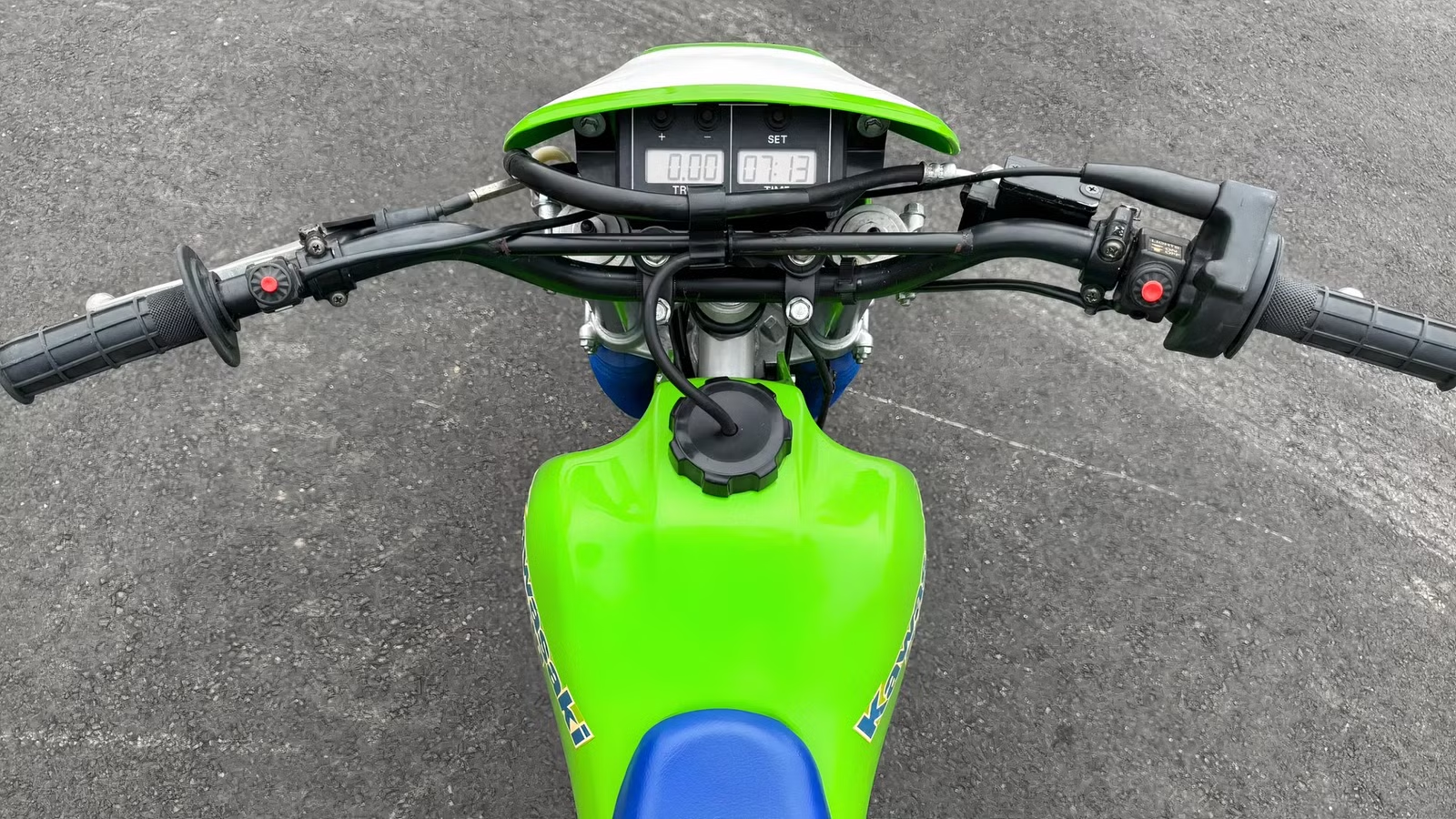
We could probably spend a lifetime talking about all the great two-strokes that became casualties of tightening emissions regulations. Their nature may have provided a major power advantage over four-stroke engines, but it also made them just about as environmentally friendly as a factory from the early days after the Industrial Revolution. And sadly, there wasn’t very much to be done about that in a feasible manner, because the lubrication method used in two-strokes was inherently less clean by design. The motor oil being mixed in with the fuel rather than added separately meant dirtier exhaust fumes, and combustion was far less efficient, with about 30% of the fuel making its way straight out the exhaust ports unignited.
Two-Strokes Held Out A Bit Longer In The Off-Roading World

As the two-stroke purge gradually unfolded in the name of cleaner air, road bikes were hit much harder than their off-road counterparts at first. There are still plenty of two-stroke dirt bikes you can buy new today, but so many fantastic nameplates have been phased out before their time. And one such model is what we’re here to look at in the following paragraphs, killed by emissions standards despite all the public interest and a production run spanning well over two decades. The bike kept evolving over time and trail riders loved it, so the off-roading community remembers it rather fondly after all these years in all its smoky two-stroke glory.
The Kawasaki KDX175 Was The Start Of Something Great

Kawasaki launched the first KDX iteration in 1980, offering a great option to those who didn’t want a fully-fledged motocrosser. It was basically a direct response to Suzuki’s popular PE175, featuring a KX125-derived frame and single-cylinder mill. The engine had a Mikuni carburetor, 7.6:1 compression, and a displacement of 173cc, making it good for up to 24 hp that reached the rear wheel via a six-speed gearbox. A top speed of 75 mph was perfectly adequate for off-road fun, and the bike weighed in at a measly 227 pounds without fluids. Furthermore, it made use of Kawasaki’s proprietary Uni-Trak suspension arrangement at the back — a linkage system more advanced than what competitors were offering at the time. The KDX175 was only a prelude to what came later, though, and the bar was raised considerably higher a mere three years after its introduction.

Enter The Bigger And Better KDX200

The updated Kawasaki KDX200 landed in 1983, powered by a fresh 198cc thumper whose additional capacity resulted from a larger stroke. It gave the Kawi a lot more power to work with, meaning 37 hp and 25 lb-ft of torque ready to deploy at a moment’s notice. Meanwhile, dry weight dropped to just 207 pounds, and the motorcycle still employed traditional drum brakes fore and aft at the time. All these upgrades made a colossal difference to the KDX, but Kawasaki sought to also take the suspension department to an entirely new level. It did so with a beefier pair of Kayaba forks at the front and some extra wheel travel at both ends, giving the bike a decent boost in its off-roading ability. Many other changes were lined up for the coming years, some more significant than others.
They were mostly adopted from the KX lineup, and the model-year 1986 brought a host of major improvements to Kawasaki’s trail bike. A broader powerband was achieved with the addition of KIPS, which stands for Kawasaki Integrated Powervalve System. The setup was developed by Eizaburo Uchinishi to address one of the main downsides of two-stroke engines, that being their peaky power delivery. It essentially employed a variable-height exhaust port together with a secondary resonator chamber to provide plenty of low-end torque as well as strong horsepower at higher revs. Besides that, the traditional drum brake at the front was ditched in favor of a disc for extra stopping power, and the forks were once again replaced with chunkier units now measuring 43 millimeters (1.7 inches) in diameter.

Things stayed pretty much the same until 1989, when the KDX200 was blessed with more upgrades to reach its next evolutionary step. Most notably, its two-stroke powerhouse was now kitted with liquid cooling for improved temperature management. A redesigned frame was on the menu, too, along with a rear disc brake and new suspension offering extra wheel travel on both ends. Other smaller changes included a bigger airbox, fresh instrumentation and a quick-release setup for the rear wheel. Inverted forks made an appearance in ’93, but Kawasaki went back to conventional items just two years later. That wasn’t the only change for 1995, though, because the KDX also gained a perimeter frame, larger radiators and revamped engine internals. The Japanese manufacturer still wasn’t done improving things just yet, though.
Come 1997, the slightly bigger KDX220 made its debut and was sold alongside the KDX200, powered by a 216cc engine. The mill had just about the same power output as the KDX200, but its architecture was slightly different to boost torque at the low end. And from then on, the KDX remained mostly unchanged as its popularity grew in the off-roading community, loved by beginners and seasoned riders alike. Kawasaki made a smart move by gradually introducing new technology to the model rather than everything at once, keeping the KDX relevant and exciting well into the 2000s. The nameplate would have likely lived on if it had not been killed off by tightening emissions standards.
The KDX’s Reign Comes To An Abrupt End

A whopping 23 years after its initial release, the KDX200 was discontinued along with its 220 sibling in 2006. This left a big, KDX-shaped hole in the enduro community, one that no other model was quite able to fill ever since. Kawasaki had plenty of time to refine its two-stroke off-roader from 1983 until 2006, on top of three more years with the KDX175 before that. As such, the model was incredibly refined by the time it was killed off in the mid-2000s and people loved it, even if the company didn’t promote it as heavily as it could have. Pricing had risen steadily over the years, from around $1,600 back in 1983 to $4,200 for the Kawi’s final iteration more than two decades later. But what are these bikes worth today given their cult status among off-roading enthusiasts?
Kawasaki’s Two-Stroke Phenom On Today’s Market

Current values for the KDX aren’t too crazy, yet they seem to be holding up quite well based on past auction results. For instance, a 1987 model in good shape was sold for $5,100 on Bring a Trailer last year, and pricing can vary quite a bit depending on the bike’s condition or model-year. A few months ago via Mecum, a clean KDX from ’83 changed hands for as little as $2,200, so the model clearly leans toward the budget-friendly side in spite of its cult status. That’s great news for anyone who wants to enjoy that two-stroke experience out in nature, as the KDX is sure to provide plenty of value without costing a small fortune. It is a shame that Kawasaki was forced to retire the KDX as it reached peak popularity, because there would have been many more of these machines on the market today if it had stayed in production a little longer. As the saying goes, all great things must come to an end.
Sources: Cyclepedia, Dirt Bike Magazine, The Motocross Vault, Cycle World, Mecum, Bring a Trailer

Related posts


Latest Post


No Comments