
Pontiac’s Overlooked Emissions Era Muscle Car Was A Trans Am With Better Manners
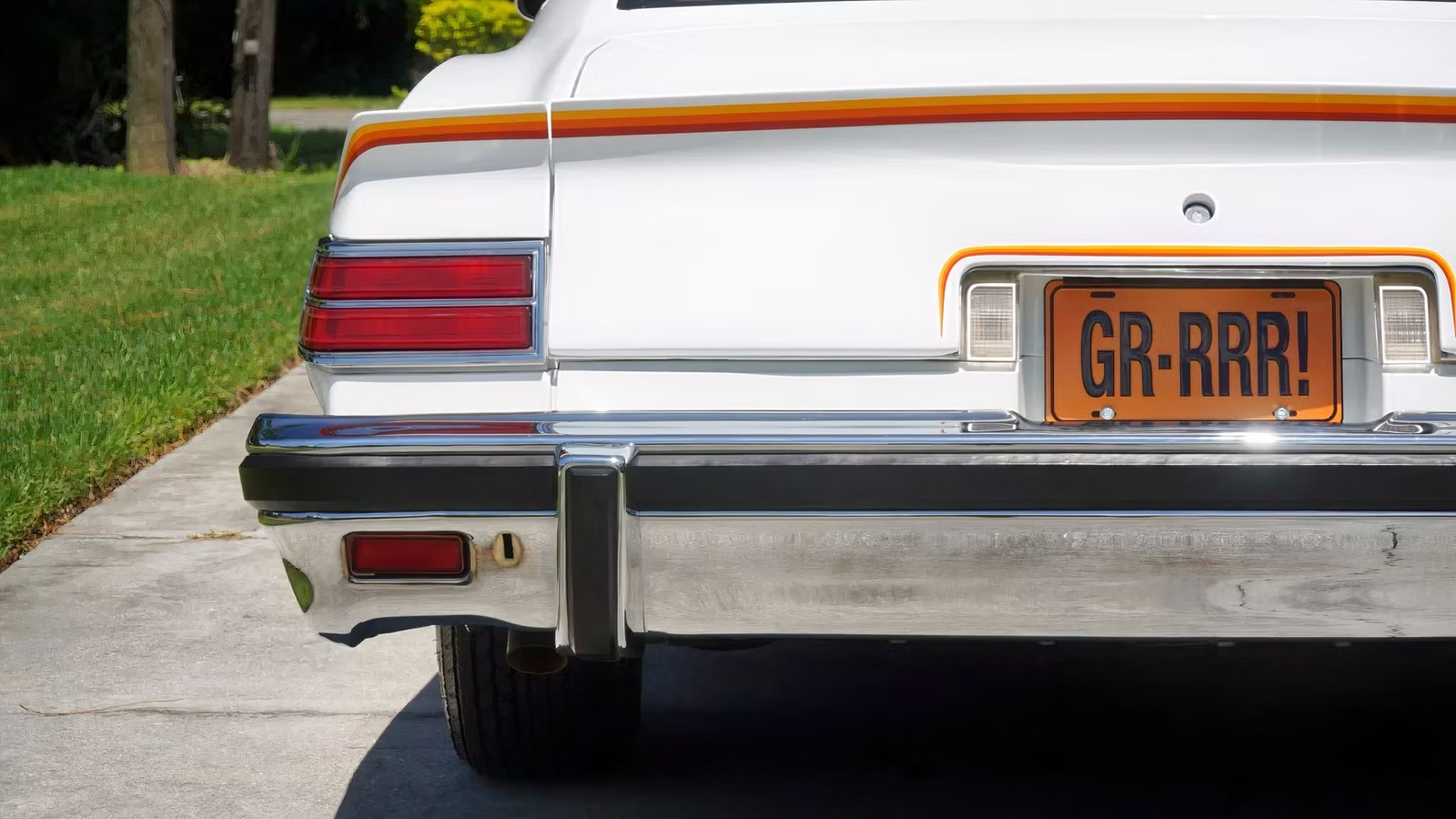
Imagine the following scenario: a white Pontiac rolls into cruise night looking almost full-sized, its long hood, upright roof, and broad rear quarters promising more lounge than lunge. Then the crowd spots the shaker poking through the hood, and the lettering on its side that belongs to one of Pontiac’s most famous performance packages. Yet, the body underneath looks ready for a quiet interstate run with four adults and their folding chairs.
Emissions Rules Did Not Kill Pontiac Performance, But They Changed Its Shape

By 1977, Pontiac’s 455 had left the order sheet. Lower compression, catalytic converters, tighter emissions rules, and SAE net ratings had made the old horsepower scoreboard look grim. Yet the usual claim that every car of the period became slow, soft, and pointless misses the interesting part. Engineers still knew how to make a car feel strong, but they simply had fewer easy tricks. Big advertised numbers gave way to axle ratios, tire choice, suspension balance, transmission tuning, and torque that arrived where street drivers could use it.
Pontiac’s answer to the changing circumstances carried option code W72 and the more exciting T/A 6.6 name. Its 400-cubic-inch V8 used a four-barrel Rochester Quadrajet and produced 200 horsepower at 3,600 rpm, plus 325 lb-ft of torque at 2,400 rpm. Those figures sound mild beside a late-1960s GTO rating, but they reflected the stricter net method and described an engine designed to pull hard at ordinary road speeds. The regular Pontiac 400 made 180 hp, and while 20 extra horses did not turn the W72 into a drag-strip bully, the wider, stronger upper range made it the engine enthusiasts wanted.
The W72 used smaller-chamber 6X-4 cylinder heads instead of the base engine’s 6X-8 castings, raising advertised compression from about 7.6:1 to 8.0:1. Pontiac also specified a more useful camshaft, a carefully calibrated 800-cfm Quadrajet, and a 60-psi oil pump in place of the standard engine’s lower-pressure unit.

One Pontiac Mixed Parts From Three Different Personalities

One Pontiac model borrowed its engine identity from the Trans Am. The shaker wore T/A 6.6 lettering, and the W72 underneath brought the same 200-hp performance intent. Pontiac paired it only with a three-speed Turbo Hydra-Matic, not the four-speed manual available in the F-body. W72 versions used the stout TH400 and 3.08 rear gearing, while buyers could add a Safe-T-Track limited-slip differential.
The chassis came from a different side of Pontiac’s personality. Power-assisted front disc brakes handled stopping duties, and front and rear stabilizer bars worked with Pontiac’s Rally Radial Tuned Suspension. The factory brochure also listed variable-ratio power steering, radial tires, and body-color Rally II wheels. None of that turned a large intermediate coupe into a tiny road racer, but it gave the car firmer control than an ordinary boulevard machine.
Then came the comfort clues. Pontiac started with the LeMans Sport Coupe body and fitted the sweeping Grand Prix instrument panel with Rally gauges and a clock. Power steering and power brakes came standard. The 112-inch wheelbase and wider cabin offered a far more usable rear seat than the Trans Am, along with an intermediate-car seating position that felt relaxed rather than tightly wrapped around the driver. The dash still gave the driver a bank of round gauges instead of a speedometer floating alone in acres of plastic. In one vehicle, Pontiac mixed the Trans Am’s engine, the LeMans’ space, and the Grand Prix’s dashboard.
The 1977 Pontiac Can Am Was The Trans Am Alternative Nobody Remembers

The car was the 1977 Pontiac Can Am. It was never intended to replace the Trans Am, and it carried far more substance than a dressed-up LeMans. Pontiac aimed it at buyers who wanted genuine performance hardware without accepting the F-body’s tighter cabin, lower roof, and louder public image. The Can Am still wore stripes, a spoiler, and a shaker, so nobody would call it shy. Yet it occupied a useful middle ground: more serious than a normal LeMans Sport Coupe, roomier than a Trans Am, and strange enough to make even seasoned Pontiac fans walk back for a second look.
Pontiac built the base cars as Cameo White LeMans Sport Coupes under the WW3 Can Am package, complete with the important mechanical equipment. The cars then went to Jim Wangers’ Motortown operation for the pieces that made them instantly recognizable. Motortown modified the hood for the shaker treatment, fitted the full-width rear spoiler, added the black lower-body finish, applied the red-orange-yellow striping, blacked out selected trim, and installed Can Am identification. The Can Am also used the taller 1976-style shaker shape rather than the flatter 1977 Trans Am scoop.

For most of the country, the formula centered on the 400-cu-in W72 T/A 6.6-liter V8, rated at 200 hp and 325 lb-ft. Pontiac linked it to the TH400 automatic and 3.08 gearing, then added Rally RTS suspension, front discs, front and rear bars, power steering, and 15-inch radials. Depending on equipment (and the source used), curb weight lands around 3,800 to 3,880 pounds. That mass mattered, but so did the torque peak: the 3.08 rear gear kept the engine close enough to its useful range without making highway travel feel like punishment.
California and designated high-altitude markets received a different Can Am. Pontiac installed the 185-hp Oldsmobile 403, which made roughly 320 lb-ft at 2,200 rpm, paired it with a TH350 automatic and usually a taller 2.41 axle, then labeled the shaker “6.6 Litre” instead of “T/A 6.6.” Registry research has identified 42 Olds-powered cars, although that figure reflects documented registry examples rather than a clean factory production total.
The Can Am Traded A Little Speed For Space, Comfort, And Exclusivity

Of course, the Can Am and a W72 Trans Am shared the hardware enthusiasts care about most: a Pontiac 400, 200 hp, 325 lb-ft, a four-barrel Quadrajet, and T/A 6.6 shaker identification. They also shared a clear goal – both cars tried to preserve Pontiac performance after the 455 disappeared. Compared with an ordinary 180-hp LeMans Sport Coupe, the Can Am added the stronger engine, firmer suspension package, front and rear bars, front discs, special wheels, and unmistakable body treatment.
The Trans Am held the dynamic advantage. Depending on equipment, it carried roughly 150 to 200 fewer pounds, plus shorter and lower F-body proportions. Buyers could order the W72 with a four-speed manual, a choice the Can Am never offered from the factory. Period testing placed a 1977 Trans Am in the high-16-second quarter-mile range, and its lower center of gravity and tighter body made it respond faster to steering, braking, and throttle changes. The Can Am could keep up with traffic and entertain its driver, but it did not attack a corner with the same eagerness.

The Can Am answered with space and ease. Its 112-inch wheelbase and broad LeMans shell created a larger cabin and a useful rear seat. The Grand Prix-style dashboard gave the driver a cockpit with real visual drama, while the softer seating position and taller glass made long drives less tiring. At highway speed, the Can Am’s extra length and weight became assets rather than penalties. It settled into a cruise, let the 400 work in its torque band, and asked less of its passengers.
Exclusivity now gives the Can Am its sharpest edge. A 1977 Trans Am remains instantly recognizable, helped by its strong sales and decades of pop-culture fame. The Can Am, in turn, looks familiar from across a parking lot, then increasingly odd as the viewer gets closer. Its LeMans roofline, louvered quarter windows, shaker, stripes, and spoiler should not quite work together, but they do.
The Market Has Finally Started Pricing The Can Am Like A Pontiac Unicorn

No single production total has ended the argument. Registries, auction houses, and Pontiac references most often repeat 1,377 cars. Jim Wangers gave a lower figure, saying Motortown completed 1,133 before Pontiac canceled the program, but that gap does not weaken the car’s story.
Completed sales show that buyers have started paying for that rarity. A W72 Can Am sold for $33,250 on Bring a Trailer in October 2024. Another brought $53,000 in April 2025, followed by a $59,000 sale in September 2025. Hagerty Marketplace recorded a $35,310 result in October 2025. Those numbers do not form a smooth value curve, but collector cars rarely behave like polite charts. They show a market willing to move well beyond used-LeMans money when the right Can Am appears, while still punishing needs, questions, or less desirable presentation.

Surprisingly, mechanical parts remain easier to source or rebuild than the model-specific pieces Motortown fitted in 1977. A modified car with fuel injection and a modern transmission may start better, run cooler, and cruise with fewer revs, and it may also make its owner happier, which still counts; but a complete survivor with documented WW3 history, original W72 hardware, correct striping, intact shaker parts, and an undamaged spoiler has become much harder to replace.
Keep in mind that because Pontiac started with an ordinary LeMans body, clones can look convincing in photos, which makes invoices, build records, date codes, and ownership history unusually valuable. The Can Am spent decades as the Pontiac that enthusiasts had to explain, but now the market has started listening, and the big white coupe is finally valued for the exact mix that once made it easy to overlook.
Source: Pontiac, Hagerty, Bring a Trailer

Related posts


Latest Post


No Comments