
The Motorcycle That Could Be The Best Alternative To A Gold Wing
Among flagship touring motorcycles, the Honda Gold Wing has a whole different fan base. Without traditional cues like a big twin or an old-school design, the Gold Wing beats long-standing American offerings from Harley and Indian on every front. In fact, the Gold Wing seems unbeatable until we pit an equally versatile and tech-savvy luxury tourer from BMW against it. Like the Gold Wing, the BMW also uses a unique engine-and-chassis combination; however, it edges ahead with more power and a lower price tag.
Here’s Why The Honda Gold Wing Is In A League Of Its Own
At $25,500, The Gold Wing Costs More Than Any Comparable Tourer — And Still Sells

The Honda Gold Wing’s $25,500 price tag is obviously not for the faint-hearted. But this is one of those very few luxury tourers that justify its premium price tag. Its niche underpinnings and engine design carry eye-watering R&D costs. It also makes no compromises regarding comfort, convenience, practicality, or performance. Despite these factors, which make wooing customers an uphill battle, the Honda Gold Wing stands out with its bespoke appeal.
The Gold Wing is powered by a unique flat-six engine, the only one of its kind. It comes with a standard six-speed manual but can also be equipped with the world’s only seven-speed DCT gearbox. The latter is a smart transmission refined over the years to work seamlessly in changing riding conditions. Honda claims its adaptive upshift and downshift points change depending on riding style and terrain.

The chassis and suspension combination is also unique and not seen on many luxury tourers. The Gold Wing uses a twin-spar aluminum frame, similar to what you see on sportbikes. It uses the engine as a stressed member to help maximize rigidity while keeping weight low. This frame is suspended on a sophisticated suspension setup.

It uses a double-wishbone layout up front to improve weight distribution and keep the wheelbase relatively short. The rear gets a Pro-Link monoshock attached to a single-sided swingarm. Yes, a single-sided setup on this 800-plus-pound luxury tourer. This unorthodox combination of underpinnings gives the Gold Wing a surprisingly nimble, sporty character. Electronic damping at both ends further sweetens the riding appeal.

The technology is loaded with top-spec components. The cockpit gets a crisp seven-inch TFT for navigation and is Bluetooth-enabled for seamless Android Auto and Apple CarPlay connectivity. Honda packs the Gold Wing with a range of riding-assistance and safety features.
Notable ones include ride-by-wire throttle, cornering traction control, ABS, cruise control, and a six-axis IMU. The automatic-transmission Gold Wings also get a dedicated reverse gear and a “walk” mode that makes getting in and out of parking spots a breeze. The Gold Wing’s well-rounded appeal that seamlessly integrates all of these top-spec features around the one-off powertrain and chassis setup is what makes it worthy of its premium price tag.
The Usual Suspects Fall Short In Key Ways

Frankly, none of the heritage-rich American big-twin luxury tourers match the versatility and technological sophistication of the Honda Gold Wing. The metric tourer is further elevated by superior reliability and refinement. The Honda Gold Wing’s closest Harley rival is the $24,999 Street Glide. While it packs the drama and old-school charm, the Harley lags in performance and riding dynamics.
Its rivals from Indian Motorcycle fare a bit better with their modern liquid-cooled V-twins and more dynamic underpinnings. But they still don’t quite match up with the Gold Wing’s overall stacked appeal. Also, the most affordable Indian rivals—the Chieftain and the Challenger baggers—are quite expensive at $27,999.

The only counterpart that is cheaper than the Honda Gold Wing is the $19,999 Kawasaki Vulcan 1700 Vaquero. But again, its aggressive pricing is because the Kawasaki luxury tourer hasn’t changed since 2009. So, it’s a bare-bones relic that doesn’t stand a chance against the technologically stacked Gold Wing.
Except For An Equally Unique BMW Touring Bike

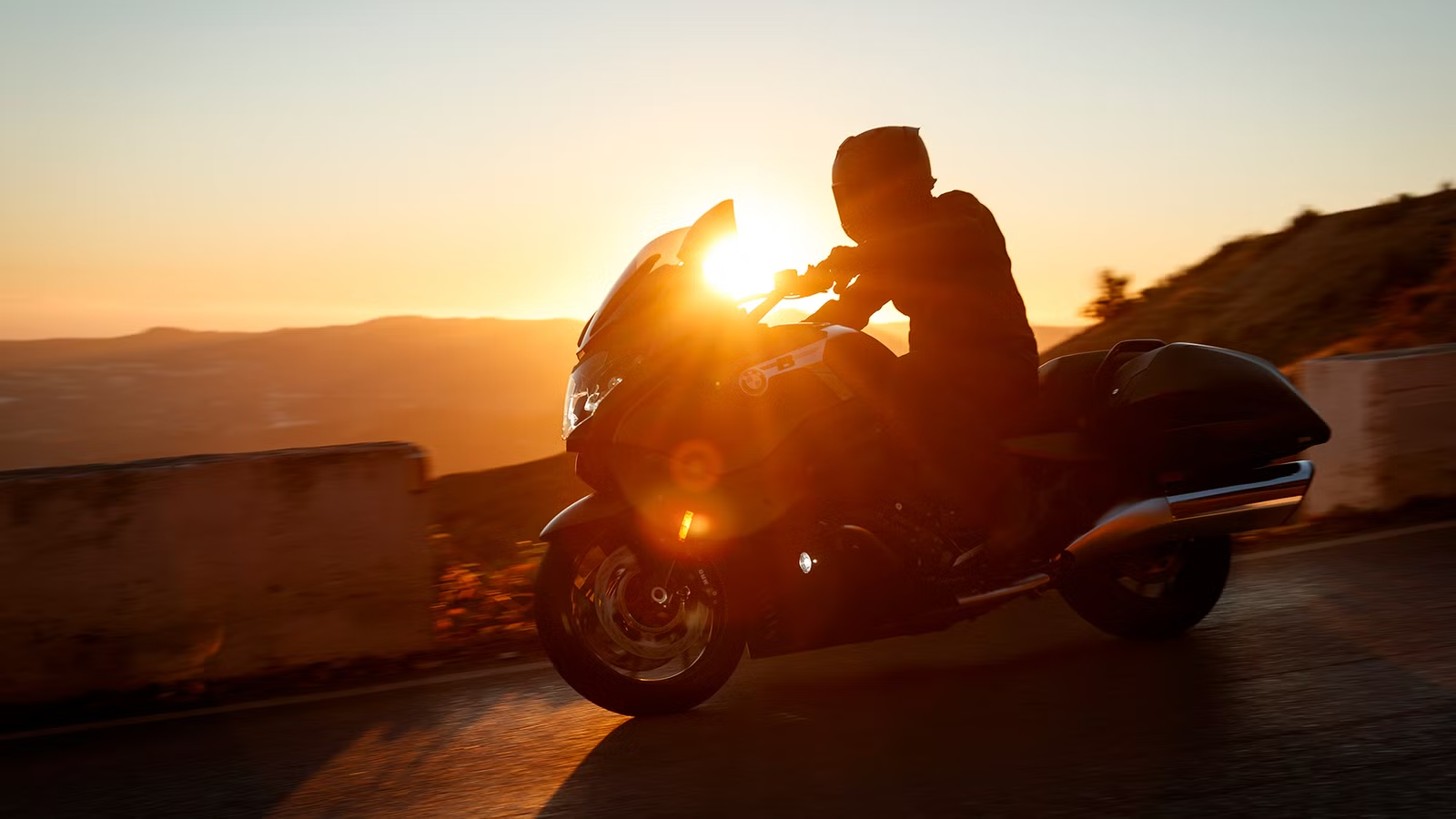
When we think that the Honda Gold Wing is undisputed, BMW clears the air with the K 1600 B bagger. Not only does this Beamer stand tall in performance, technology, and riding dynamics, but it is also more affordable than the similarly stacked Gold Wing. Just like the Honda, the BMW K 1600 B also gets a slew of unique features that put it in the spotlight.
The BMW K 1600 B Is A Surprisingly Affordable Arch-Rival To The Gold Wing
The 2027 K 1600 B Still Undercuts The Gold Wing By $425 — Even After Its Price Bump

The BMW K 1600 B shares many similarities with the Honda Gold Wing. For starters, both pack unique, non-mainstream six-cylinder engines. Both nameplates also have a rich legacy. The BMW K series has been around for over 40 years, and the Gold Wing has been proving its mettle for around half a century. Both baggers are also loaded with premium comfort, convenience, and technology features.
Beyond the similarities, the K 1600 B edges ahead with more power and a lower price tag. In fact, even the upcoming 2027 model, despite the price bump, is still cheaper than the current-gen Honda Gold Wing. The Beamer also differs in its character, with more sportiness and engagement baked in. Numerous long-time owners on forums describe a more connected, mechanical experience.
The Inline-Six That Produces 160 HP In Less Displacement Than The Gold Wing’s Flat-Six

The BMW K 1600 B matches the Honda Gold Wing’s flat-six engine with the only production inline-six motorcycle engine. The Honda’s 1,833 cc mill makes nearly 125 horsepower and 125 pound-feet of torque. But the BMW K 1600 B’s inline-six is a lot more ferocious in smaller packaging.
The 1,649 cc mill produces 160 horsepower at 6,750 RPM and 133 pound-feet of torque at 5,250 RPM. This also makes it the most powerful luxury touring bike on sale in 2026. Power is sent to the rear wheel via a six-speed manual gearbox and a final shaft drive system neatly hidden in its single-sided swingarm.
120-MPH Cruising Ability And An Early Torque Surge That Embarrasses American V-Twins

The K 1600 B’s performance figures are solid for cruising at over 100 mph all day long. BMW claims that its bagger can hit a top speed of 120+ mph with ease. Its smooth, relaxed highway character is further complemented by an early surge of torque that contributes to a meaty low-end and mid-range. BMW also offers reverse gear for easy urban maneuverability. Furthermore, the K 1600 B can be equipped with an optional quickshifter.
Adaptive Underpinnings Can Keep Up With The Gold Wing’s Sophistication

The K 1600 B sits on a twin-spar cast aluminum chassis. This is similar to the Gold Wing’s underpinnings and is not a popular choice among luxury touring bikes because this chassis design is often used on sportbikes and sport tourers for more spirited riding dynamics. The K 1600 B also features a unique suspension setup.
It features a double-wishbone ‘Duolever’ setup up front with 4.5 inches of travel. The rear gets a monoshock-induced ‘Paralever’ setup with 5.3 inches of travel. BMW also offers electronic adjustment and automatic load leveling to further elevate the K 1600 B’s adaptive riding appeal.

Braking duties are taken care of by dual 320 mm discs coupled to four-piston fixed calipers up front. The rear gets a single 320 mm disc coupled to a double-piston caliper. Helping this Beamer lean into corners like no other luxury tourer are its chunky 120-section front and 190-section rear tires wrapped around lightweight 17-inch cast aluminum wheels.
A Muscular Design That Offers Gold-Wing-Level Road Presence

The low-slung BMW K 1600 B has custom bagger styling cues sprinkled throughout. This Beamer is defined by its streamlined bagger design with notable design cues like a low-slung rear subframe and neatly integrated weatherproof side cases. The silhouette flows organically from front to rear, with dual chrome mufflers that blend in seamlessly.
Its design emphasizes a laid-back appeal, with a chunky front quarter and a compact, minimal rear quarter. The BMW K 1600 B and the Honda Gold Wing also differ in size, as the Beamer trades some of the Gold Wing’s no-compromise luxury features for a more streamlined bagger form factor. This makes the 1600 B less bulky and better suited to comfortable urban rides. This is reflected in its curb weight of 758.4 pounds.

For reference, the Honda Gold Wing bagger weighs over 800 pounds. Even with the Beamer’s focus on styling, it doesn’t compromise on comfort. The K 1600 B is very accessible with a low seat height of 29.5 inches. Furthermore, the rider sits relaxed, with forward-set footboards and a tall, wide handlebar that offers an upright torso position. The chunky front deploys a sizable windscreen and side fairings to help with wind deflection for fatigue-free highway runs.
Top-Spec Technology Rounds Things Out For This Gold Wing Rival

The K 1600 B’s stacked electronics aim to deliver comfort, convenience, and engaging dynamics. The cockpit features a huge 10.25-inch TFT with an easy-to-read software skin. It gets Bluetooth connectivity and integrated map navigation. Features that elevate convenience and comfort on the road include an adaptive cornering LED headlamp, a four-button cluster on the side fairing for custom functions, and USB-C charging with dedicated storage space for gadgets.
Assistive and safety features like three ride modes, a tire pressure monitoring system, dynamic traction control, engine brake control, and hill start control support engaging riding dynamics, among others. Beyond its already stacked standard suite, the BMW K 1600 B can also be fitted with a slew of optional extras. Notable options include keyless ride, a central locking system, an anti-theft alarm, LED auxiliary lights, engine protection bars, ground-leveling lights, custom seats, forged wheels and handlebars, and even a center stand.
Sources: BMW Motorrad and Honda Powersports

Related posts



Latest Post


No Comments