
The Performance Car That Offers More Character Than Its Numbers Suggest
Horsepower has become the easiest way to judge a performance car and one of the least useful ways to understand it. That creates a problem for any sports car arriving with less power than some family sedans. On paper, 181 horsepower, 151 pound-feet of torque, and a roughly six-second sprint to 60 mph hardly sound exceptional. From behind the wheel, however, a lightweight chassis, responsive controls, and an engine you can actually exercise can deliver more excitement than another hundred horsepower that rarely gets used.
Performance Has Become A Numbers Contest This Car Cannot Win
Its Horsepower Figure Would Look Ordinary In A Family Car

Modern performance cars rarely arrive with subtle specifications. A Ford Mustang EcoBoost produces 315 horsepower, while the Toyota GR86 makes 228 horsepower from its naturally aspirated 2.4-liter engine. One performance car uses a 2.0-liter four-cylinder that produces just 181 horsepower at 7,000 rpm and 151 pound-feet at 4,000 rpm. Those figures would be respectable in an economy car, but they can look inadequate in something marketed primarily around driving enjoyment.
That judgment reflects the industry’s growing fixation on outputs rather than experiences. Horsepower can tell you something about acceleration potential, but it cannot measure steering feedback, throttle response, shift quality, visibility, or how confidently a car communicates its limits.
A Modest 0–60 Time Hides What Happens Between The Corners

Independent testing has put this car’s 0–60 mph time at approximately 5.7 seconds. That is genuinely quick, but it will not embarrass many modern performance cars. A manual Toyota GR86 can reach 60 mph in about 5.4 seconds, while turbocharged coupes frequently generate stronger acceleration with less effort.

The difference lies in how this fun, active roadster asks you to deliver its performance. Its naturally aspirated engine makes peak power at 7,000 rpm and continues toward a 7,500-rpm redline. You must select the correct gear and work through the upper half of the tachometer instead of relying on a broad wave of turbocharged torque. You are not merely requesting acceleration from the car. You are participating in the process, and that distinction matters more than a few tenths of a second.
The Mazda MX-5 Miata Turns Modest Output Into Genuine Excitement
Approximately 2,400 Pounds Changes What 181 HP Can Accomplish

The car is the 2026 Mazda MX-5 Miata Club soft top, and its defining specification is not found under the hood. With the six-speed manual, the Club weighs approximately 2,366 pounds.
That makes it roughly 400 pounds lighter than a manual GR86 and more than 1,000 pounds lighter than many modern performance coupes. Mazda does not need enormous output to overcome unnecessary mass because there is relatively little mass to move.
Low weight improves nearly every part of the driving experience. The Miata can change direction quickly, brake without requiring enormous hardware, and communicate its movements without filtering them through a heavy body. Its front-mid-engine layout also helps produce a near-50:50 weight distribution. The result is a car that feels eager before you reach the upper limits of its performance. You do not need to double the speed limit to experience the chassis working underneath you.
The Six-Speed Manual Makes Ordinary Roads More Engaging

The Miata Club comes exclusively with a six-speed manual transmission, reinforcing its position as a driver-focused soft-top. Its short, mechanical shift action turns even an ordinary downshift into part of the entertainment.
The engine complements the gearbox because it rewards revs. Its 151 pound-feet of torque does not allow you to leave it in high gear and surge out of every corner. You must plan your shifts and keep the engine in the useful part of its powerband.

That involvement is the Miata’s real performance advantage. A faster car may deliver greater acceleration while asking less of you. The Mazda creates enjoyment by making your timing, inputs, and decisions matter.
Lower the manually operated fabric roof, and the sensation of speed increases without the actual speed becoming unreasonable. The Miata does not simulate drama through speakers or aggressive drive modes. It uses wind, engine noise, road texture, and proximity to the pavement.
The Club Adds Capability Without Smothering The Experience
Its Hardware Is Designed For Feedback Rather Than Bragging Rights

The Club justifies its place above the Sport with hardware you can appreciate on a winding road. It adds Bilstein dampers, a front shock-tower brace, and an asymmetric limited-slip differential. Mazda’s Kinematic Posture Control is also standard across the range, applying a small amount of braking to the inside rear wheel during hard cornering to reduce body lift.
The tuning does not eliminate every trace of body roll. Instead, the car progressively transfers its weight, telling you what the chassis is doing. That movement can make the Miata look less composed than a stiff, track-focused rival, but it provides useful feedback before the tires surrender grip.
You can explore that balance at manageable speeds. Rather than concealing weight transfer, the Miata uses it as part of the conversation between the chassis and driver.
The Brembo/BBS/Recaro Package Sharpens The Car At A Price

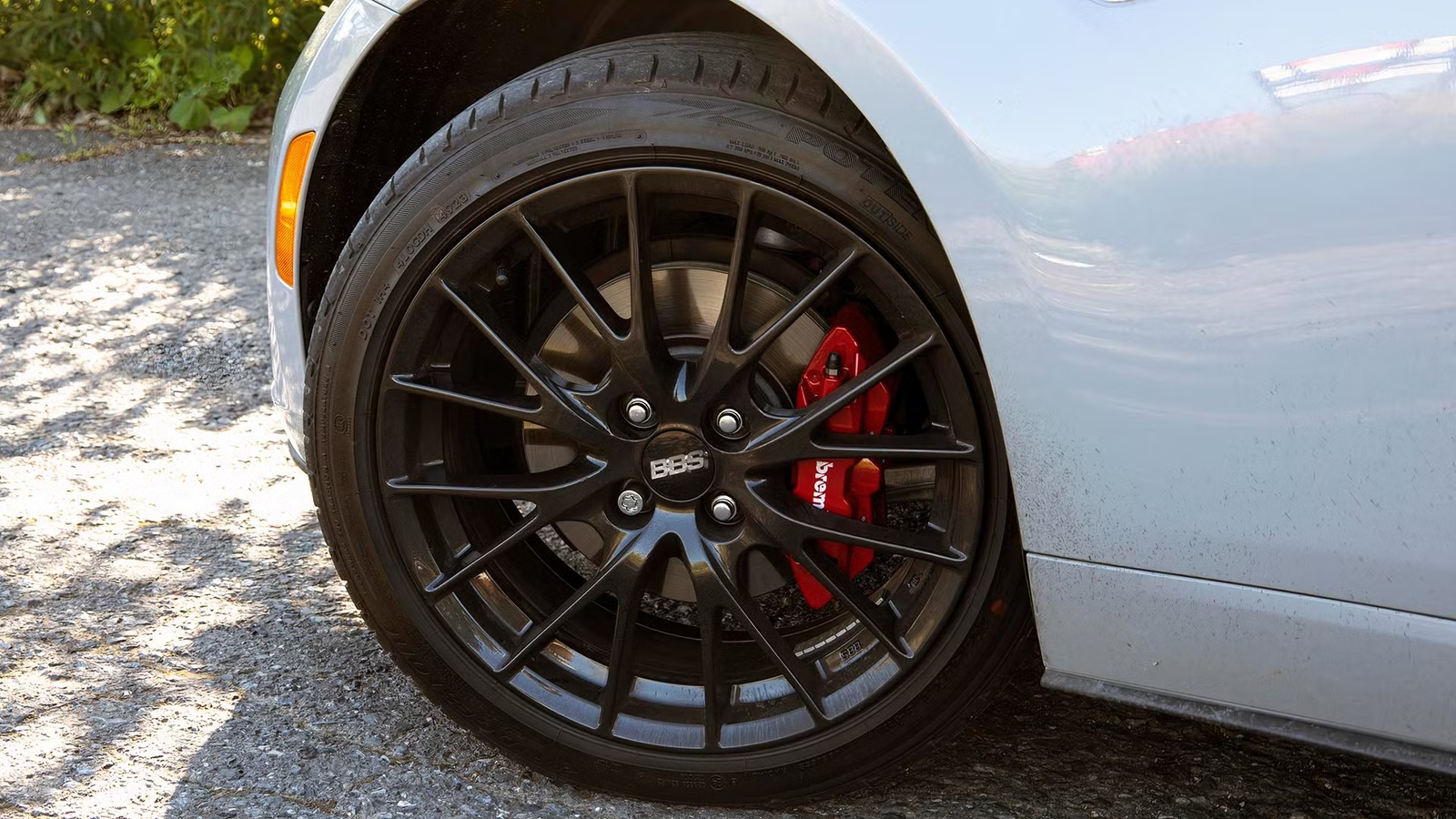
Mazda continues to offer the Brembo/BBS/Recaro package on the 2026 soft-top Club. It adds Brembo front brakes with red-painted calipers, 17-inch BBS forged wheels, and heated Recaro sport seats. The package costs approximately $4,900, substantially increasing the price of a car that starts at $34,230 before destination.
The components are legitimate upgrades rather than an appearance package pretending to improve performance. The forged wheels reduce unsprung weight, the seats provide additional support, and the Brembo brakes should be more valuable during repeated hard use.
However, you do not need the package to discover the Miata’s character. The standard Club already includes the suspension and differential hardware that shapes how it drives. Unless you plan to attend track days or strongly prefer the Recaro seats, the regular Club offers the better value.
More Powerful Rivals Still Offer Things The Miata Cannot
A Toyota GR86 Is Faster, Roomier, And Easier To Use

The Miata’s engaging character does not erase its limitations. The Toyota GR86 produces 47 more horsepower and 33 more pound-feet of torque, giving it stronger acceleration and greater passing flexibility. Its fixed roof provides better weather isolation, and its small rear seats can fold down to create useful cargo space. Those advantages make the Toyota easier to live with as the only car. You can carry more than one passenger in a pinch, load larger objects through the trunk, and spend hours on the highway without quite as much wind or road noise.
The Miata counters with substantially lower weight, an open roof, and controls that make relatively modest speeds feel meaningful. It is the more specialized car, which can be either its greatest strength or the reason you cannot own one.
The Miata’s Character Comes With Real Compromises

The cabin is snug, particularly for taller or broader drivers. Anyone concerned about space should sit in both seats and operate the roof before buying. The trunk holds only 4.6 cubic feet, so two people must pack carefully for a weekend trip.
Highway driving exposes additional sacrifices. Tire and wind noise are difficult to ignore, the short wheelbase can make the ride feel busy, and the Miata’s small size is impossible to forget when surrounded by trucks and SUVs.
The naturally aspirated engine also requires frequent downshifts to achieve meaningful acceleration. Drivers accustomed to turbocharged torque may interpret that as a lack of power. The Miata asks you to participate, and not everyone wants that from a daily driver.
The Miata Proves Character Cannot Be Reduced To A Specification Sheet
You Can Explore Its Personality Without Doubling The Speed Limit
Modern performance cars frequently offer limits that are almost impossible to approach responsibly on public roads. A throttle application lasting only a few seconds can produce triple-digit speeds, while enormous tires and sophisticated electronics keep the chassis composed far beyond what most drivers will ever attempt.
The Miata follows a different formula. Its approachable limits let you experience the engine, transmission, steering, and chassis at speeds that do not immediately threaten your license. You can carry momentum through a corner, work the gearbox on the exit, and feel the suspension load and unload. A faster car may produce a larger number on a screen. The Miata gives you more to do along the way.
The Club Is The Version To Buy If Driving Matters Most
The Sport remains the value choice. It has the same 181-horsepower engine, six-speed manual, lightweight body, and basic personality for $3,500 less. If you want an affordable convertible for relaxed drives, it gives you nearly everything that defines a Miata.
The Club justifies its premium when cornering performance matters. Its limited-slip differential, Bilstein dampers, chassis brace, and sport suspension make it a more complete driver’s car without requiring the expensive Brembo/BBS/Recaro package. You give up some ride comfort and pay more without gaining power, but the additional control fits the reason for buying a Miata in the first place.
The 2026 Mazda MX-5 Miata Club will lose nearly every bench-racing argument involving horsepower, torque, cargo capacity, or outright acceleration. None of that makes its character accidental. The Miata feels special because Mazda resisted the temptation to chase bigger numbers at the expense of lightness, simplicity, and driver involvement. Its specifications tell you how little car you are buying. The first winding road reveals how much experience it delivers.
Sources: Mazda, Toyota, Ford, Kelley Blue Book, Edmunds

Related posts





Latest Post


No Comments