
The Luxury Hybrid That Now Costs Less Than A New Corolla
Few segments reward patient shoppers quite like used luxury hybrids. While new-car buyers chase the latest tech and fresh-off-the-lot smell, a growing number of enthusiasts have discovered that genuine prestige — refined cabins, smooth powertrains, and badge cachet — can be had for surprisingly little money once depreciation does its work. The brand we’re examining today occupies a fascinating middle ground — it carries genuine prestige yet sells in a fraction of the volume its parent company moves annually, keeping that sense of rarity very much intact.

What makes this particular story compelling is the intersection of two powerful market forces. Hybrids have surged in popularity, and for the second consecutive year, iSeeCars confirms that hybrids rank among the strongest resale-value performers in the new-car market. Most luxury vehicles don’t share that trait — but this brand is the exception. Together, those two qualities make this luxury hybrid one of the more intriguing used-car buys around, because used examples can now be found for less than the price of a brand-new base-level Toyota Corolla LE. That raises a genuinely interesting question: do you buy new and practical, or spend the same money on something with a bit more prestige?
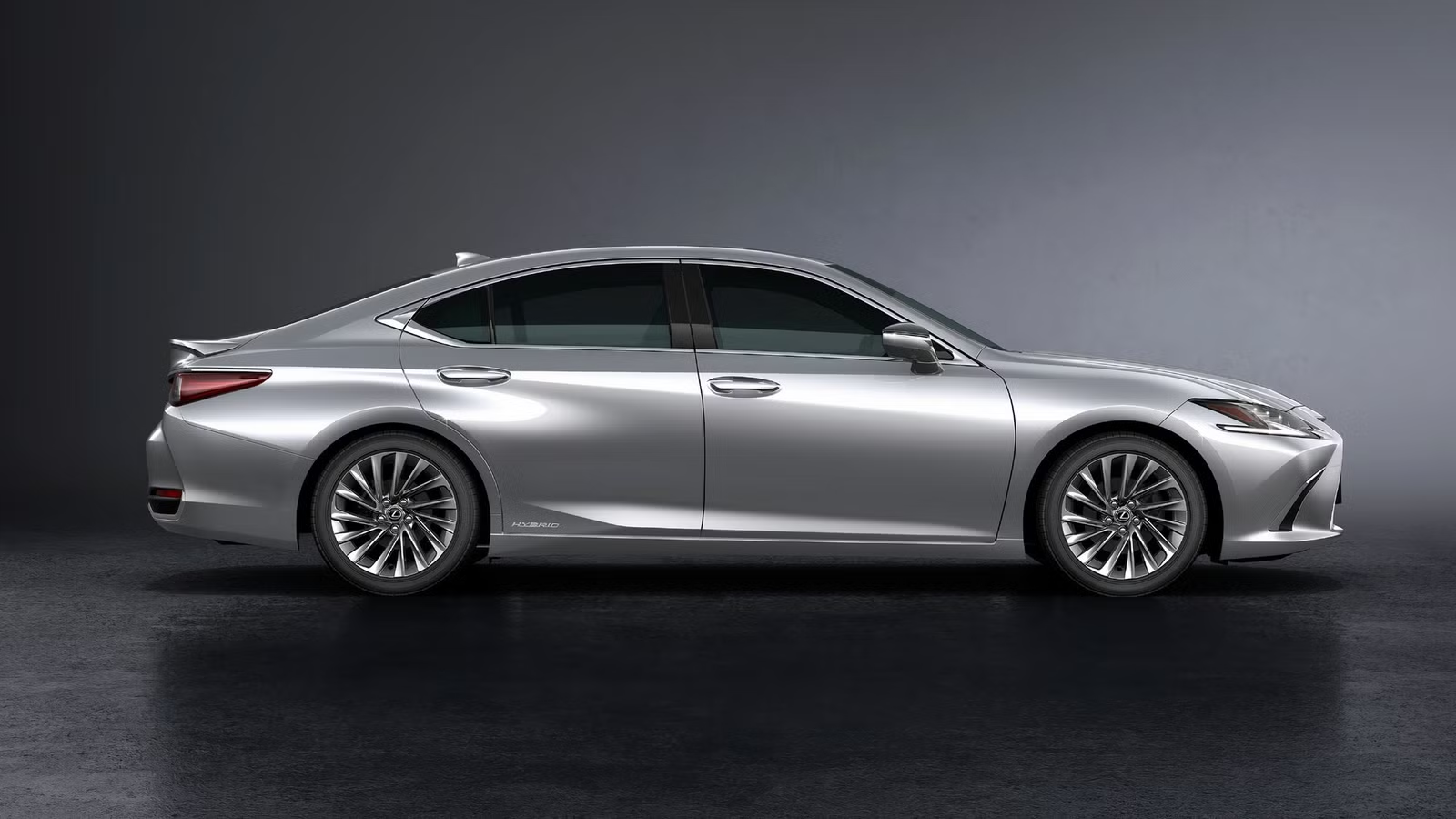
Take A Look At The Lexus ES 300h
The car in question is the 2013–2018 Lexus ES 300h. According to Kelley Blue Book, a 2018 ES 300h currently carries a Fair Purchase Price of approximately $21,900, while private-party values can fall between roughly $18,440 and $21,040 depending on condition. That puts the final year of the sixth-generation ES 300h below the starting MSRP of a new Corolla LE. Earlier examples can be cheaper still.
Sells For $20,870 Or Less

iSeeCars’ data on the sixth-generation Lexus ES doesn’t extend to the 2013 model year, since they only track values up to the 10-year mark. The encouraging news is that the 2018 model year — the final production year of the sixth-generation — carries a used price of $18,270 to $20,870 as per KBB. That means nearly every sixth-generation ES on the market will undercut the base Corolla LE’s sticker. The table below shows average prices for ES models from 2015 to 2018.
Used Lexus ES Prices
|
2018 Lexus ES 350 (8 years old) |
$20,870 |
|
2017 Lexus ES 350 (9 years old) |
$21,000 |
|
2016 Lexus ES 350 (10 years old) |
$17,180 |
|
2015 Lexus ES 350 (11 years old) |
$15,000 |
Why Used ES Ownership Is Less Frightening Than It Sounds

Buying a luxury car for Corolla money usually raises an obvious concern: maintenance costs could quickly erase the savings at purchase. The ES 300h sidesteps much of that worry because its 2.5-liter hybrid powertrain is closely related to Toyota systems used across several high-volume models, rather than being an unusually complex, low-production luxury drivetrain. It won’t feel as athletic as a contemporary BMW 5 Series or as technologically ambitious as a Mercedes-Benz E-Class, but that relative simplicity is a core part of its appeal. Strong parts availability, Toyota’s extensive hybrid experience, and the absence of a conventional stepped transmission all strengthen its case as a luxury car that remains manageable long after the warranty has expired.
According to iSeeCars, the Lexus ES 300h has an average lifespan of 168,586 miles, or about 14.7 years. The publication also notes it has a 25.4 percent chance of reaching at least 200,000 miles. Built on the same platform as the highly regarded Avalon and Camry, the ES 300h is among the most respected entries in the reliable-luxury segment. J.D. Power grants the 2017 ES one of the highest quality and reliability scores on record, at 97/100.
CarEdge places five-year ownership costs at just under $50,000, with only $1,961 of that attributable to maintenance. For comparison, the BMW 5 Series carries a five-year cost-to-own estimate approaching $70,000, while the Audi A6 climbs even higher at nearly $72,000 — and both demand more than double the maintenance spend over that period. The Mercedes-Benz E-Class is marginally cheaper to own than its German rivals, but the ES still costs nearly $20,000 less over five years than the E-Class.
What To Expect In An ES 300h

The sixth-generation Lexus ES brought a fresh sense of style to the midsize luxury sedan segment — something sorely lacking in earlier models. For the first time, buyers weren’t choosing an ES purely for its reliability.
Newfound Sense Of Style

The sixth-generation ES was the first in its lineage to receive the Spindle Grille treatment. This evolution of the L-Finesse design language also gave the ES a fastback-like silhouette, thanks to its shortened trunk lid. Sportier proportions and sleeker lines meant the exterior was finally a genuine selling point rather than an afterthought.
A mid-cycle facelift arrived for 2016, which also marked the moment the ES began to be assembled in the United States. However, only the ES 350 was built in Kentucky; the ES 300h continued to be manufactured exclusively in Japan. The refresh introduced new color options, revised wheel designs, and a more assertive front end characterized by a bolder Spindle Grille and chrome foglamp housings.
The exterior finally gave buyers a reason to notice the ES, but the interior is where the car makes its strongest argument for choosing used luxury over a new economy sedan.
An Interior Of Calm And Serenity

Like the exterior, the interior was thoroughly reimagined for this generation. A predominantly horizontal dashboard layout emphasized the cabin’s width, while the ES 300h offered various trim and color schemes depending on the variant chosen. Whatever the configuration, stepping inside felt calm and unhurried — helped in no small part by an infotainment approach that predates the era of screen-dominated cockpits.
Sumptuous materials were used throughout most of the cabin, though some harder plastics crept into the lower sections of the interior. In practice, those areas rarely see your hands anyway. What you will interact with constantly is the Remote Touch Interface (RTI), a mouse-like infotainment controller that earned few admirers for its awkward cursor-based operation. It remains the cabin’s clearest weakness, and prospective buyers should try it before committing. Beyond that frustration, passenger space across all five seats is genuinely generous, and the quiet, well-finished cabin still feels substantially more special than anything a new Corolla offers at similar money.
But There’s Another Luxury Hybrid Worth Considering

While this article has focused primarily on the sixth-generation Lexus ES 300h, there’s a second midsize hybrid luxury sedan worth seeking out — one that is potentially available for less than a new Corolla LE yet delivers a noticeably sportier, more dynamic driving experience. We say “potentially” because this model sold in far smaller numbers, meaning concrete resale data is thinner on the ground. Search carefully, though, and most examples do come in under the Corolla LE’s price in the used market.
Don’t Forget About The Lexus GS 450h

Lexus once offered two midsize luxury sedans, but as the world’s appetite for SUVs and crossovers grew, maintaining both became untenable. The ES survived; the more dynamic Lexus GS did not, having sold in far smaller volumes. The GS was one of my dream cars and remains my absolute favorite Lexus, apart from the LFA. It featured a rear-wheel-drive layout and a 3.5-liter V-6 that, paired with an electric motor, produced a combined 338 horsepower and dispatched 0–60 mph in 5.6 seconds.
Sportier Than The ES

Perhaps its one notable compromise was the transmission. Rather than the well-engineered eight-speed automatic found in the GS 350 (all-wheel-drive GS 350s made do with an older six-speed unit), the GS 450h used an e-CVT, as befits a series-parallel hybrid. The result was the characteristic rubber-band sensation of that drivetrain layout during hard acceleration. To its credit, the engine’s strong output meant it didn’t drone excessively when pushed. Selecting Sport mode introduced simulated gearshifts through the paddle shifters and swapped the power meter for a tachometer display.
|
2013-2018 Lexus ES 300h |
2012-2018 Lexus GS 450h |
|
|
Engine |
2.5-liter four-cylinder hybrid |
3.5-liter V-6 hybrid |
|
Horsepower |
200 hp |
338 hp |
|
Torque |
N/A |
N/A |
|
Transmission |
e-CVT |
e-CVT |
|
Layout |
FWD |
RWD |
|
EPA Fuel Economy (Combined) |
40 MPG |
31 MPG |
When it came to handling and poise, however, the GS delivered convincingly. A BMW 5 Series still felt more athletic, but the GS 450h was far more capable than any mass-market Lexus of the era. Only the nimbler IS and the RC coupe offered more dynamic engagement within the Lexus lineup. The ES 300h, by contrast, was single-mindedly focused on comfort, quietness, and refinement. The GS lineup was discontinued in 2020, with the GS 450h bowing out after 2018. For buyers prioritizing comfort, efficiency, and availability, the ES 300h remains the safer recommendation; the rarer GS 450h is the more exciting alternative for anyone willing to search patiently.
Sources: Lexus, iSeeCars, Edmunds

Related posts


Latest Post


No Comments