
The Mass-Market GM V6 Enthusiasts Turned Into A Budget LS-Swap Killer
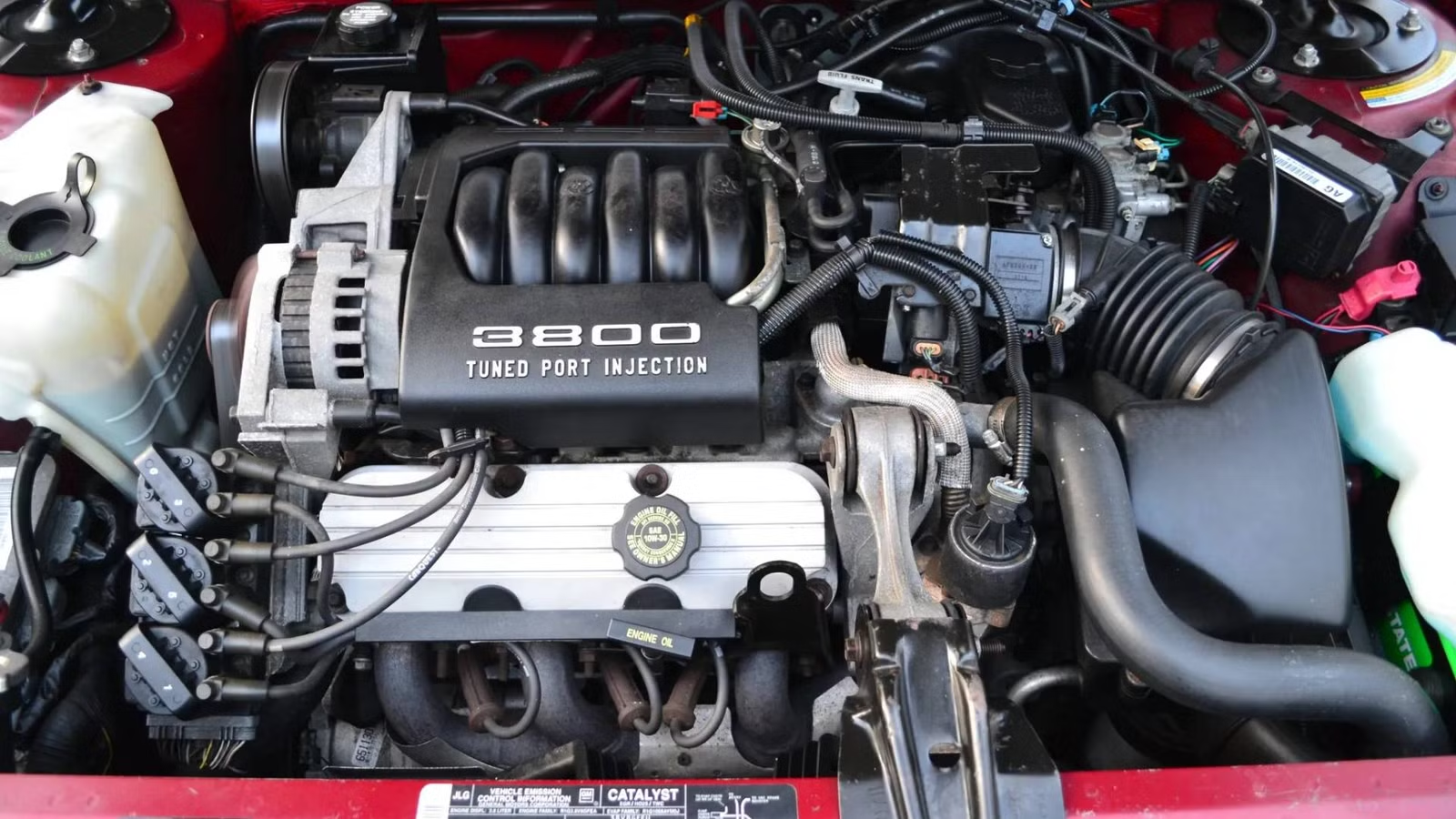
When you think of six-cylinder engines with all the strength in the world and a penchant for lasting decades on end, while being exceptionally tolerant of mods and boost, you immediately think of something German or Japanese. It’s hard not to, as the zeitgeist surrounding the six-cylinder modding scene is entirely oversaturated with N54s and 2JZs. Both are well and good, and you won’t see any of us complaining about a well-sorted restomod rocking either of them. Yet, the annals of history routinely leave out another side of the equation: the Americans. When you factor the Americans in, you can appreciate that they too had a six-cylinder engine in the late ’90s and early 2000s that accepted boost all day long and hardly ever broke.
The Buick V6: 60 Years of Excellence From Muscle Cars to the Near Present

Though Buick is best remembered for its iconic lineup of brand-exclusive V8s in the ’60s, it was a far more eclectic and varied automaker in the engine department than most history books give it credit for. At the same time the much-beloved Nailhead family of V8s was mingling with the all-aluminum 215-cubic-inch V8 soon to be used by Rover, Buick was in the midst of developing what was, by the standards of the day, a more reasonable commuter engine. Dubbed the Fireball V6, this 198-cubic-inch plant used an iron block a la the Buick V8, but with two fewer cylinders to work with.
The heads were made of iron as well, most likely to help keep costs down in the days before aluminum casting was cheap. Available starting with the 1962 Buick Special, this little six-spitter was the first American V6 ever to be mass produced in great numbers. A handful of other global manufacturers toyed with the idea prior, most notably Lancia of Italy for their Aurelia luxury car. Yet, the Lancia represented the extreme, mostly unattainable end of the V6 paradigm. The Buick V6 represented the practical side of the form factor, where it would thrive on the global market for the next six decades. At first, the Buick V6 made a paltry 135 horsepower and 205 lb-ft of torque. These days, there are lawn tractor engines that make more.
Yet in those days, that was a fair amount of power for something that wasn’t a V8. Before long, that same motor was bored out to 225 cubic inches, adding more low-end torque and highway capability at the height of interstate expansion. From there, GM sold the rights to the production tooling to Kaiser-Jeep in 1967, who renamed it to the Dauntless 6 for use in the CJ-5 and Jeepster Commando. Sure enough, GM bought the rights back after the 1973 Oil Crisis, ostensibly to boost fuel efficiency figures in the early post muscle car years. With this move, a further 40 years of development was underway. And boy, was the end game magical.

Decades of Continuous R&D

The early oil crisis years were a difficult time for the American auto industry, and the re-introduced Buick V6 was no exception. Upon its reintroduction to the GM lineup in 1975, Buick’s V6 made a paltry 105 horsepower, or 110, depending on the model. Such was the nature of archaic and imprecise emissions-regulation hardware at the time, but this was the low point of the Buick V6’s capability, not its endpoint. The next two decades saw a series of relentless refinements, tweaks, and hardware changes to make Buick’s bread-and-butter engine more powerful and efficient. The first among them was the introduction of an even-firing crankshaft that provided a less lumpy idle and smoother acceleration.
Later, multi-port fuel injection and a distributorless ignition system were added, and by then, the motor had swollen into a robust 3.8-liter, 231-cubic inch slab of American beef. Ironically enough, that meant a V6 once intended to be an economical alternative to a muscly V8 was now a viable sports car motor as well. With a few more tweaks, including sequential fuel injection and a Garrett turbocharger, the original Buick V6 lineage reached its arguable zenith in the form of the LC2. It was this legendary engine that found its way under the hood of the Grand National and its even sportier counterpart, the 1987 GNX.
With a power output somewhere in the vicinity of 300 horsepower, the GNX in particular was notorious for going toe-to-toe with Corvettes and Ferraris over quarter-mile sprints.That burly V6 was the cornerstone of all the sporty cars riding the larger second-generation Regal platform but by the turn of the late 80s, it was clear that the old-school, rear-drive layout it once championed was rapidly being phased out. Spurred on by Japanese imports, it was clear the future was FWD, and that meant the Buick V6 needed to adapt as well. When it did, Buick wound up breathing new life into the old format.
The 3800: The Series II V6 With Toyota Reliability and Boost Tolerance

Let’s set the scene: the year is 1988, the muscle car wars have been over for almost two decades, and the 3800-series Buick V6 has just arrived. Well, at least the nomenclature did. It’d take a few more years of R&D before the underlying architecture had a profound change internally. Skip ahead to 1995, and the Series II Buick V6 looks radically different than its predecessors. Still a cast-iron block, the rest of the new engine was radically different. For starters, it employed cross-bolted main bearing caps and a deep-skirt block design for extra bottom-end rigidity.
This extra block strength was crucial in making the Series II 3800 tough on a level that even the Germans and Japanese OEMs it was competing with had to respect. As a consequence, it also made the block tailor-made for forced induction. Naturally-aspirated, these overbuilt engines made a reasonable 200 to 205 horsepower depending on the application. While it doesn’t sound like a lot today, the N/A L36 had some of the same benefits that helped Japanese automakers like Toyota muscle their way into the US market around the same time.
The very fact that it was underpowered meant the L36 was durable on a level almost no other engine made in America was. It could withstand deferred oil changes, coolant flushes, and the kind of punishment that would turn lesser engine blocks into rubble. It also made light work of hauling families of five in the cabin, and a trunk full of groceries all the while. In applications like the Buick LeSabre, Park Avenue, and the Riviera, the L36 was a defining piece of the car, and the only one most people remember fondly. Even Pontiac, Chevrolet, and Oldsmobile were in on the fun, with famous faces like the base Impala, Monte Carlo, the Oldsmobile Eighty-Eight and Ninety-Eight, Pontiac Bonneville and Grand Prix, plus the Gen-IV Camaro sporting a 3800 at some point.
Adding a Supercharger? Why Not!!

Knowing how stout these Series II 3800 V6s were, it was only a matter of time before somebody at GM had the bright idea to stick a big thumping supercharger on top of it. By lowering compression to 8.5:1, the block was easily capable of accepting the extra boost pressure of an Eaton M90 roots-style blower. Connecting rods were beefed up, as were the cylinder heads, complete with fuel injectors higher up in the intake tract. The new power figure was 240 horses at the crank and 280-lb-ft of torque. In cars like the Buick Regal GS, Pontiac Grand Prix GTP, and later the Chevy Impala SS and Monte Carlo, the L67 gave these vehicles a sporting character that Japanese manufacturers couldn’t quite match.
For some context, the V6 in an equivalent Honda Accord or Toyota Camry made maybe 190 to 200 horsepower, and nowhere near the same level of torque. The L67 was a lethal combination of serviceable horsepower and real-world reliability which, historically, were mutually exclusive. Further changes came in 2004 via the Series III 3800, complete with an electronic throttle control, stronger connecting rods, and emissions equipment that restricted power less while not sacrificing emission regulations. A supercharged variant, the L32, brought power up to 260 horses, a mighty figure for a 3.8-liter six-pot.
The Series III turned out to be the last in the 3800 line, as Buick transitioned to employing the all-new High Feature and High Value six-pots beginning in 2004. Complete with aluminum blocks and sequential multi-port fuel injection, these were okay motors, but nowhere near as strong or dependable as their iron block predecessors. A fourth-generation variant of this same 3.6-liter engine continues to be used to this day in the Cadillac XT5, and in the Chevy Blazer crossover until early 2026.
2J-What? The 3800’s Not Too Far Off
No, we’re not smoking anything — apart from tires, maybe. But the iron block, pushrod 3800 Series II really can accept modifications and extra boost on a level nearly as capable as the mighty Toyota straight-six in the Gen-IV Supra. By playing around with aftermarket smaller supercharger pulleys, high-flow downpipes, and ECU tunes, DIY wrenches can easily send horsepower surging past 300 or even 400.
With aftermarket turbo kits, 500 to 600 hp or more isn’t just theoretically attainable, but practically as well. Yet, because it’s an American engine in understated American cars, you won’t catch any Initial D-watching enthusiasts singing the praises of a 3800. If only they knew just how comparable they were to the 2JZ straight-sixes they still can’t stop talking about, nearly 30 years later.
Source: Hagerty, Buick

Related posts


Latest Post


No Comments