
A New Hand-Built Naturally Aspirated V12 Engine Signals A New Era For Hypercar Startups
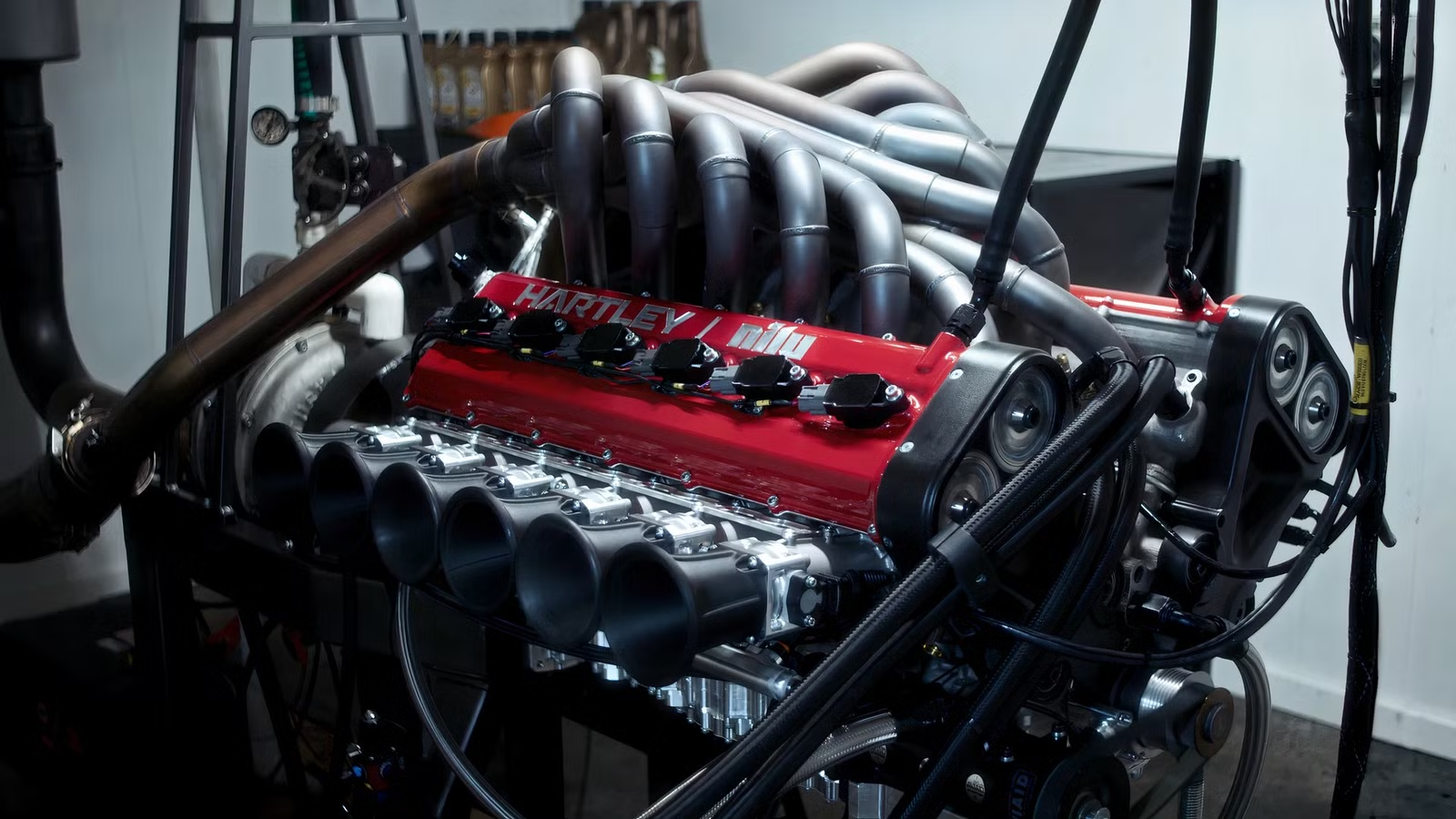
A small automotive startup has just crossed a milestone that most independent builders never reach, as it recently and successful fired-up a purpose-built 1,070-horsepower 6.5-liter naturally aspirated V12 destined for its upcoming hypercar. The engine roared to life, and that’s a much bigger achievement than it might seem.

Developing a bespoke large-displacement V12 from the ground up—with custom castings, unique engineering, and a clean-sheet design—is something typically reserved for established European marques backed by decades of motorsport expertise and billion-dollar resources. This newcomer has now joined that incredibly exclusive club, proving that world-class engineering can emerge from unexpected places.
A Hypercar Maker Nobody Has Heard Of And Why the Numbers Matter
The engine was designed by a Philipine-based supercar maker, with no turbos, and no hybrid assist — just displacement and revs doing the work.

To put 1,070 hp in context, the Zenvo Aurora Tur, one of the most technically ambitious hypercars, runs a bespoke quad-turbocharged V12 pushing around 1,250 hp. Bugatti’s Centodieci — spotted at Goodwood just this week — carries the W16 to 1,578 hp. Koenigsegg’s Jesko Absolut, with its twin-turbo 5.0L V8, sits at 1,600 hp on E85. At 1,070 hp, the Nilu27 unit isn’t the most powerful engine in the hypercar conversation, but it’s naturally aspirated, which means the power curve is different — and the engineering challenge is arguably harder. Forced induction can paper over displacement shortfalls. A big NA V12 has nowhere to hide.
Why Hand-Building a V12 Is Harder Than It Looks

Most independent hypercar projects sidestep the powertrain problem entirely. They license a unit from a major supplier, pull a donor engine from an existing platform, or partner with a specialist like Cosworth or HWA. That’s not a shortcut born of laziness — it’s a rational engineering decision. Developing a bespoke engine block requires custom casting tooling, metallurgical validation, and a testing regime that can run into thousands of hours before a production-intent unit is signed off.
A V12 compounds all of that. Twelve cylinders mean twelve sets of tolerances stacking against each other. Balancing a 6.5-liter twelve-cylinder for both street durability and hypercar output requires the kind of iterative dyno work that even well-funded European startups have stumbled on. The fact that Nilu27’s first fire-up produced more power than the team expected — rather than less — suggests the development program is tracking well, not just surviving.
For comparison, Gordon Murray Automotive’s Le Mans GTR, which just completed prototype laps at Circuit de la Sarthe, relies on a V12 developed in partnership with established European suppliers. RUF recently unveiled a bespoke twin-turbo flat-eight, which itself drew attention precisely because independent engine development at this level is so rare. Nilu27 is operating in genuinely uncommon territory.
What This Milestone Means for Independent Hypercar Builders

A first fire-up is not a finished engine. Durability validation, emissions calibration, and integration into the actual chassis still lie ahead. But the milestone matters because it’s the hardest gate to clear — it’s the moment the simulation work either proves out or doesn’t.
For the broader independent hypercar scene, Nilu27’s achievement signals something worth watching. The gravitational center of bespoke hypercar engineering has always been Europe — Italy, Sweden, Denmark, the UK. A Philippine startup completing a ground-up V12 development program doesn’t shift that center overnight, but it does demonstrate that the infrastructure gap is closing. CAD tools, CNC machining capability, and materials science knowledge are more globally distributed than they were even a decade ago.
Gearheads who follow the independent builder space should keep Nilu27 on the radar. The NILU hypercar is still in development, and confirmed specs beyond the engine remain limited. But the engine is real, it runs, and it makes 1,070 hp without a turbocharger in sight. That’s a foundation worth building on.

Related posts

Latest Post


No Comments