
The Longest Buick Ever Built Out-Stretched A 1973 Lincoln Continental
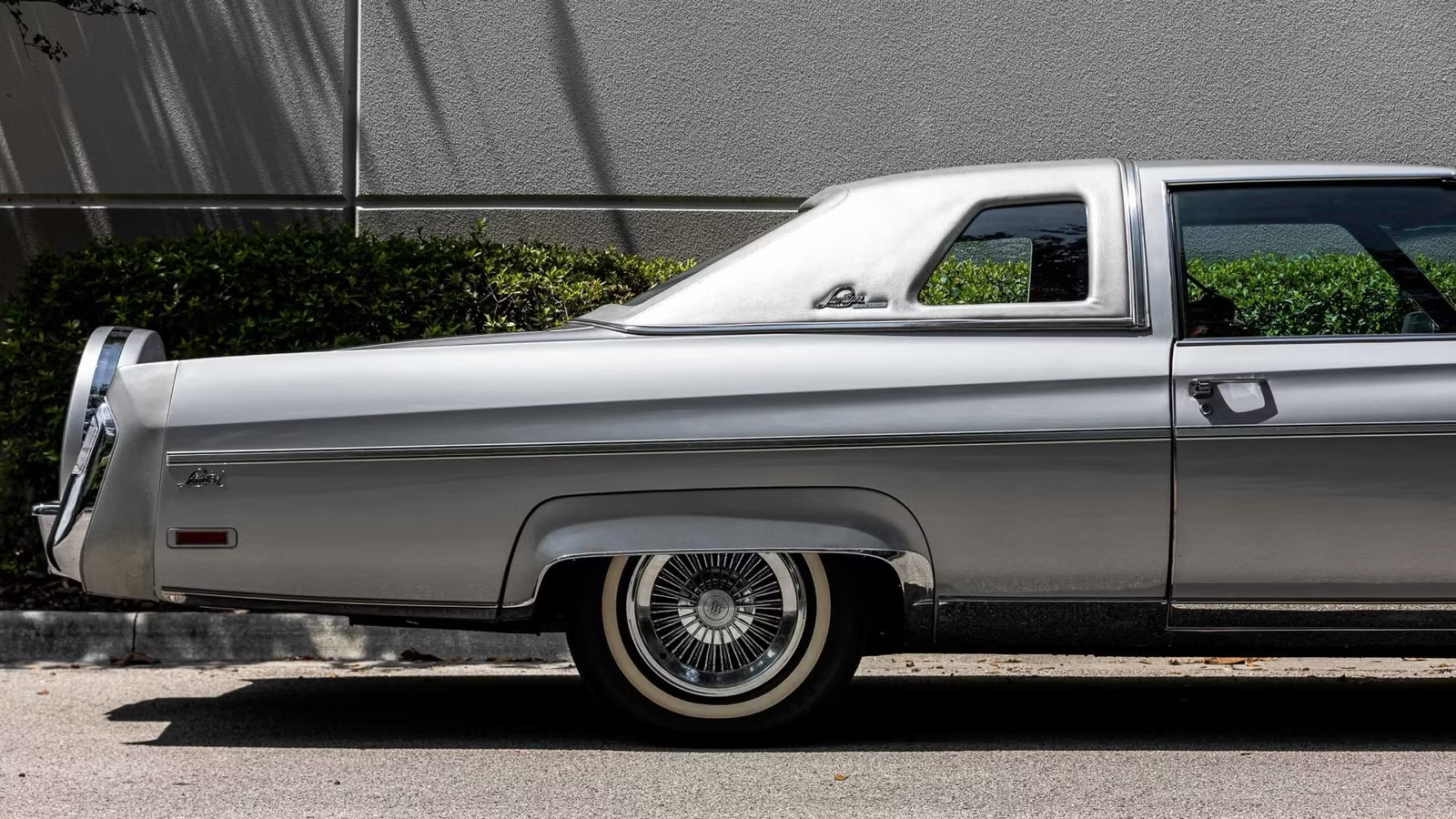
Before drivers needed a full-size SUV “to see over traffic” and vehicles started reaching ever higher, there was a time when it felt like American luxury cars were all competing to see how much horizontal space they could occupy. Spacious interiors, comfy seats, and big V8s under long hoods were a given, with bonus points for a trunk that could accept more than a few golf bags.

Since streets and highway lanes could only accommodate so much width, true opulence seemed to be defined by how long a car could get.
American Luxury Cars Were Getting Ridiculously Big
The American luxury car experience of the 1970s didn’t come out of nowhere. There was a logic to it.

If space was good, then more space must be better. Plus, long wheelbases enabled the smooth ride that luxury buyers expected long before more advanced suspensions made it easier to deliver that across different-sized chassis. Generous dimensions also created room for expansive bench seats with tons of elbow room and enough space between the first and second row for everybody to stretch their legs.
Less pragmatic but just as influential was styling. Long hoods and ample rear decks created the presence luxury buyers expected, not to mention a tangible nod to automotive superiority that could be taken in at a glance without having to peek inside.
Federal bumper requirements were also a factor, as regulations introduced in 1973 required passenger cars to withstand certain low-speed impacts, with tougher rear-impact provisions following in ‘74. They were the kind of bumpers that were made for bumping, and they added additional bulk to cars that were already ballooning on their own. By the middle of the decade, some of America’s biggest sedans were approaching 20 feet in length. And one of the most impressive examples didn’t even say Cadillac or Lincoln on the badge.
The Buick Electra 225 Grew Beyond Its Own Name

If there was any doubt that manufacturers were putting a whole lot of stock in how long their vehicles were stretching, some built the flex right into the name. The Buick Electra 225 arrived in 1959, openly boasting of its 225-inch overall length and earning its enduring nickname of “Deuce and a Quarter.” This was a long car. But Buick was just getting started.
The Electra saw a major redesign for 1971, picking up the smooth, rounded styling that marked a new generation of cars from General Motors. Sitting on a 127-inch wheelbase, the new bodywork stretched even further than the 225 inches implied by the name. The Electra was new, long, and imposing, with both size and luxury that threatened to encroach on a market usually reserved for Cadillac.
The Electra didn’t stop there, either. Further design changes, including even bulkier bumpers, pushed overall length to 233.4 inches by 1975. That’s just under 19.5 feet of unrepentant Buick, the longest production car the company had ever built. The length remained about the same for 1976, which would prove to be the final year for Buick’s biggest generation of Electra. It was all downhill (and downsized) from there.
It Was Longer Than A Continental And Nearly As Long As A Fleetwood Brougham

It’s hard to get your head around the sense of scale when it comes to stretched-out ‘70s cars, especially if you weren’t around to see them cruising down the street. As a frame of reference, the iconic Lincoln Continental of 1973 was a statement-maker of the era and was 229.9 inches long. In other words, three and a half inches shorter than the 1975 Buick. Both cars rode on 127-inch wheelbases, meaning that the extra length was all outside the wheelbase.
Lincoln wasn’t the only brand that could serve as a heavyweight luxury measuring stick, though. The ‘76 Cadillac Fleetwood Brougham, perhaps the most prestigious sedan in GM’s lineup, edged out the 1975 Electra by just three-tenths of an inch. It was a difference that you’d be hard-pressed to spot without a tape measure and barely worth measuring even with one. That said, the Fleetwood Seventy-Five did exist, and could more or less end the conversation with its 252.2 inches of length.
Assuming you weren’t in the market for an actual limousine, the Brougham and the Electra were cars that you could at least talk about in the same breath. Of course, if length alone could take the luxury crown, ‘70s rock stars would have all lusted for school buses. And so Buick brought a bit more to the table.
Buick Gave Its Biggest Car A 455-Cubic-Inch V8

Pushing nearly 20 feet of American luxury down the road in a way that doesn’t feel labored meant dropping something substantial under the hood. The Electra’s rear wheels were powered by a 455-cubic-inch V8 through most of this generation, which ran from 1971 through 1976. There was horsepower.
Like any conversation about power output in the early ‘70s, though, the exact numbers are complicated a bit by the transition from SAE gross horsepower ratings to the net figures that became the standard in 1972. The 455 in the ‘71 Electra put out 315 gross horsepower. As of ‘75, the Electra was rated at 205 net horsepower. It would be easy to conclude that the big Buick had misplaced a third of its get-up-and-go, but the switch in measurement standards makes that comparison misleading. Tightening emissions requirements were indeed robbing engines of some of their pep, however.
In any case, there was also torque. A lot of it. By 1975, the Electra’s 455 was putting out 345 lb-ft of torque at a rumbling low 2,000 rpm. This is really where you want to focus your attention when you’re planning to lumber down the main drag in a car weighing just under 5,000 pounds. The four-door Electra Limited with a hardtop was 4,927 pounds. This was a long way from a muscle car, and nothing about it suggested it was trying to be one, but it did deliver the effortless, low-speed power that was the name of the game in this particular era of American luxury.
Buick Took The Electra Into Cadillac Territory

Buick was objectively below Cadillac in the GM pecking order, and rivaling the flagship brand’s length wasn’t going to be enough to put the two on equal footing. By the mid-’70s, buyers could option out an Electra with enough luxury features to start to blur the distinction.
The attempt to help the Electra 225 step into the big leagues came in the form of a top-tier option package for the Electra Limited, introduced in 1975 with a name you’ll probably recognize: Park Avenue. Opting for it provided an extra cushy interior, better carpeting, and even more ornate door panels. You could also opt for a full-length center console that split the front bench into individual seats. Taken together, it might not have been a Cadillac, but Buick had joined the conversation.
The Park Avenue option package would eventually evolve into the standalone model that replaced the Electra name. By then it was 1991, and the outrageous proportions of the original Electra were long gone, even if Buick’s luxury ambitions remained.
The 1977 Downsizing Ended Buick’s Size Contest

The era of the Electra as one of the longest cars you could buy came to an end in 1977, when GM completely revamped the lineup in favor of smaller full-size cars. The incoming generation was more than 11 inches shorter than its predecessor, and the wheelbase scrunched from 127 inches down to just under 119.
As cars tended to do at that time, it lost quite a bit of weight, as well. Some variants shed around 700 pounds, and along with that weight the 455-cubic-inch V8 also faded into history. Buick’s 350 became the standard engine, with an available 403 from Oldsmobile for drivers aiming to recapture some of that former rumbly glory.
The remarkable proportions of the 1975–76 Electra were never seen again from Buick. The brand might have had room to grow even further, but changing market conditions and pressure for better efficiency had spoken: there was a high-water mark on such things, and for Buick it was a Deuce and a Quarter.
Sources: Buick, Lincoln, Cadillac, Hagerty, Automobile-Catalog, Curbside Classic

Related posts



Latest Post


No Comments