
The Forgotten Supercharged Sports Sedan That Should Have Saved Oldsmobile
By the late 1990s, Oldsmobile faced a challenge bigger than just building good cars. As a new millennium approached, it needed to give buyers a reason to agree that the brand founded way back in 1897 still had a reason to exist.

In what would turn out to be one of the last gasps of the brand, Olds did something nobody expected from it: a serious performance push complete with big brakes, a tuned suspension, and forced induction. For the briefest of moments, it felt like the company might have a shot at reinventing itself just as the clock ran out.
Oldsmobile Was Running Out Of Time
Oldsmobile didn’t wake up at the eleventh hour and try to become something new on the fly. It had spent much of the ‘90s going through a pretty significant evolution and redefining what it meant to drive an Oldsmobile. The Aurora had launched in 1995 as a posh flagship sedan aimed at convincing Americans to rethink their preference for luxury imports. An ethos that was supposed to carry the brand into its next generation was beginning to emerge.

That approach showed up across the lineup. Familiar names like Cutlass disappeared, the rocket logo morphed into something you may not have realized was supposed to be a rocket, and newer cars like the Alero and Intrigue set a new tone that seemed equally committed to attracting Lexus and Acura buyers and poaching from Toyota and Honda.
There was just one problem. If the tide was turning, it wasn’t turning fast enough. This sleek reimagination of what an Oldsmobile could be needed to make clear to General Motors that the brand even needed to exist.
The Intrigue OSV Was A Supercharged Sports Sedan

Against that precarious backdrop came an almost ridiculously bold statement of a car. In 2000, the Intrigue OSV was a concept that took Oldsmobile’s otherwise sensible midsize sedan and turned it into something hard to ignore. Adding a supercharger to the existing 3.5-liter DOHC V6 brought a 215-horsepower motor up to 260, with 260 lb-ft of torque to match.
The OSV wasn’t intended to be a one-off design exercise. It was introduced as a showcase not just for how GM could punch up the Intrigue, but as a model for a proposed performance-oriented subbrand called Oldsmobile Specialty Vehicles, hence “OSV.”
For a company fighting the notion that Oldsmobile had become an aging brand aimed at an aging population of drivers, a factory-built Intrigue with a supercharger was a significant change in direction. It was still front-wheel-drive, though.
Olds Wanted OSV To Become A Real Performance Brand

To appreciate what was happening with the Intrigue OSV, it helps to look beyond the car itself. Oldsmobile wasn’t just trying to grab headlines on the car show circuit, though those were very much a thing then, and it wasn’t just a trial balloon to see if buyers could look to Olds for a spicier sedan. This wasn’t entirely new territory for the company. Olds had already given us the Rocket 88, the 4-4-2, and the Hurst/Olds, serious performance names that would still have been familiar to plenty of enthusiasts.
What was missing was a modern thread stringing all of that history together into the present day. Oldsmobile’s reinvention had delivered sophisticated-looking cars and more modern technology, but nowhere in the lineup was the spiritual successor of those earlier performance offerings.
OSV was a way to change that, or at least it could have been. Oldsmobile even took the idea to the 1999 SEMA Show, putting its new performance ambitions in front of exactly the sort of audience likely to appreciate them. Instead of simply dusting off an old muscle-car name, Olds was trying to move forward and give enthusiasts something new to get excited about.
More Than A Supercharger

The OSV premise was more than just bolting forced induction onto a pretty-okay powerplant.
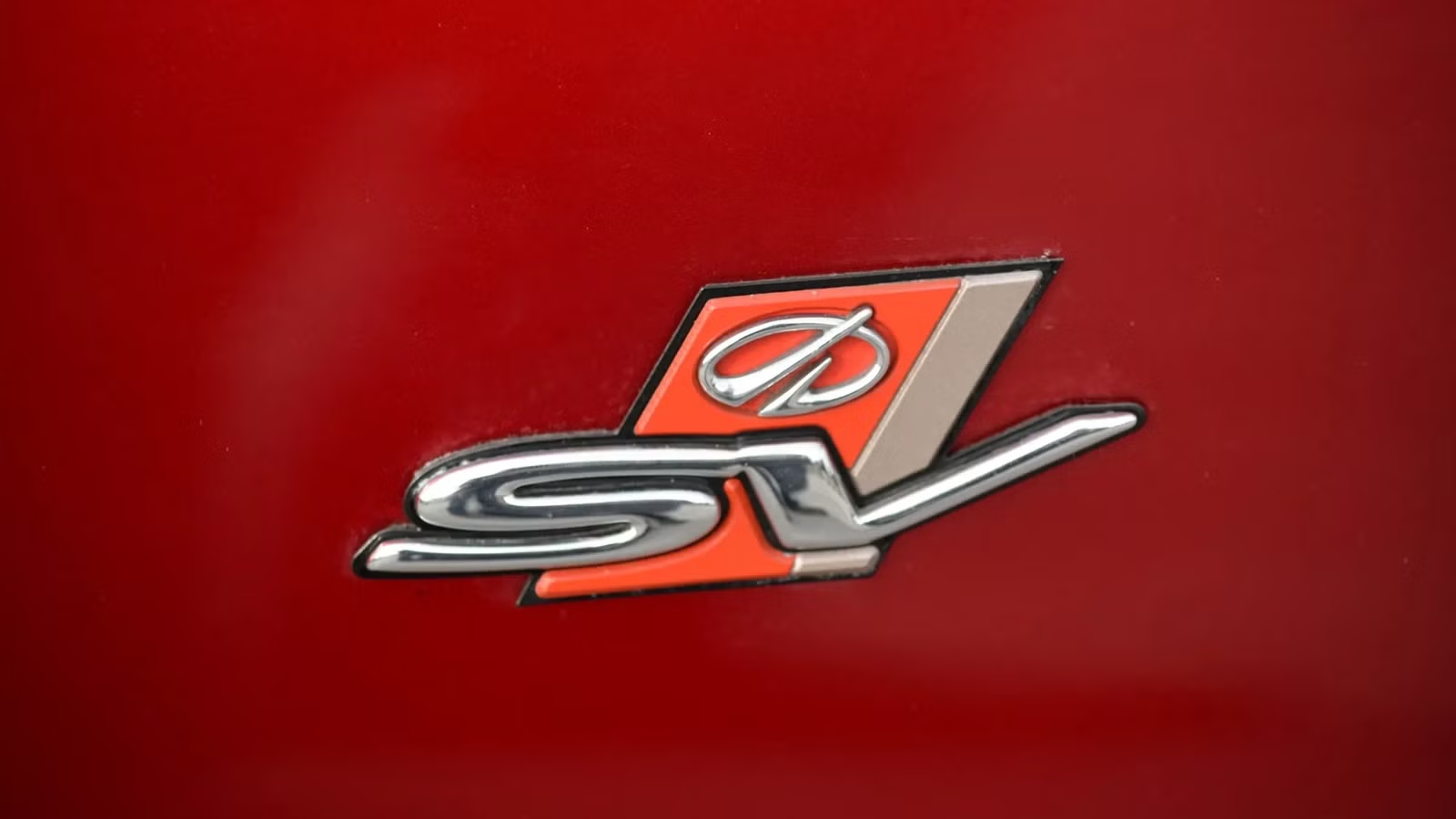
The Intrigue OSV had Koni coilover struts and springs for more credible handling and 13-inch cross-drilled Brembo brakes slowing it down into the corners. It had 19-inch wheels during a time when 19-inch wheels really meant something, wrapped in Michelin Pilot XGT Z4 tires. There was a Borla center-exit exhaust, front and rear spoilers, and a sporty body kit. Of course, OSV badging also told onlookers they were seeing something special.
Inside, the usual seats were swapped for eight-way climate-controlled Recaros. The driver got a two-tone leather steering wheel and titanium pedals, too. Some of that was pretty standard turn-of-the-millennium concept-car excess, of course, but the statement was clear enough. OSV wasn’t just trying to turn heads, but meaningfully alter the personality of the car.
The Alero And Silhouette Were Also In The Mix

The Intrigue may have been leading the charge in this performance play, but it wasn’t supposed to stop there. The same performance treatment found its way into the Alero, which got serious hardware of its own, including a supercharged 2.4-liter four-cylinder, Koni suspension, and Brembo brakes. But the real madness came in the form of the OSV Silhouette minivan.
The Silhouette name still carried plenty of baggage from its iconic Dustbuster-shaped predecessor, which made a performance version of Oldsmobile’s family hauler an especially strange proposition. The OSV Silhouette got a Koni suspension, 13-inch cross-drilled Brembo brakes, 19-inch wheels, a Borla exhaust, Recaro seats, and a 3.4-liter V6 modified with a tuned intake and headers. Output was rated at 210 horsepower and 270 lb-ft of torque. It was still a minivan, obviously, but it was a minivan built with the same basic philosophy as the Intrigue and Alero.
The unexpectedly striking minivan at SEMA, flanked by the brand-redefining Alero and Intrigue with bold style and surprising performance, was more than a trade-show novelty. It was a substantive indication of just how ambitious Olds really was about this. OSV wasn’t going to be a hero car sitting on a slowly rotating convention-center pedestal. It was a proper performance identity that just might help the brand return to former glory, or at least relevance.
The Right Idea, Too Late

In the end, maybe none of it mattered. Whatever the OSV Intrigue and the rest of the possible OSV lineup had in ambition and execution, what it lacked was time. The trio of concepts showed up at the SEMA Show in 1999 and just over a year later, General Motors was announcing that Oldsmobile was done. The company had already spent years working to modernize its designs, transform the lineup, and reposition the brand. But sales had continued to slide and Olds failed to make the case for its own continued existence, especially with Oldsmobile already squeezed between GM’s other divisions.
Unlike a lot of these stories of cars that weren’t, the OSV project left behind some metal in the form of real cars that found their way to collectors years later. The Intrigue spent time in the GM Heritage Museum collection before landing on Bring a Trailer in 2019, where bidding reached $9,600 but didn’t meet reserve. An Alero OSV sold at Barrett-Jackson in 2009, and there have even been a couple of transactions involving the Silhouette OSV, which went for $18,150 at Barrett-Jackson in 2012.
And so the oddities live, even as Oldsmobile does not. Perhaps they were the wrong answer to a question the car-buying public wasn’t asking anymore.
Sources: Hagerty, Bring a Trailer, Barrett-Jackson, Consumer Guide, DrivingLine, The Washington Post

Related posts


Latest Post


No Comments