
The Motorcycle That Can Do Almost Everything Without Being Boring
Different days of the week ask different things of motorcycle riders. Mondays can be a slog through stop-and-go traffic where a light clutch and an engine that does its best work at the lower end of the rev range are all that matter. The script flips on a Saturday as you lean the bike hard and get greedy with the throttle on your favorite twisty road. And Sundays are about packed panniers, a tank that calls the road (and not the gas station) its home, and a seating position that you can hold comfortably for six to eight hours.
Most motorcycles on the market ask you to pick a day that matters most and build your riding life around that choice. The ones that call themselves versatile tend to feel competent everywhere, but thrilling nowhere. Alternatively, the ones that excite you end up punishing you once their moment of glory is over. It’s the oldest trade-off in the world of motorcycling, and it’s often dubbed unavoidable. One motorcycle, however, manages to dodge it anyway.
The Problem With Motorcycles That Try To Do Everything
There’s a reason that most motorcycle manufacturers slap the do-it-all label on most motorcycles. It helps the motorcycle rider believe that their split riding personalities can be satisfied by one motorcycle. However, building a motorcycle that is genuinely good at commuting, canyon carving, and touring requires solving three contradictory engineering problems.

A soft suspension that gobbles up the potholes on your commute ends up wallowing the moment you start pushing it in the corners. Ergonomics that make your everyday ride comfortable feel too relaxed for canyon carving. And weight — the kind that comes with a touring motorcycle — is the last thing you want while canyon carving.

Most manufacturers try to get you on board by leaning hard into one identity and quietly apologizing for the rest. Sport-tourers end up apologizing for their reach to the bars whereas adventure bikes end up being sorry for their top-heavy nature at a stoplight. It is, then, rare to find a motorcycle that is not making an excuse in one area, and a Triumph manages to plug that gap.
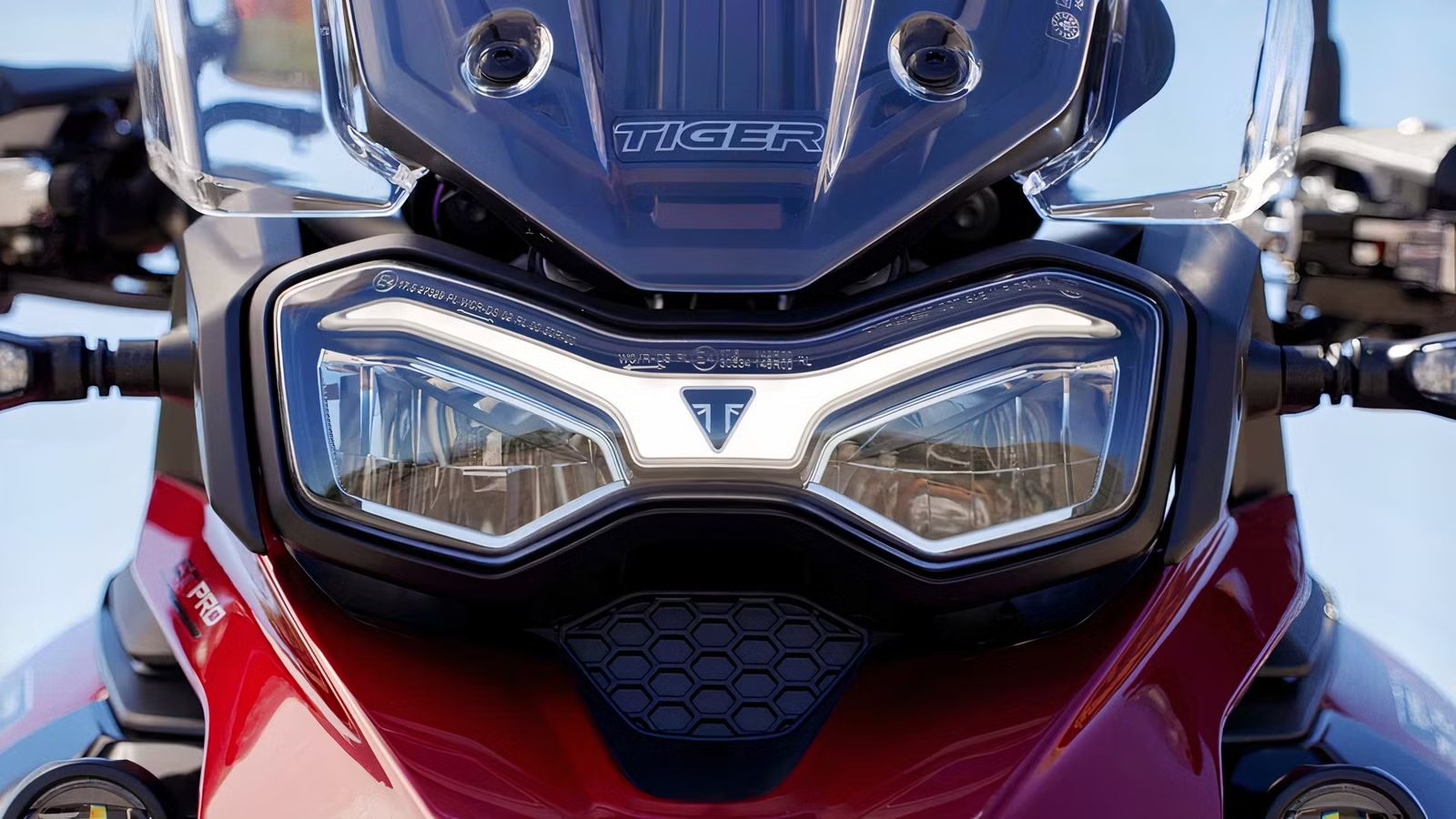
The Tiger 900 GT Pro’s Triple Growl Isn’t Just For Show

The 888cc T-plane triple engine is the loudest clue (pun intended) that the Tiger 900 GT Pro isn’t just another mild-mannered all-rounder motorcycle. Its uneven firing, unlike a conventional inline-triple, gives the exhaust a raspy note.
That said, the uneven firing order is not just for show. It also changes how the Tiger 900 GT Pro puts power to the ground and manages to induce some “fizz” into the ride, regardless of where or how you ride it. The brochure claims it makes 106.5 horsepower at 9,500 rpm, with peak torque of 66.4 pound-feet arriving much earlier at 6,850 rpm. The numbers are respectable in the middleweight class, and honestly, some other bikes with a similar displacement do have a higher output. However, the peak numbers aren’t really telling the story here.
The T-Plane Crank’s Low-End Torque Advantage For Commuting And Overtakes

What really matters is when the meat of the torque shows up. The T-plane crank gives the kind of low- and mid-range shove that’s often lacking on conventional triples. And that means that the Tiger 900 GT Pro doesn’t need to be given a handful of throttle to feel alive. The advantage shows up when pulling away from a stoplight or when overtaking a truck on a two-lane road — the kind of riding that fills most of your seat time. The bike just responds in the moment, irrespective of where the revs are sitting.
Why The Tiger Doesn’t Feel Like It’s Compromising

Engine character will only get you so far if the chassis underneath it can’t back it up, and this is where a lot of do-it-all bikes start showing their seams. The 900 GT Pro features Marzocchi suspension — a 1.7-inch upside-down fork up front which is manually adjustable for compression and rebound paired with a rear shock that is electronically adjustable for preload and rebound.
It splits the difference between plush and controlled instead of picking a side. It can be set up soft enough to shrug off the kind of broken pavement you deal with on a daily commute, but stiffen it up and the damping holds its composure once you start pushing it hard in a corner. As far as suspension travel goes, you get 7.08-inches in the front and 6.69-inches at the rear.
The tubular steel trellis frame underneath does a lot of the quiet work too. The 61.26-inch wheelbase is reasonably tight for a bike in this class and centers mass low and close to the rider, rather than piling weight up high the way some adventure-styled machines do. At a claimed 489 pounds wet, the GT Pro isn’t a featherweight, but the way the weight is distributed matters more than the number on the spec sheet. It’s why the Tiger 900 GT Pro tips into corners without the top-heavy hesitation you’d expect from something built to also carry luggage on long road trips.
A Seat That Actually Fits Both Short And Tall Riders Without Compromise

The fit is where a lot of versatile bikes quietly fail shorter or taller riders, so Triumph built in some give. The seat height can be adjusted between 32.28-inches and 33.07-inches, letting riders dial in a stance that keeps both feet planted at a stop without forcing taller riders into a cramped bend at the knee. Combined with a relatively neutral bar reach, it’s a riding position that doesn’t feel purpose-built for one body type at the expense of everyone else.

Hardware is only half the equation, and the Triumph Tiger 900 GT Probacks it up with an electronics suite that actually changes how the bike behaves, instead of just decorating the dash. A seven-inch TFT display is the centerpiece of the cockpit, running through rider modes that adjust throttle mapping, traction control, and ABS intervention together rather than leaving you to fiddle with each of them separately. Cornering ABS and traction control lean on a six-axis IMU to read what the bike is actually doing mid-lean, not just what the wheels are doing in isolation.
Cruise control handles the monotony of a long interstate stretch, and heated seats and grips turn a chilly morning commute from something you endure into something you actually enjoy. All these features aren’t there to make the GT Pro a flashy bike. Instead, it’s the kind of electronics package that shows up exactly when you need it and disappears when you don’t.
Over 200 Miles Per Tank Means The Tiger Sets Your Itinerary, Not The Fuel Map

Factory-fit panniers are available for riders planning to load up for a week away, and the windscreen does real work cutting fatigue on longer highway stretches rather than just looking the part. A 5.28-gallon tank paired with a claimed 45 mpg puts real-world range comfortably past 200 miles between fuel stops. It’s the kind of range that allows you to fill up at your discretion, instead of hunting for fuel stations along the way.
The Tiger 900 GT Pro Costs A Pretty Penny, Though

Add up all of the above, and it becomes clear that the GT Pro earns its reputation honestly: an engine with real personality, a chassis that doesn’t ask you to choose between comfort and control, an electronics package that quietly supports whatever kind of ride you’re on that day, and accessories that genuinely work instead of just looking the part. Such a coming together of traits is a genuinely rare thing in this class.
That capability comes at a price, starting at $17,295. It puts the GT Pro solidly in premium middleweight territory and well above plenty of competent commuter-plus-weekend-warrior alternatives. For riders who genuinely use all three sides of what this bike offers — the commute, the canyon, the cross-country trip — that number is easy to justify. For riders who only need one or two of those, it’s worth pausing before signing.
The Tiger Sport 660 Is A Budget-Conscious Alternative

Triumph’s own lineup actually offers an out for exactly that rider. The Tiger Sport 660 starts at $10,445, and its 660cc triple makes a claimed 95 PS and 50.2 pound-feet of torque; most of that torque is available from just 3,000 rpm. It’s not chasing the same off-road-adjacent versatility as the GT Pro, and the suspension is softer with only rear preload adjustability, but for a rider whose “everything” is really just commuting and the occasional spirited weekend ride, it delivers a huge chunk of the same do-it-all spirit for a lot less money.
Source: Triumph

Related posts




Latest Post



No Comments