
The Lincoln Luxury Coupe That Packed The Big-Block Muscle Its Rivals Couldn’t Match
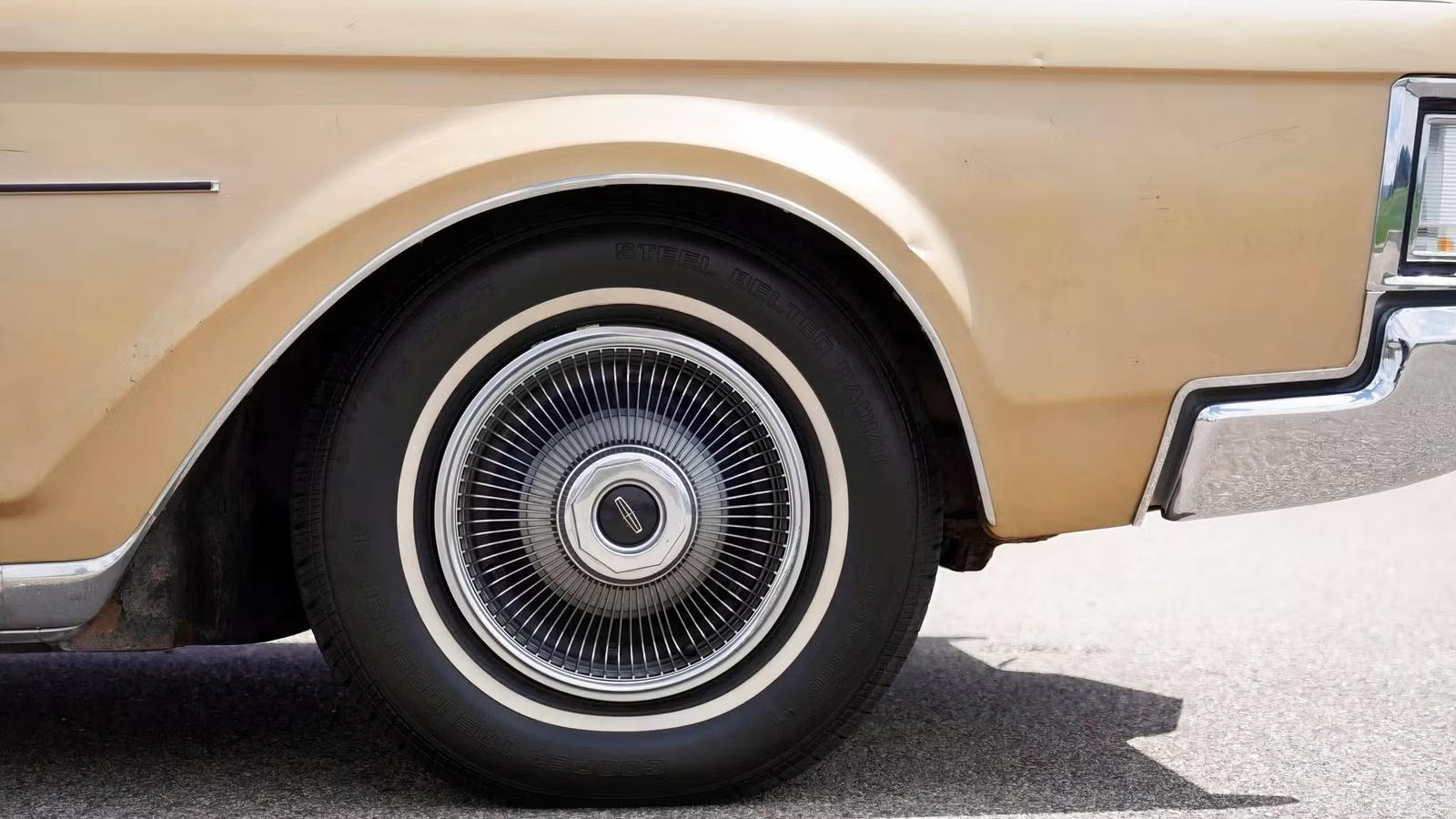
Horsepower and noise built the muscle car legend. Big-block power didn’t need either. While street racers flexed at red lights in bright pony cars, luxury automakers dropped monster engines into velvet-lined cruisers. The ultimate factory sleeper was not a stripped-down drag special at all. It was a heavy luxury coupe hiding pure muscle car architecture under deep carpets, polished chrome, and boardroom elegance.
The Sleeper Nobody Clocks At The Strip

The staging lanes at a modern drag strip are full of the usual players, from stripped-out compacts to loud muscle cars and purpose-built bracket racers. Then, out of nowhere, a massive land yacht rolls up to the staging beam. It stretches nearly eighteen feet long, a car and a half by modern standards, tipping the scales at close to five thousand pounds of American iron. Heavy chrome bumpers glisten under the track lights, while the interior looks like a corner office wrapped in deep-pile carpeting and plush leather.

Spectators in the bleachers chuckle as the big machine creeps forward, expecting a slow, floating parade lap. Inside the cabin, the driver sits calmly behind the wheel, isolated from the roar of uncorked exhausts around the track. There are no aggressive racing stripes on the doors, no towering hood scoops, and no idle chop to hint at what is waiting under the sheet metal. A few crew members in the next lane over size up the chrome and the whitewalls, then turn back to their own cars without a second thought.
The Christmas tree blinks down through the amber lights to green, and the unexpected happens. Instead of spinning its tires in a cloud of smoke or screaming at redline, the giant coupe plants its rear axle, hooks hard, and launches down the quarter-mile with terrifying force. There’s no violent chassis twist or dramatic tire squeal, just a smooth wave of low-end torque pulling the heavy luxury barge down the lane. By the time it clears the traps, the digital scoreboard flashes a time that leaves the driver in the adjacent lane staring in total disbelief, while everyone in the stands wonders what kind of monster is hiding under that long hood.

A Big, Quiet Luxury Coupe With Something To Hide

Away from the drag strip, this thing is pure old-money theater. Riding on a wheelbase just over 117 inches, with a hood long enough to have its own zip code, the car balanced a formal roofline against a short rear deck that commanded instant respect. The styling exuded country-club prestige, not drag-strip aggression, built for executive parking lots rather than weekend street races.

Behind that regal presence was an engineering brief focused entirely on effortless, whisper-quiet cruising. Quite a lot of sound-deadening material sealed out the outside world so completely that passengers could hold a whispered conversation at highway speeds without hearing the road below. Feather-light power steering and plush suspension let the coupe float over highway expansion joints without a hint of harshness. Genuine wood trim lined the dashboard, a Cartier clock ticked on the instrument panel, and the seats were finished in leather specified to wrinkle like a favorite armchair rather than sit flat and showroom-stiff. Every detail sent the same message. This was a car built for comfort, not conquest.
Yet beneath all that velvet isolation and heavy brightwork sat something surprisingly wild. The calm demeanor of this personal luxury cruiser was a masterclass in corporate misdirection, the automotive equivalent of a banker who moonlights as a heavyweight boxer. The massive iron heart resting between those front fenders wasn’t just built to push a heavy boulevard barge down the road. It was forged off the exact same engineering blueprint that built engines meant to terrorize quarter-miles across the country, pure muscle dressed in a tailored suit and waiting for someone bold enough to let it off the leash.
The Lincoln Continental Mark III Hid A Cobra Jet’s Big Block Brother

The sleeper taking names at the track is none other than the 1969-1971 Lincoln Continental Mark III. Beneath its formal, regal long hood lived Ford’s titan of power, the 460-cubic-inch V8. Blame it on genetics. In 1968, Ford rolled out a brand-new big-block family called the 385-series, built to replace the aging MEL block that had powered Lincoln’s flagship for a decade. Two engines came out of that same design, and they grew up to live very different lives.

One sibling, the 429, was built in the same 4.36-inch bore with a shorter 3.59-inch stroke and went off to build a reputation as a street brawler, the block behind the legendary 429 Cobra Jet and Super Cobra Jet screaming out of Mustangs and Torinos. The other sibling stayed home. The 460 kept the same 4.36-inch bore but stretched its stroke to 3.85 inches, and that makes it, mechanically speaking, the Cobra Jet’s actual big brother. The Cobra Jet name was a dedicated high-performance 429 package built for stoplight domination, a reputation that made insurance companies nervous the moment they saw it stamped on a fender. The 460 carried that exact bloodline under a completely different set of clothes.
Ford kept this massive 460 hidden strictly behind the luxury Lincoln badge for its first four years, from 1968 through 1971, before sharing it with the rest of the corporate lineup. The factory numbers were staggering for the era, with the Lincoln 460 churning out 365 gross horsepower and an earth-moving 500 lb-ft of torque at a low 2,800 RPM. Despite a curb weight of 4,866 pounds, nearly two and a half tons of chrome and carpet, that mountain of low-end grunt launched the Mark III from zero to sixty in roughly nine seconds, leaving its true quarter-mile potential for future builders to find out.
Inside The 460 V8 Ford Buried In A Boardroom Cruiser

The whole thing started with one blunt order from Lee Iacocca: put a Rolls-Royce grille on a Thunderbird, he reportedly told his design team. Ford wanted a personal luxury coupe that could go toe-to-toe with the Cadillac Eldorado, and that instruction turned out to be a better design brief than most marketing departments manage in a hundred-page deck.
Concealed headlamps and a fake spare-tire hump on the trunk lid finished the disguise, details built purely for prestige that would later double as perfect drag-strip camouflage. Iacocca later called the whole project a bargain-basement price, just $30 million, less than half of what Ford had spent developing the Mustang. That thrift left room to make the state-of-the-art 385-series 460 standard equipment in the Mark III, while Ford reportedly pocketed a fair amount of profit on every unit that rolled off the assembly floor.
The Insurance Math That Made A Big Block The Safe Choice

That luxury disguise was also a brilliant response to the brutal insurance climate of 1969 and 1970. Nationwide Mutual alone slapped a 50 percent surcharge on 1970 models it classified as overpowered, catching roughly 30 percent of Detroit’s entire lineup in the net.
High-performance badges like Cobra Jet, GTO, and Hemi got hit particularly hard, turning a young buyer’s monthly insurance bill into a second car payment. The Lincoln Continental Mark III offered a clever loophole, flying completely under the insurance radar while delivering 500 lb-ft of torque.
Buyers responded, and the nameplate went on to sell 79,381 units across its three-year run, at prices ranging from $6,585 at launch to nearly $9,500 fully optioned. Somewhere out there, a Torino Cobra Jet buyer was signing an insurance rider that cost more than his car payment, while his boss cruised past in the exact same bloodline wearing a very different disguise.
Why The Mark III Still Wins At The Strip Decades Later

Decades after the last Mark III rolled off the assembly line, these cars remain remarkably attainable. Recent sales have ranged from around $2,800 for a project car to $47,800 for a pristine example, with most changing hands closer to $17,000. That staying power at the strip traces straight back to the shared 385-series architecture. Because the Lincoln 460 shares its bones with the 429 Cobra Jet, the hot-rodding potential hidden inside this luxury coupe is virtually endless.

High-performance parts built for the 429 Cobra Jet share the same architecture as the Lincoln 460, so performance intakes and manifolds can be adapted for each other without complicated custom fabrication. Builders can pair Cobra Jet cylinder heads and aggressive camshafts with the 460’s longer stroke, and that simple swap turns a whisper-quiet cruiser motor into a high-horsepower drag strip monster. One example, stroked to 612 cubic inches from the stock 460, has run 10.62 seconds at 130.86 mph, and a second, separately documented Mark III build has posted times in the same range. Neither carries an official sanctioning body’s stamp, and that’s fitting, since neither car was ever supposed to be quick in the first place.
Ford engineered this powertrain to move with authority rather than urgency, and that same engineering is exactly what fools everyone watching it stage today. It’s bragging-rights territory settled in staging lanes and comment sections, not NHRA record books. But the pattern holds. More than one builder has taken the same factory architecture and landed in the same place. The 1969–1971 Lincoln Continental Mark III was never just a heavy luxury boat that happened to carry a big engine, but rather a Cobra Jet’s big-block brother wearing a tailored suit, quietly waiting to wreak havoc on the drag strip.
Sources: Classic.com, Mecum, Bring A Trailer

Related posts



Latest Post


No Comments