
You Can Still Snatch This ’60s Big Block Mopar For Dirt Cheap
The wonderful thing about 2026 is that you can still get a running and driving project car from any era of automotive history for under $20,000. Want the visceral experience of an open-wheel pre-war race car? There are tons of options cheaper than a Grand Prix Bugatti. Want a RADwood-era sports car? You get a relatively quick vehicle, much cheaper than a Countach or Testarossa. And yes, the occasional concours-quality Dodge Charger or Boss Mustang commands a $100,000+ winning bid. But there are still running and driving Detroit V8 project cars around for under $20k. And some of them have Mopar big blocks under the hood.
Classic Dodge Chargers Are Too Darn Expensive

If you’re shopping for a late-’60s muscle car, the obvious choices come with an obvious problem: everyone else wants them too. A 1968-70 Dodge Charger is rarely just a forgotten Mopar barn find anymore. NASCAR’s aero wars and decades of Hollywood films, from Bullitt to The Dukes of Hazzard to the Fast & Furious franchise, turned the Charger nameplate into a name-brand. There aren’t any early GTOs, Dodge Challengers, or E-body Barracudas hiding in the bargain bin, either.
Classic.com’s second-generation Charger market shows 697 recorded sales over the past 13 years, averaging $128,284. Over the past 12 months, 78 sales averaged $175,513. The less recognizable first-gen Charger (1966-67) averaged $42,258 across 19 sales over the same period. If what you truly want is old-school Chrysler big-block hardware, it’s smart to look past the most famous badge.
Dodge’s First Muscle Car Wasn’t A Charger


The Dodge Coronet was a pioneering muscle car while the Charger was still just a twinkle in some Chrysler Corporation executive’s eye. In 1959, Dodge’s full-size lineup ran from the entry-level Coronet through the Royal and Custom Royal, but offered the D-500 and Super D-500 performance packages across the range. Five years before Pontiac made headlines by introducing the GTO package on the inexpensive Tempest, Dodge was selling horsepower to the everyman.
Dodge introduced the Coronet name in 1949. By 1959, you could order a Super D-500 version. It featured a 383-cubic-inch V8 with dual four-barrel carburetors that made 345 horsepower and 420 lb-ft. It added $540.45 to the $2,707 car, for a $3,247 price tag without other options. The Coronet name then disappeared for several years. When Dodge revived it for 1965, the company pulled a neat switcheroo: Coronet came back as Dodge’s 117-inch-wheelbase B-body, while Polara moved up to Dodge’s full-size range. Beginning in 1966, Dodge added the Charger as another B-body fastback alongside the Coronet.
The 1965-68 Coronet Is A Big-Block Mopar Bargain

Classic.com’s broad fifth-generation Coronet data puts standard variants at a $37,787 benchmark and R/Ts at $70,608, but that bucket covers 1965–70 cars across wildly different engines, bodies, conditions, and levels of originality. You can get into one of these Mopars for surprisingly cheap.
Obviously, the used Coronet market is shifting all the time. Sometimes there are cars for sale, other times there aren’t. At the time of this writing, a Southern California 1967 Coronet 440 project is listed for $9,900; importantly, that “440” is the model name and the car currently has a rebuilt 318, while the seller offers a rebuilt 440 Six-Pack separately. A running and driving LA-area 1967 Coronet with a 440 V8 is listed for $16,000.
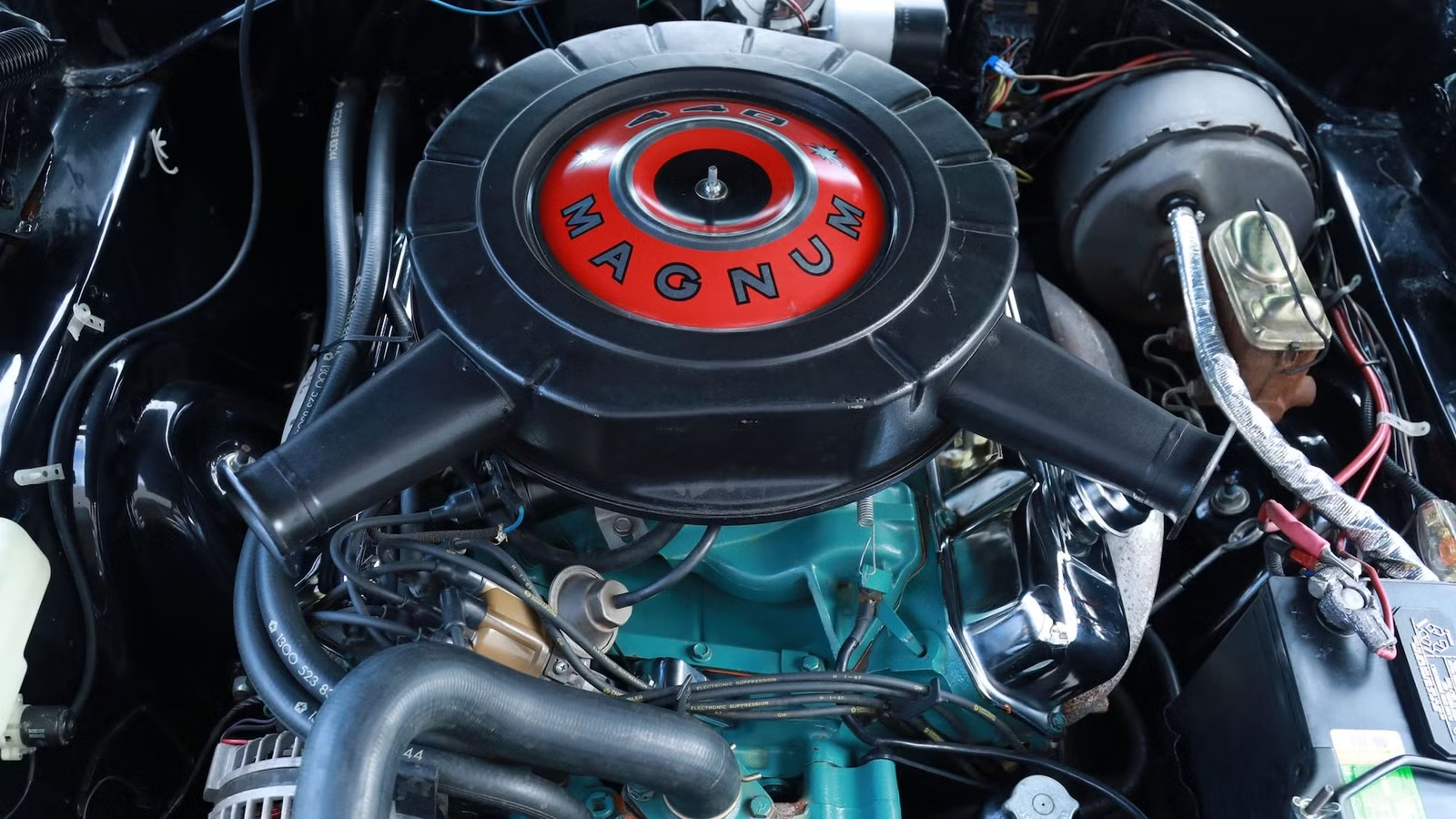
What about the top end? One of the most desirable Coronets around, a sharp 1967 R/T hardtop (pictured) with a 440 Magnum V8 that spent roughly four decades in one family, appeared on Bring a Trailer in April 2026. It was bid up to just $30,000, but didn’t meet the seller’s reserve. For a Dodge Charger in that condition, you’d have to add a “1” before the winning bid.
The Dodge Charger Borrowed Its Best Hardware From The Coronet

The 1966 Dodge Charger turned heads with its futuristic fastback body, electroluminescent gauges, and four-seat interior defined by a full-length center console. But mechanically, it leaned heavily on the Coronet’s 117-inch B-body underpinnings. You could order both with the same 325-hp four-barrel 383 or the all-new 425-hp Street Hemi. The transmissions, rear-drive layout, and much of the supporting hardware came from the same Mopar parts bin.
By 1967 and 1968, the overlap was even harder to ignore. The Coronet R/T made the 375-hp, 480-lb-ft 440 Magnum standard and offered the 425-hp, 490-lb-ft 426 Hemi as an upsell. For 1968, Dodge used that same R/T badge on the redesigned second-generation Charger: 440 Magnum was standard, Hemi optional, with heavy-duty suspension, brakes, transmissions, and driveline hardware designed to survive the torque. The famous Charger never had a monopoly on Dodge’s best big-block ingredients.
The Coronet Was The Average Joe’s Muscle Car

By 1955, the Coronet had become Dodge’s entry-level full-size, and its 1965 revival turned it into a broad, mainstream B-body family of body styles. Depending on year and trim, you could buy two-doors, four-doors, convertibles, and wagons; by 1968, even the Coronet 500 trim could be had as a hardtop, convertible, four-door sedan, or station wagon. If your dream is a classic Mopar with big-block potential, you can widen the search further. Plymouth’s Belvedere and Satellite shared the B-body ecosystem and make natural cross-shops, while even Chrysler built 375-hp big-block sleepers for buyers who like their horsepower hidden by leather and chrome.
Classic Industries estimates Dodge built 250,842 Coronets in 1966 and another 179,583 in 1967. Compare that with 37,344 and 15,788 first-generation Chargers, respectively. That’s good news if you worry the muscle-car market has locked every interesting V8 behind a velvet rope. The best-known cars may cost serious money now, but real V8 muscle cars are still turning up at project-car prices. You just have to know which badges to search for.
Sources: Sources: Stellantis, Over-Drive Magazine, Classic.com, Craigslist, Bring a Trailer,

Related posts


Latest Post


No Comments