
The Last Mainstream SUV Still Riding On A Solid Front Axle
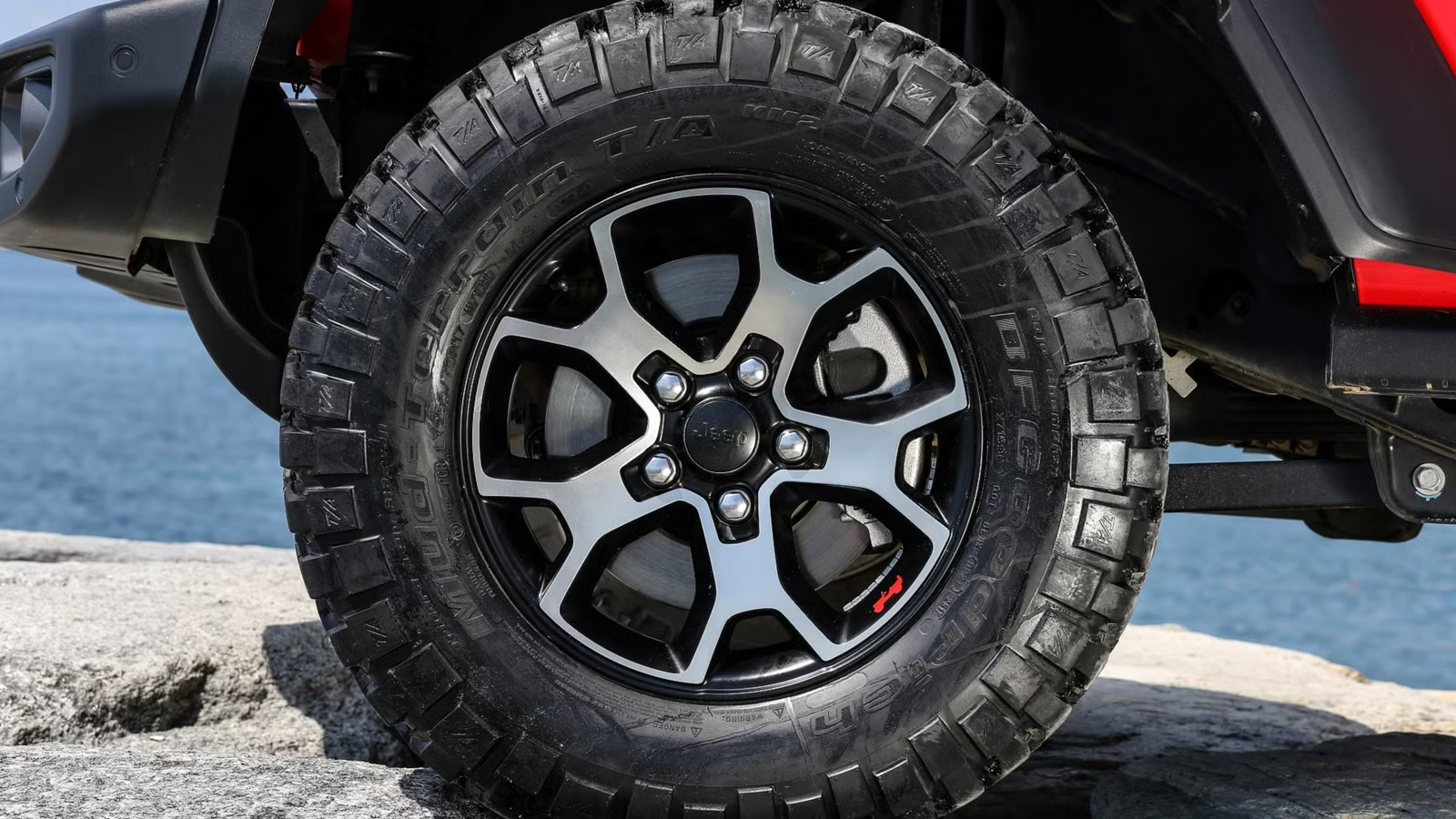
Most new SUVs have spent years sanding away the rough edges that once defined serious four-wheel-drives. Their suspensions isolate bumps, their steering feels tighter, and their front wheels no longer have to agree on what the trail looks like. One stubborn design has survived that cleanup, though—it adds weight, less-polished road manners, and an architecture engineers largely abandoned decades ago. But on rocks, that supposedly outdated hardware can still do something modern suspension struggles to copy.
Solid Front Axles Disappeared For Some Very Good Reasons

A solid axle ties the left and right wheels together through one rigid housing. The differential, axle tubes, shafts, steering knuckles, and much of the hardware all move as the wheels move. That arrangement is wonderfully tough, but it also creates a lot of unsprung weight—mass that the springs do not fully isolate from the road. When one tire smacks a pothole, a large chunk of metal has to react with it. Independent front suspension, or IFS, moves far less hardware at each wheel and usually mounts the front differential to the chassis.
That difference matters long before an SUV reaches a trail. Less unsprung mass lets the tire follow fast bumps more easily while the body stays calmer. Since each front wheel can move without dragging the other through the same motion, engineers gain more control over camber, steering geometry, and damping. The payoff usually appears as a smoother ride, more exact steering, greater stability at highway speed, and better control when rough terrain arrives quickly rather than one rock at a time.
IFS also makes rack-and-pinion steering a natural fit. The rack can sit across the chassis and send short tie rods toward independently moving knuckles. A solid axle complicates that packaging because the whole axle travels beneath the vehicle, which helps explain why traditional designs often stick with steering boxes and linkages.

On The Rocks, Old-School Hardware Still Has A Trick Modern SUVs Want

Slow everything down to walking pace, point the nose at a boulder field, and the argument changes. When one wheel climbs and compresses, the rigid axle housing rotates with it and allows the other side to move the opposite way relative to the body. That helps keep the lower tire pressing toward the ground instead of hanging uselessly in the air. More tire contact means more chances to turn engine torque into forward motion rather than an expensive little cloud of dust.
The design also suits the sort of people who regard a brand-new SUV as an unfinished project. Solid axles are strong, mechanically straightforward, easy to understand, and friendly to suspension lifts and oversized tires. Axle housings can take abuse, gear ratios can be changed, lockers can live inside them, and decades of aftermarket knowledge already exists. Keep in mind a suspension lift raises the body but does not magically raise the differential housing farther from the rocks – taller tires do that. Physics remains annoyingly resistant to catalog photography.

Conventional IFS creates a different puzzle. More wheel travel demands longer control arms and half-shafts, while CV joints still need to operate within sensible angles. Raise the vehicle too far, and those joints, tie rods, and control-arm geometry begin to send the bill. Yet IFS has become much better at stealing the solid axle’s best party trick. Long arms, sophisticated dampers, locking differentials, and disconnecting anti-roll bars now let independent suspensions flex far more than old-school SUVs ever could.
The 2026 Jeep Wrangler Is The Last Mainstream SUV With A Solid Front Axle

The 2026 Jeep Wrangler is currently the only mainstream U.S.-market passenger SUV that still commits to solid axles at both ends. Why “mainstream”? Because the Ineos Grenadier also uses solid beam axles front and rear, but it occupies a much smaller, more specialized corner of the market. The Wrangler remains the familiar showroom SUV with two doors or four, removable body panels, a nationwide dealer network, and a suspension layout that looks almost rebellious beside a Bronco, 4Runner, G-Class, or most other modern rivals.
That hardware makes more sense when the rest of a Rubicon is viewed as one system. Its Rock-Trac transfer case has a 4:1 low range. With the six-speed manual and available 4.88:1 axle gearing, Jeep says a Rubicon can reach a 100:1 crawl ratio. In plain English, the gearing can turn the engine many times while the tires creep forward once, giving the driver very fine control and heavy torque multiplication at low speed. Rubicon models also get front and rear Tru-Lok locking differentials and an electronic front sway-bar disconnect that lets the front suspension compress and droop more freely at low off-road speeds.

The body geometry follows the same logic. Jeep claims an available 47.4-degree approach angle on four-door 2026 Wranglers with the right equipment, along with a breakover angle as high as 32.4 degrees on two-door versions. An approach angle does not prove the superiority of a solid axle; it mainly tells how steep an obstacle the nose can meet before the bumper becomes an accidental shovel. Still, it shows where Jeep spends its engineering currency – the Wrangler is built around clearing ledges, keeping vulnerable parts out of trouble, multiplying torque, unlocking both differentials, and allowing its axles to twist through uneven terrain.

The axle has therefore become more than mere hardware. It is part of the Wrangler’s character in the same way a manual gearbox can be part of a sports car’s appeal even when an automatic shifts faster. A committed Wrangler buyer is purchasing capability, but also a mechanical connection to the machines that built the Jeep legend. Solid axles, a steering box, removable doors, exposed hinges, and a transfer-case lever give the SUV a degree of mechanical stubbornness that most manufacturers engineered out years ago. But Jeep has not simply forgotten to modernize the front suspension – it has modernized around it.
The Ford Bronco Raptor Exposes What The Wrangler Gives Up At Speed

The trouble begins when “off-road” stops meaning crawling. Desert tracks, whoops, washboard roads, jumps, and fast broken ground ask a suspension to do almost the opposite job. Instead of slowly placing a tire over a ledge, the suspension must repeatedly accelerate wheels upward and shove them back down before the next hit arrives. Heavy unsprung parts become harder to control, and coupling the two front wheels becomes less helpful. Independent suspension lets each corner react to its own problem.
The 2026 Ford Bronco Raptor pushes that philosophy hard: Ford gives it HOSS 4.0 independent front suspension, FOX 3.1-inch Live Valve internal-bypass dampers, special control arms, 37-inch tires, and up to 13 inches of front wheel travel. Rear travel reaches 14 inches, while the approach angle sits around 47.2 degrees for the Raptor, only two-tenths behind Jeep’s headline 47.4-degree Wrangler figure.

Ford’s solution is revealing because the Bronco Raptor does not abandon solid axles everywhere – it retains a solid rear axle while using IFS in front. The front wheels have to steer as well as absorb hits, so reducing their coupling and controlling their motion independently brings an especially valuable benefit at speed. The Raptor also carries a front stabilizer-bar disconnect, meaning Ford can loosen the bar for extra articulation when the trail slows and reconnect it when stability matters again. That is the uncomfortable part of the comparison for Jeep – IFS no longer has to surrender every crawling advantage in exchange for better fast-terrain behavior. Electronics and clever hardware keep narrowing the old gap.
Replacing The Solid Axle Could Make The Wrangler Better And Less Like A Wrangler

On a spreadsheet, IFS wins a surprising amount of the argument. It can reduce unsprung mass, sharpen steering, improve ride quality, isolate one wheel’s movement from the other, and give engineers greater freedom to tune high-speed behavior. Modern long-travel systems have also become far stronger and more flexible than the delicate independent suspensions that helped create the old “solid axle or nothing” rule. The Bronco Raptor proves how far the idea can go. Meanwhile, a solid axle answers with fewer moving pieces, proven durability, simple modification, easy accommodation of big tires and gearing, and excellent low-speed articulation. Neither layout owns the entire dirt world.
That balance explains why Jeep’s refusal to follow the market can still make sense. The Wrangler does not need to be the single best SUV for freeway commuting, desert racing, mountain switchbacks, rock crawling, and school pickup duty at the same time. Trying to win every category could turn it into another extremely competent SUV that happens to wear round headlights. Its solid front axle forces compromises, but those compromises support a package built around lockers, low gearing, a disconnecting sway bar, favorable body clearances, and an enormous modification industry. Even the Wrangler’s steering choice tells the very same story: the 2026 model still uses recirculating-ball hardware while rivals pair IFS with rack-and-pinion systems. That is not an accident.

The danger is that the competition keeps learning. A Bronco can disconnect its sway bar and crawl, then reconnect it and use independent front suspension to attack rough terrain at speed. Extreme IFS conversions show how far travel can grow when cost, complexity, and factory packaging stop setting the rules. The Wrangler’s solid axle therefore looks heroic from one direction and limiting from another—it survives because Jeep accepts that the vehicle will be worse at some jobs so it can remain unusually good—and unusually recognizable—at one particular kind of hard off-roading. The solid front axle is both the Wrangler’s constraint and one of its clearest reasons for existing.
Source: Jeep, Ford, Ineos

Related posts


Latest Post


No Comments