
The Forgotten 197-Pound Motocrosser That Outmuscled The 1974 Honda Elsinore
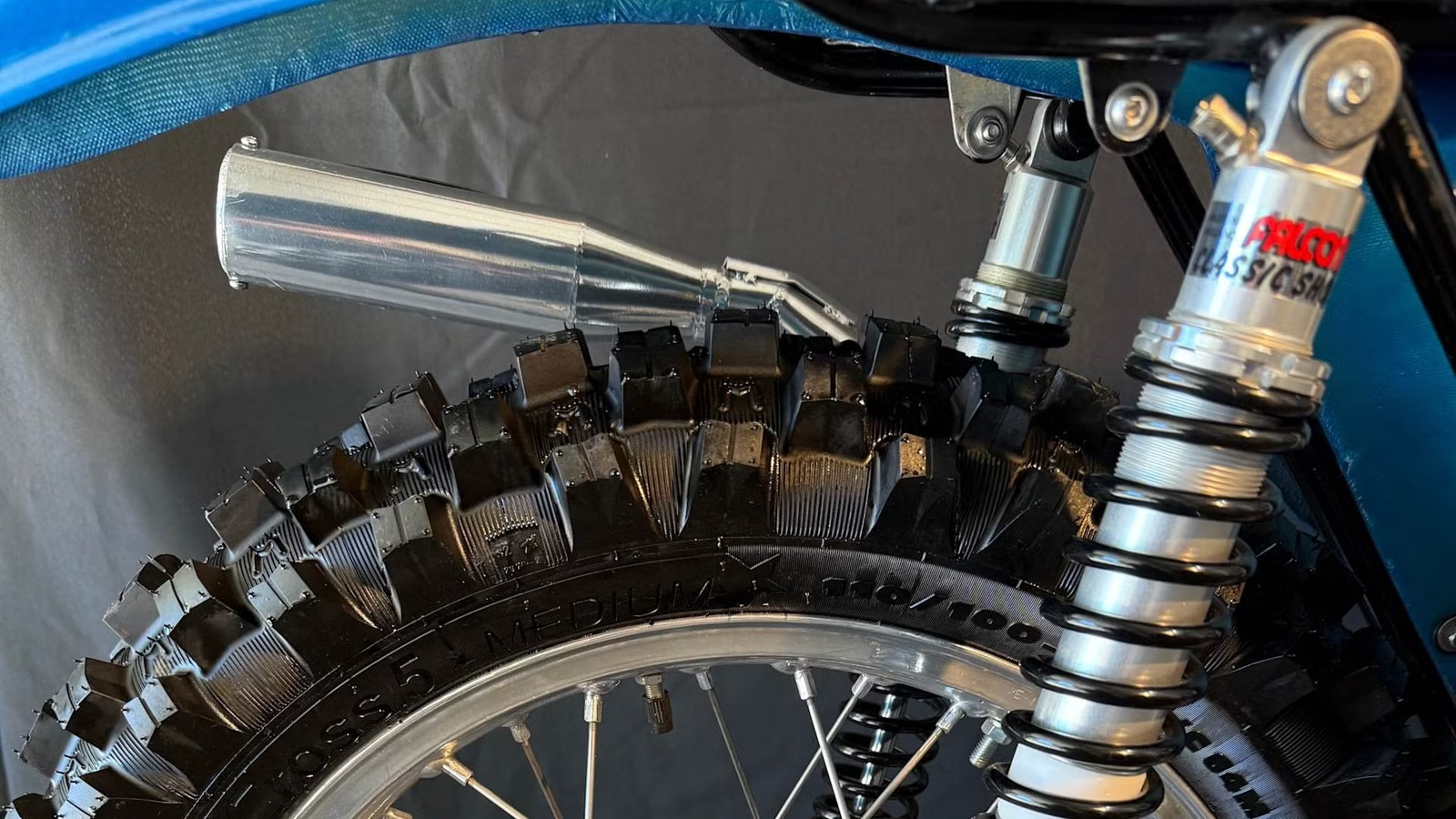
By the mid 1970s, motocross manufacturers around the world were locked in a brutal battle to build the lightest motorcycle. One dark horse company, founded to build movie projectors of all things, pivoted to motocross because of a recent tragedy. In a historic alchemy of clever engineering, a philosophy of sacrifice, and perhaps some beginner’s luck, it won the weight war. Then it disappeared forever. Its forgotten motocrosser is widely regarded as the first 250 cc to break the 200-pound barrier.
The Lightweight Motocrossers Of The 1970s

Honda’s 1973-1976 Elsinore was the lightweight motorcycle to beat. The 1974 CR250M Elsinore weighed about 214 pounds dry. At 28 horsepower, its 247.8 cc two-stroke single cylinder was no slouch.
At the same time, Yamaha was taking a slightly different approach. Its 1974 Yamaha YZ250 weighed in a bit above the Elsinore: roughly 220 pounds dry. But its 246 cc two-stroke made up for it with 33.5 horsepower. Meanwhile, the Suzuki TM250 lagged a bit behind its competitors’ power-to-weight ratio. In 1974, it tied the Yamaha’s 220-pound weight but with an output that was 27-31 horsepower, depending on the market.

European motocrossers weren’t far behind the Japanese machines. The 1974 Husqvarna CR250 made approximately 30 horsepower and weighed in at 220-230 pounds, depending on how it was specced. Representing Germany, the Maico 250 GP landed in the middle of the market, with a 220-pound dry weight and 30 horsepower output.

No one expected a brand new company from Spain to steal the crown. But it did.
OSSA’s Long Strange Road To Motocross

In 1924, Manuel Giró of Barcelona founded Orpheo Sincronic Sociedad Anónima to build 34 mm movie projectors. The four-armed emblem that often appeared in the middle of the “O” may have looked like a clover, but it was actually the escapement device for a projector.
Giró did well enough in the film business to fund his own motorcycle racing career. He won the Spanish sidecar racing national championship with co-pilot Francisco “Paco” Bultó. (Interestingly, Bultó would go on to work for Montesa motorcycles and then leave to found Bultaco motorcycles).
After WWII, technology developed by German automakers such as DKW spread throughout Europe. Giró snapped up cutting-edge two-stroke engine technology in 1949. He knew exactly what to build with it: motorcycles.

OSSA eventually fielded a factory race team. The competition’s Grand Prix motorcycles already had large engines that made more horsepower than OSSA’s 249 cc single-cylinder two-stroke. Manuel Giró’s son, Eduardo, engineered a magnesium and aluminum monocoque motorcycle that weighed 44 pounds less than the competitors. By 1965, OSSA’s factory team was a major competitor. In 1967, it swept first and second place at the 4 Hours of Montjuich on the streets of Barcelona and won the 250 cc Spanish national championship in both 1967 and 1968. Then, in 1970, factory driver Santiago Herrero died at the Isle of Man TT. The factory team immediately withdrew from road racing altogether.
OSSA pivoted to off-road racing instead. British rider Mick Andrews helped the company design a trials bike to take full advantage of its powerful and lightweight 249 cc two-stroke. He won the European Trials Championship in 1971 and 1972. In 1973, OSSA finally announced a publicly available version of the off-road bike for the 1974 model year.
The OSSA Phantom Was A 197-Pound Motocrosser

The 1974 OSSA Phantom’s most revolutionary stat was its weight. Cycle World’s test bike weighed in at 197 pounds without gasoline or oil. With oil and a half tank of fuel, it came to 206.2 pounds. Its front/rear weight bias was 44.8%/55.2%. But unlike the Elsinore, the Phantom didn’t give up an ounce of horsepower to undercut its competitors’ curb weights.
OSSA claimed the bike would make 33 horsepower. Reviewers found it made 29.77 bhp at 9,000 rpm and 18.15 lb-ft at 7,500. Either way, the Phantom’s real-world power-to-weight ratio beat out every competitor’s claimed ratio.

Reviewers also found that the bike pulled well at low rpm and was a joy on forest trails, even at low speeds. But crank the throttle, and it could pull a wheelie in fifth gear. It was also a capable high-speed race bike, though its steering was a bit advanced. In fact, with the short wheelbase, it responded so quickly it felt like “riding an overpowered 125.”
The Phantom Was Weighed Down By Compromises

There may have been a reason competitors all weighed more than the OSSA Phantom. The company needed to make many sacrifices to hit its target. For example, the motocrosser’s foot pegs weren’t even spring-loaded. Instead, a nut and bolt torqued them just tight enough that after they were inevitably knocked up while cornering, the rider was supposed to be able to kick them back into place.
The number plates were integrated into the airbox and could get rubbed raw by the rider’s boots. And the kickstarter pivot point did have a spring, but it was so weak that the lever could swing out while riding, threatening to gash a leg you put down in a corner.

What about that chromoly frame and aluminum swing arm combo? Suffice it to say that it appears OSSA deleted the aluminum swingarms partway through the very first model year in favor of a traditional steel unit.
Finally, the OSSA sacrificed its MSRP for all those lightweight materials. In 1974, it would set you back $1,375. That was actually less than some European competitors and the race-ready Yamaha YZ250. But the Suzuki TM250L Champion started around $1,200, and the featherweight Honda Elsinore boasted an MSRP of $1,145.
Spanish Labor Strikes And Japanese Pricing Killed The Brand That Got There First

OSSA was never able to gain a foothold in the lucrative American market, thanks to its nearly nonexistent dealership and maintenance network. Things weren’t much better at home: As Spain’s Franco Era ended and its markets opened, the deluge of cheap Japanese motorcycles killed domestic manufacturers. A 1977 labor strike sped up the company’s decline, but its fate was already written.
While modern 125 cc bikes often weigh in under 200 pounds, manufacturers never again pursued a production 250 cc motocrosser with the Phantom’s obsession with minimum weight. Instead, they upped the output of their 220-pound 250 cc bikes, and eventually four-stroke engines took over motocross. The OSSA Phantom stands as an unrivaled feat of engineering, even today.
Source: Cycle World

Related posts




Latest Post


No Comments