
The Forgotten 150-HP Turbo Buick That Previewed The Grand National
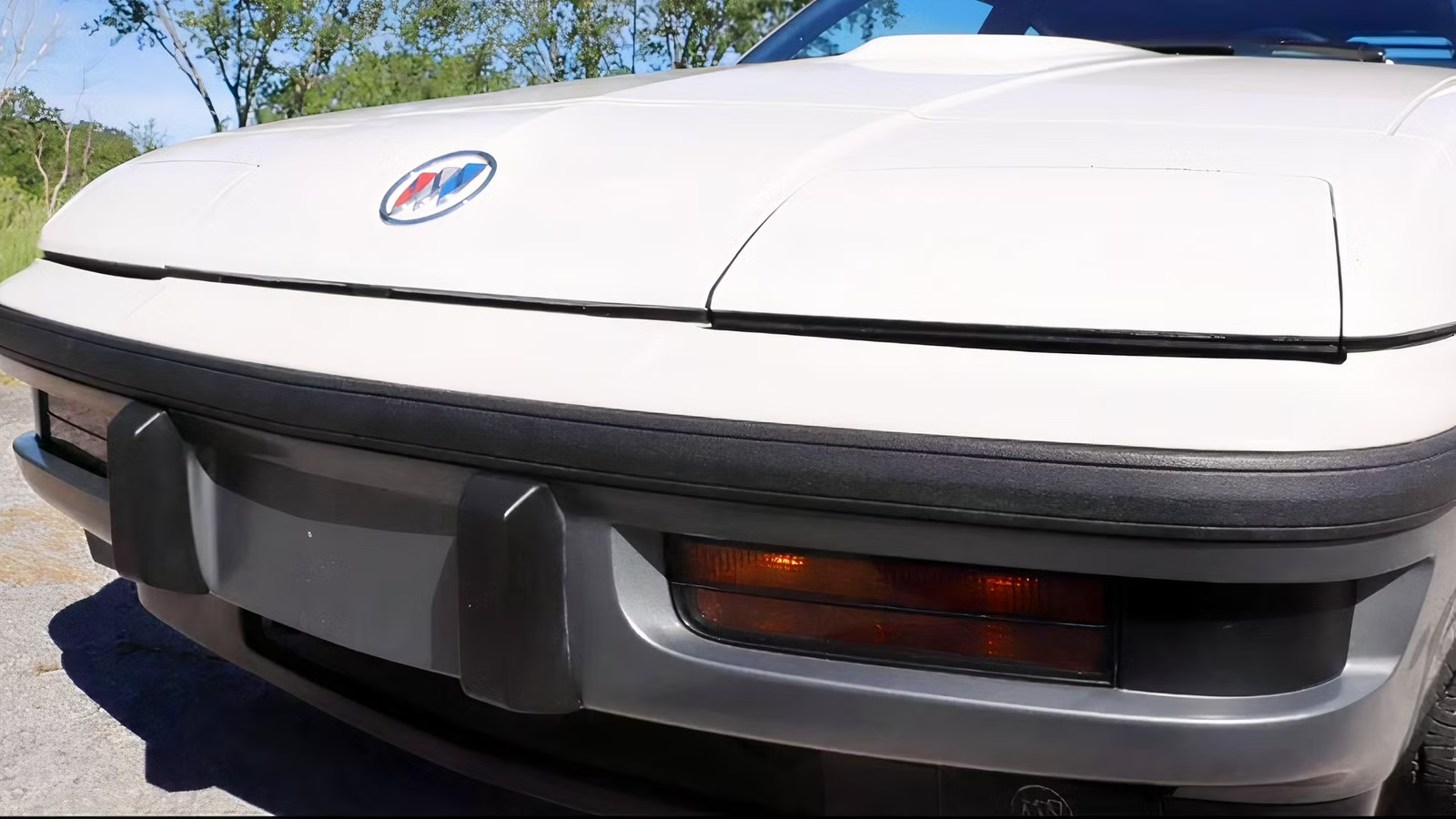
The history of turbocharged Buicks usually begins and ends with the Grand National. Well, that’s assuming you don’t count a gaggle of rebadged Opels in the 2010s, and we certainly don’t. The thing is, that line of thinking really doesn’t hold up to scrutiny when you take more than a cursory look at the pages of history. There, you’ll find at least one other turbo Buick from the mid-1980s, and it was nothing at all like the flagship Grand National in looks, or performance either. Still, it was quite the automotive curiosity, as you’ll soon find.
Buick in the 80s: A Brand in Search of a New Identity

Buick as a brand was in a pretty unenviable spot as the ‘70s became the 1980s. Early in the previous decade, Buick was forced to relinquish what made it and so many other American brands so special in years prior, as emissions regulations and a global oil crisis brought the muscle car era to an abrupt, pitiful end. Buick’s own line of V8s, the defining feature of icons like the GSX and Gran Sport 455, managed to survive in a neutered state, choked by catalytic converters and other restrictive hardware, until 1981.
From there, Buick had to make hard choices regarding the future of its brand. It could keep marketing watered-down land-barge cruisers with sloppy handling and couches for seats until Honda and Toyota wiped them off the face of the Earth, or it could provide an alternative to German and Japanese imports from an American perspective. In the end, Buick wound up doing a little bit of both. Iconic nameplates like the LeSabre and the Electra stuck around, often using engines from other GM brands like Oldsmobile and Chevrolet. In some cases, they even carried the iconically awful Oldsmobile 350-cubic-inch diesel V8.
Buick also pivoted around the same time to smaller compact models with comparatively tiny footprints. From this philosophy came the GM J platform. Unveiled in 1981, the J platform was aimed squarely at the Honda Accords and Volkswagen Golfs, as well as the menace that was the Toyota Camry, soon to come in 1983. It was compact, lightweight, and capable of being marketed across the world under GM’s North American as well as European brands. Chevy and Cadillac in the US, Vauxhall in the UK, Opel in Continental Europe, and Holden in Australia, all used the J platform to varying success. On the one hand, you had the Chevy Cavalier, and on the other, well, you had the Cadillac Cimarron. Still, Buick took its own approach to the J platform.

A Different Kind of Buick From the Norm

In truth, the story of the Buick Skyhawk predates the J platform. Introduced in 1975, the first-generation Skyhawk used the same H-body underpinnings as the Oldsmobile Starfire, Pontiac Sunbird, and the much-maligned Chevy Vega. It was Buick’s first proper attempt at a downsized hatchback, offered with rear-wheel drive and a 3.8-liter V6. Marketed ostensibly as a rival to the Ford Mustang II, the original Skyhawks had a secondary function of competing with cars like the Toyota Celica and Datsun 200SX as well. There were even special editions with exciting names like “Road Hawk,” which sounds like the title of a ‘70s action movie.
Paired with a five-speed manual gearbox instead of the ubiquitous three-speed automatic, the Gen-I Skyhawk really was a true-to-form sports car. Albeit not a very fast one by any means, with a zero-to-60 sprint of around 12 seconds. The first-generation Skyhawk left production in 1979, giving Buick roughly three years and change to turn it into something more in line with a modern compact economy car. Certainly, given how slow the Gen-I rear-drive Skyhawk was, this was a role far better suited for it.

Hitting dealer lots in 1981, the J platform Skyhawk was a direct response to a struggling American economy and a second oil crisis in a decade. It was front-wheel-drive with a transverse engine layout, launching with a 1.8-liter four-cylinder pushrod engine with all of 88 horsepower to its name. This equaled a zero-to-60 run of 16-plus seconds and the quarter mile time in the 20s. Granted, fuel economy was impressive, exceeding 30 MPGs with a light right foot. Yet, somehow, GM reckoned it could squeeze at least a little bit of performance into the Skyhawk platform. When they did, they inadvertently alpha-tested the basic formula for the Grand National.
1984 Skyhawk T-Type: A Little American Turbo Rocket

As it turned out, the humble Gen-II Skyhawk did have some latent sporting credentials. The key to unlocking it came from Brazil, where GM had been manufacturing a 1.8-liter, overhead-cam four-cylinder engine with multi-port fuel injection and a single Garrett turbocharger. Originally designed for Opel in Germany and built at GM’s plant in São José dos Campos, the engine, dubbed the LA5 in the US, packed multi-port fuel injection and a slightly lower 8:1 compression ratio to handle that added boost pressure.
Shoved under the hood of a Skyhawk and dubbed the T-Type, the LA5 made 150 horsepower, or a roughly 70 percent improvement over the base engine it launched with in 1981. These days, that kind of power bump from one engine to another in a singular model is almost unheard of. In the case of the Skyhawk T-Type, it meant performance was considerably less pathetic. We’re talking about a zero-to-60 run in roughly 8.5 seconds and a quarter-mile done in the mid-16s. It wasn’t exactly quick, per se, but by the standards of the day, the Skyhawk T-Type was almost like a Civic Si or Type R before either was a gleam in Honda’s eye.

Other features included sportier suspension with a stiffer anti-roll bar and quick-ratio steering rack, bucket seats, and a fully functional boost pressure gauge in the cockpit. In the early ‘80s, the Skyhawk T-Type was perhaps the only performance product from Buick even remotely worth talking about. Honestly, it might be the only performance car from Buick during this time, full stop. Ultimately, the Skyhawk T-Type was a blip on the radar, selling just over 11,300 units in its sporty two-door coupe layout. The rest were family-hauling sedans and station wagons that did not feature the turbo engine.
Setting the Scene for an Icon

If, like Kendrick Lamar, all you’ve ever wanted was a black Grand National, consider that it would’ve likely never seen the light of day had it not been from lessons learned from the Skyhawk T-Type. It was a limited trial run to see if Buick’s customer base was even interested in a non-traditional turbocharged four-cylinder engine in lieu of a normal V8. As it turned out, the answer was a resounding yes. Granted, the rest of the J-body line was pretty uninspired, even if the Cavalier once sold in the hundreds of thousands.
In 2026, a running and driving Skyhawk T-Type is nothing short of a rarity. But because almost nobody outside of people who drove them new has ever heard of them, they routinely wind up on websites like Bring a Trailer for measly four-figure sales prices. For the proverbial alpha build of a Grand National, that’s a remarkable deal.
Source: Hemmings, Bring a Trailer, Buick

Related posts

Latest Post


No Comments