
The Japanese Sport Bike That Still Understands What Riders Actually Want
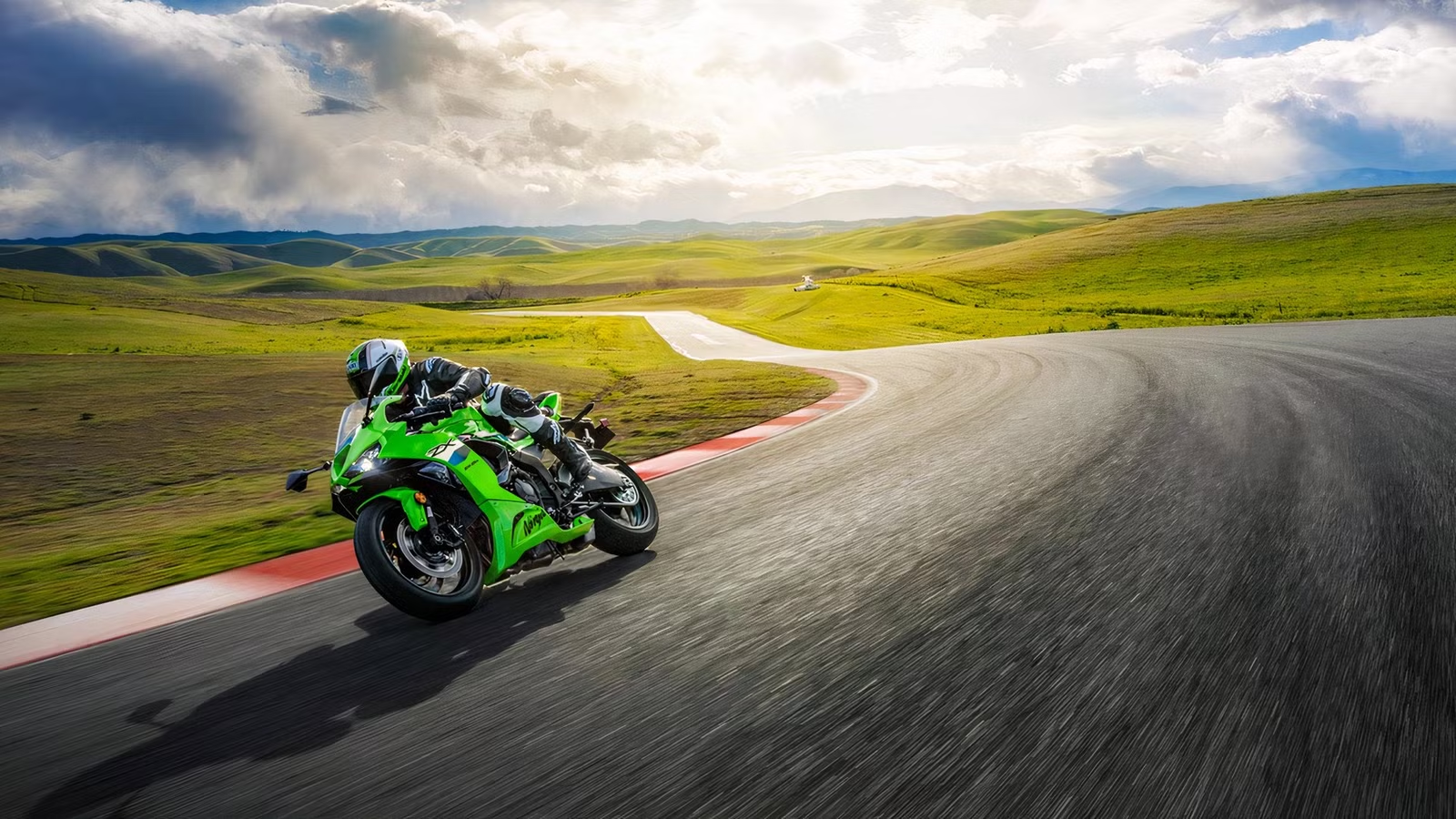
Sport bikes have long held a clichéd place in motorcycling. They promise extraordinary performance wrapped in stylish designs and interwoven with so much technology that it makes your head spin. But the best machines are not necessarily the ones with the biggest numbers. Weight, engine character, feedback, and the ability to use meaningful amounts of performance on real roads can matter just as much. Modern electronics have also changed rider expectations, bringing sophisticated rider aids and sharper chassis technology into increasingly accessible packages. The basic appeal, though, remains the same.
Why Middleweight Sport Bikes Still Matter

The traditional supersport formula once seemed almost untouchable. A 600cc four-cylinder engine, an aluminum chassis, serious suspension, and track-focused ergonomics created motorcycles that could deliver astonishing performance without reaching superbike levels of intimidation. Machines such as the Honda CBR600RR helped define that recipe, while Yamaha’s YZF-R6 became one of the most recognizable names in the class.

But the segment has changed: emissions regulations, development costs, and shifting customer preferences have made pure 600cc supersports harder to justify. Some manufacturers have moved toward parallel-twin alternatives, with motorcycles such as the Aprilia RS 660 and the Yamaha YZF-R7 emphasizing accessible performance and road usability. They are excellent examples of how the middleweight sport-bike category has evolved.
Bigger Numbers May Not Always Be Better

An easy assumption to make is that moving up to a larger engine automatically makes a motorcycle desirable. In practice, it can make a sport bike less usable on ordinary roads. Superbikes are phenomenally capable, but their performance envelope is so broad that riders often have to work harder to experience what the motorcycle has been designed to deliver.

This is where middleweights remain compelling. A motorcycle with roughly 600 to 700cc can be fast enough to feel serious while staying compact enough to exploit its handling on public roads. The engine can be worked harder, the chassis can be enjoyed, and the motorcycle can retain some of the mechanical involvement that made older sport bikes so appealing.
The Kawasaki ZX-6R Is Still Playing The Right Game

We chose the Kawasaki ZX-6R because it represents a rare idea: a middleweight sport bike that has not forgotten why riders liked middleweights in the first place. Rather than abandoning the traditional supersport formula, Kawasaki refined it, combining a 636cc engine with adjustable suspension, good braking power, a lightweight frame, and modern electronics. Basically, everything that’s required to go faster than a supersport could decades ago. There is no disguising its sporting intentions, but Kawasaki’s engineering has also made sure that the ZX-6R still manages useful road manners when necessary.
The 636cc Engine Is The ZX-6R’s Defining Feature

The defining feature of the Kawasaki ZX-6R is sitting right between the rider’s knees. The 636cc inline-four uses DOHC and 16 valves to produce 127 horsepower at 13,000 rpm and 52.1 pound-feet of torque at 10,800 rpm. These figures explain exactly why the 6R feels so different from many of the other middleweight alternatives. Aside from being the most powerful Japanese middleweight, the engine is designed to keep pulling as the revs rise, rewarding riders who have the stones to explore that upper part of the tacho.

Now, high revs are ingrained into the engine, but lower down in the rev range, there is a sense of refinement that is characteristic of Kawasaki motorcycles. Aside from this, the company has also used four 38mm Keihin throttle bodies, electronic ignition, and a six-speed transmission to manage engine output. It’s a combination that gives the ZX-6R a sort of layered personality, allowing you to cruise around town, twist around mountain passes, and assert dominance at a track.
The Chassis Is Designed Around Rider Confidence

The ZX-6R’s chassis is every bit as serious as its engine. Up front is a 41mm Showa Suspension Separate Function Big Piston Fork, with rebound and compression damping as well as spring preload adjustment. The rear gets a Uni-Trak linkage system with a single shock offering adjustable compression damping, rebound damping, and spring preload. Travel is 4.7 inches at the front and 5.9 inches at the rear. Keep in mind, these shock absorbers are tuned stiff for sport use, but they offer a little grace for normal street use as well.

To further emphasize its sporty intent, the ZX-6R gets an aluminum perimeter frame with a 55.1-inch wheelbase, a 23.5-degree rake, and a 4-inch trail. Braking duties are handled by dual semi-floating 310mm discs with radial-mounted four-piston monobloc calipers at the front, and a 220mm disc and a single-piston caliper at the rear. Kawasaki lists a curb weight of 432.2 pounds for the non-ABS 50-state model and 436.6 pounds for the ABS 50-state model.
True Ninja Styling Topped With Modern Electronics

You don’t really need an explanation when it comes to the ZX-6R’s styling. The bodywork immediately identifies it as a Ninja, with a sharp front end and side cowls. The windscreen is compact, too, and the silhouette is undoubtedly that of a supersport. The company has also got with the times and given the ZX all-LED lighting and a blacked-out engine. The dimensions are compact, too.

The ZX-6R’s armor comes from its electronics. It is thoroughly modern and fairly focused on the bike’s intent. There is Kawasaki Traction Control that offers three levels of assistance on the track, and Full and Low power modes. Four integrated riding modes combine these settings into Sport, Road, Rain, and Rider-Adjustable Manual configurations, which allow you to tailor your ride to your preference. There is a 4.3-inch full-color TFT dash for information and smartphone connectivity via Kawasaki’s app for convenience on the streets. The electronics are actually what tempers the bike nicely, allowing for comfortable cruising, but face-melting acceleration when you want it.
The Kawasaki ZX-6R’s Details Make The Difference
Price Starts At $11,599

The ZX-6R gets a 4.5-gallon fuel tank, which offers a somewhat practical range. The 32.7-inch seat is neither too low nor too high, so it’s within reach for the majority of riders. Kawasaki offers the ZX-6R at $11,599 for the non-ABS version and $12,599 for the ABS version, in four paint schemes. The pricing also places it in an interesting place. It isn’t cheap in an entry-level sort of way, but it still provides a substantial amount of engine and some serious cycle parts that reward spirited riding.
Source: Kawasaki

Related posts


Latest Post


No Comments