
Lexus’ Biggest Success Story In 2026 Isn’t A Hybrid
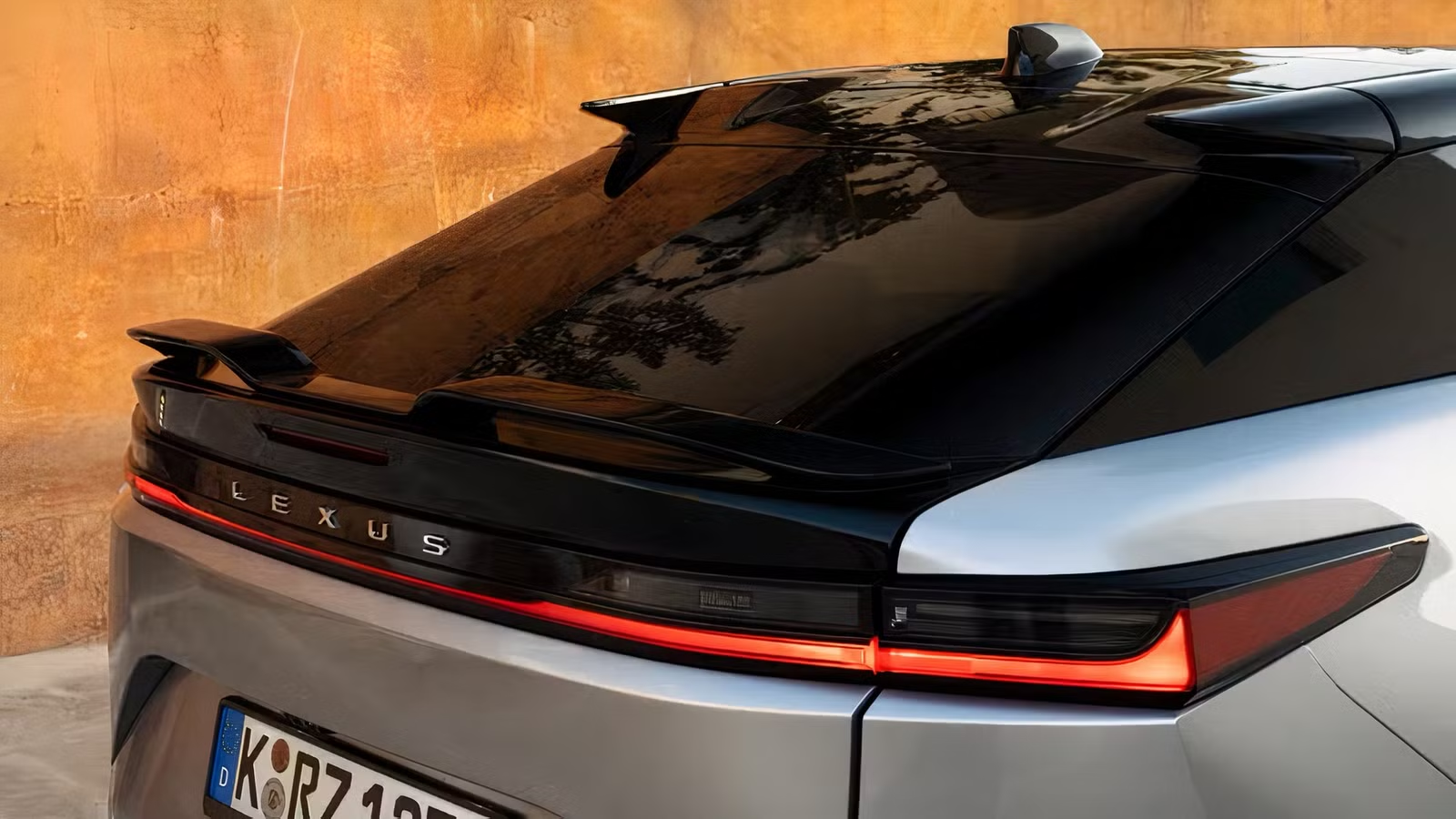
For many people, Lexus doesn’t seem to get a lot wrong. Some models are affordably priced; they tend to have calm, luxurious interiors, the technology is top of the line, and they are exceptionally reliable, both in the mainstream market and the luxury one. Some of their most popular models are their SUVs and crossovers.

Models like the UX, the NX, the RX, and the GX cater to everyone from family drivers to luxury off-roaders, and it is Lexus’ hybrid SUVs that are the most celebrated on the market, with a fine blend of efficient powertrains and versatile builds. That’s why it may surprise you that, so far in 2026, it is an electric Lexus model that is selling the fastest.
Hybrids Still Sit At The Heart Of Lexus’ Success
Lexus may be broadening its horizons with battery-electric models, but hybrids remain the backbone of the brand’s success. Long before electrification became an industry buzzword, Lexus was refining hybrid systems that deliver genuine fuel savings without asking drivers to change the way they drive. Lexus’ formula still works very well today.

Whether it’s the compact UX Hybrid, the family-focused NX 350h, the hugely popular RX 350h, or the three-row TX 500h, buyers choose these Lexus models thanks to their combination of performance and refinement, and unlike many luxury rivals that have rapidly shifted focus toward full EVs, Lexus has taken a far more measured approach.

Instead of forcing buyers toward a single technology, Lexus has continued to expand its hybrid lineup across almost every segment. That means there is a choice for urban commuters, long-distance drivers, and luxury buyers who want efficiency but aren’t quite convinced by full EVs.
Electrified Models Continue To Power The Brand’s Sales

This strategy continues to work for Lexus. Across the U.S., hybrid versions of Lexus’ most popular SUVs consistently account for a growing share of sales, with models like the NX Hybrid and RX Hybrid increasingly becoming the default choice rather than the premium alternative. Their combination of lower running costs, strong resale values, and Toyota-grade reliability has helped Lexus keep up the pace even as the wider luxury market becomes more competitive.
Performance hybrid variants have also given Lexus a distinctive appeal. Models like the RX 500h F SPORT PERFORMANCE and TX 500h prove that electrification doesn’t have to come at the expense of character, thanks to turbocharged engines with electric assistance that deliver impressive acceleration and fun alongside respectable efficiency. For Lexus, hybrid technology has evolved far beyond simply getting better efficiency.
Battery-Electric Models Have Played A Supporting Role

By comparison, and perhaps surprisingly for some, Lexus’ battery-electric vehicle (BEV) ambitions have been more restrained. Rather than flooding the market with EVs, Lexus has focused on strengthening its hybrid and plug-in hybrid offerings while gradually expanding its electric portfolio. It is a cautious strategy, especially as most other brands are pursuing the former, but it does reflect the reality of today’s luxury market, where charging infrastructure, demand, and owner confidence continue to vary widely.

Even so, Lexus has not stood still. For 2026, its EV lineup is beginning to expand with the introduction of the ES 350e and the ES 500e, giving Lexus its first all-electric luxury sedan in the U.S. market. A larger three-row electric SUV, the Lexus TZ, is also waiting in the wings, and could be signaling that Lexus is finally starting to build a bigger EV lineup.
Despite Lexus’ limited EV range and the popularity of its hybrid models, 2026 is shaping up to be a different kind of year for Lexus, and one of its latest all-electric SUVs is drawing considerable attention away from the hybrids that dominate its sales.
The 2026 Lexus RZ Has Quietly Emerged As The Standout

Despite the wide array of hybrid Lexus vehicles on offer, and the general slowdown in EV sales in the U.S., the 2026 Lexus RZ EV SUV has done what many thought was a difficult task: it is growing in sales at a remarkable rate.
The RZ entered the U.S. market in 2023 and was the first BEV model Lexus offered. There are four trim levels available for this year’s Lexus RZ lineup: the RZ, the Premium, the Luxury, and the F Sport. The 2026 RZ trim lineup and starting prices are as follows.
Triple-Digit Sales Growth Sets It Apart From The Rest Of The Lineup

According to the latest Lexus sales report, 7,184 RZ models have been sold in 2026 year-to-date. That may not sound like a lot, but compared to the 3,779 RZ models sold in 2025 (up to June 2025), this is a significant step up in sales. In fact, that makes for a 106.8 percent increase in sales compared to this time last year.
In June 2025, 763 RZ models were sold, whereas June 2026 saw 1,004 RZ models sold. This again makes for a sizable increase of 31.6 percent in sales volume and a 26.3 percent increase in daily selling rate. In short, the Lexus RZ has grown in sales more than any other Lexus model from 2025 to 2026.
The Electric SUV Is Finally Finding Its Audience

The actual sales numbers are still some way behind those of the Lexus TX Hybrid, which has seen 5,623 models sold year-to-date, and the exceptionally popular Lexus RX Hybrid, which has seen 25,483 models sold in 2026 year-to-date. But in terms of sales growth, even the most popular Lexus models are far behind. For comparison, some of the most popular hybrid Lexus models have the following 2025–2026 sales figures.
|
Model |
2025 Sales (Calendar Year To Date) |
2026 Sales (Calendar Year To Date) |
Volume Increase |
|---|---|---|---|
|
Lexus RX Hybrid |
21,507 |
25,483 |
18.5% |
|
Lexus UX Hybrid |
5,001 |
5,382 |
7.6% |
|
Lexus TX Hybrid |
4,364 |
5,623 |
28.8% |
With federal tax credits for EVs no longer available, it is easy to see why electric vehicle sales have softened. However, there must be something genuinely appealing about the RZ to drive such a surge in sales, and it cannot simply be Lexus’ measured reputation.
What The 2026 Lexus RZ Offers Buyers

The starting price for the base trim of just under $48,000 may not sound particularly affordable, especially when you consider a Toyota bZ has a starting price of around $35,000, and a 2026 Chevrolet Equinox has a similar starting price. Where the RZ stands out, though, is in its Lexus-grade value for money, attention to detail, and useful powertrain options. There are three powertrain setups for the 2026 RZ, with the following specifications.
The RZ 350e is available as the base trim and the Premium trim; the RZ 450e is available as the base trim, Premium trim, and Luxury trim, and the RZ 550e is solely the F Sport trim. 0–60 mph times are impressive, with the FWD RZ 350e getting up to speed in 7.1 seconds, the RZ 450e models doing it in 4.3 to 4.9 seconds (with the quickest sprint times courtesy of the Lexus Performance Badge for an extra $1,750), and the RZ 550e sprinting to 60 mph in as little as 4.1 seconds. However, where the RZ truly delivers is in its combination of impressive battery range and cabin appointments.
Everyday Practicality Meets Premium Comfort

FuelEconomy.gov says the most efficient RZ model is the FWD RZ 350e fitted with 18-inch wheels, which can achieve 126 combined MPGe (136 MPGe city/115 MPGe highway). The RZ 350e with 20-inch wheels can achieve 120 combined MPGe; the RZ 450e with 18-inch wheels can achieve 110 combined MPGe; the RZ 450e with 20-inch wheels, 108 combined MPGe; the Lexus Performance Badge RZ 450e, 95 combined MPGe; and the RZ 550e can achieve the same. Estimated battery ranges and electricity costs are as follows.
Then there is the amount of space you get inside. Lexus says the 2026 RZ has 34.9 cubic feet of space behind the second row, and with the rear seats folded down, a relatively impressive 53 cubic feet. You also get a decent amount of space over both rows, with the following interior dimensions.
The entry-level trim feels properly upmarket, with NuLuxe-trimmed seating, heated front seats, a heated steering wheel, and an eight-way power-adjustable driver’s seat. There is also extensive sound deadening, so highway speeds are not too intrusive. The higher you go, the more genuine luxury you get, with ultrasuede-trimmed seats replacing the synthetic leather ones, ventilated seats becoming standard, and driver’s seats gaining memory settings.
At the top of the range is the RZ 550e F Sport, which gets heavily bolstered sports seats, aluminum pedals, blue interior accents, and unique trim finishes that give the cabin a far sportier yet still plush feel.
Updated Technology Helps It Compete With Luxury EV Rivals

The modern EV market (with some notable exceptions, such as the new American EV startup brand you should be paying attention to) is largely defined by the amount of usable, futuristic-looking technology in the cabin. Here, Lexus has stayed true to form, and instead of overloading the cabin, it has approached the technology in a tactile, considered way.
The centerpiece is Lexus’ latest 14-inch touchscreen, which is standard across the lineup, but unlike some rivals that seem determined to bury every function in endless menus, Lexus has retained a healthy dose of common sense. Frequently used controls are easy to access, the interface is clean and responsive, and the cabin feels like it was designed by people who actually drive cars, rather than software engineers.


Standard equipment is generous: you get wireless Apple CarPlay and Android Auto, a wireless charging pad, multiple USB-C ports, cloud-based navigation, OTA updates, and Lexus’ Intelligent Assistant. If you opt for the Luxury trim, you also get a HUD, a digital rearview mirror, and a panoramic roof.
The RZ 550e F Sport gets the most, though, and it is equipped with paddle shifters for M Mode (which effectively mimics manual gear shifting for a sportier feel, complete with simulated engine noises), configurable ambient lighting, and a 13-speaker Mark Levinson surround sound system.
Why The 2026 Lexus RZ Could Be A Smarter Buy Than Ever

According to owner reviews on Kelley Blue Book, the 2026 Lexus RZ gets an overall rating of 4 out of 5, which includes a value rating of 3.8 out of 5, 4 out of 5 for performance and reliability, 4.7 out of 5 for comfort, and 4.8 out of 5 for styling and quality.
The new RZ does not have the longest range in the segment, and it does not have the most impressive sprint times, but that is typical of many Lexus models. Instead, Lexus models keep the mid-to-high-end ground firmly covered without the flashy gimmicks that will feel dated in a few years. What Lexus has done very well here is in sharpening the RZ, giving it a better driving range, faster charging capability, revised battery and eAxle tech, and a better overall lineup compared to the original RZ.

More importantly, despite being a modern EV SUV, the RZ still plays to Lexus’ traditional strengths. Build quality remains high, cabin refinement is among the best in the class, and the ownership experience appears to carry the same reassurance that Lexus-grade reliability offers.
In an EV market where some premium EVs still feel like rolling beta tests, there is something quite refreshing about buying an electric crossover SUV designed to work properly every day. A recent TopSpeed test drive of the RZ 550e F Sport sums it up nicely: “The styling hit most of the marks, but issues with range, battery size, and charging times may have deterred some potential customers. In fairness, that is usually the case with any new EV, with these markers improving year after year. For 2026, Lexus didn’t make any drastic changes to the RZ, but focused on improving the things that matter by expanding the RZ lineup with more power, better overall efficiencies, and quicker charging times.”
That’s why the new Lexus RZ lineup has become such a success over the last year. Rivals continue chasing bigger batteries, ever-faster charging speeds, and headline-grabbing performance figures, while Lexus has focused on building an EV that feels unmistakably like a Lexus first and an EV second. Judging by its recent sales momentum, that is proving to be a far smarter strategy than many people may have expected.
Sources: Lexus, Kelley Blue Book, and FuelEconomy.gov

Related posts





Latest Post


No Comments