The Japanese Coupe That Delivers Pure Driving Joy Without The Drama
8 minutes reading
Saturday, 1 Aug 2026 21:00 0 91 autotech
We live in an era of absolute sensory overload on the tarmac. If you pick up a modern car magazine or browse an automotive forum, you are bombarded with numbers that sound like they belong in aerospace engineering: 1,000 horsepower, sub-three-second 0–60 mph times, active torque vectoring, and dual-clutch transmissions that shift in milliseconds.
But somewhere along the way, we lost the plot. In the chase for sheer straight-line speed and track-day dominance, the connection between driver and machine has been thoroughly sterilized. The modern sports car has become a high-speed video game where the computer does most of the heavy lifting. If you are tired of the digital isolation, there is an antidote. Deep in the heart of Japan’s car culture, a back-to-basics blueprint was drawn up; a sports car that rejects the modern horsepower arms race in favor of pure, tactile sensation.
Front right three-quarter shot of a white 2022 Dodge Charger SRT HellcatStellantis
Before we even mention a badge, a model name, or a manufacturer, we have to talk about a philosophy. It is an engineering ethos that asks a simple, radical question: What if we stopped trying to build land missiles and focused instead on how a car actually makes a human being feel?
Let’s be completely honest with ourselves: where can you actually use 500 horsepower? On a public road, flooring a modern supercar for more than two seconds means you are either instantly breaking the law or hurtling toward a ditch. Massive power requires massive grip, massive brakes, and heavy electronic nannies just to keep the car on the asphalt.
High-horsepower cars have become “point-and-shoot” weapons. They are astonishingly fast, but they make the driver feel like a passenger. The true joy of driving isn’t just surviving a burst of straight-line acceleration; it’s the work you put in to carry momentum through a tight corner, managing weight transfer, and feeling the car work beneath you.
Prioritizing Weight And Balance Over Raw Speed
A 2021 Mazda MX-5 Miata RF going around the trackIsaac Atienza | TopSpeed
The vehicle we are talking about operates on a different plane of existence. Its design began not with a target horsepower figure, but with a weight limit and a tape measure. By keeping the curb weight well under 2,800 pounds, the designers bypassed the need for heavy, complex components.
When a car is light, everything changes. The suspension doesn’t have to be rock-hard to control body roll, meaning you get a more compliant ride. The brakes don’t need to be massive, expensive carbon-ceramics to shed speed. With a classic front-engine, rear-wheel-drive layout and an ultra-low center of gravity, this coupe prioritizes balance above all else, ensuring that the chassis rotates naturally around the driver’s hips.
The Toyota GT86: A Modern Legend Born
Front three-quarter view of a white Toyota GT86 convertibleToyota
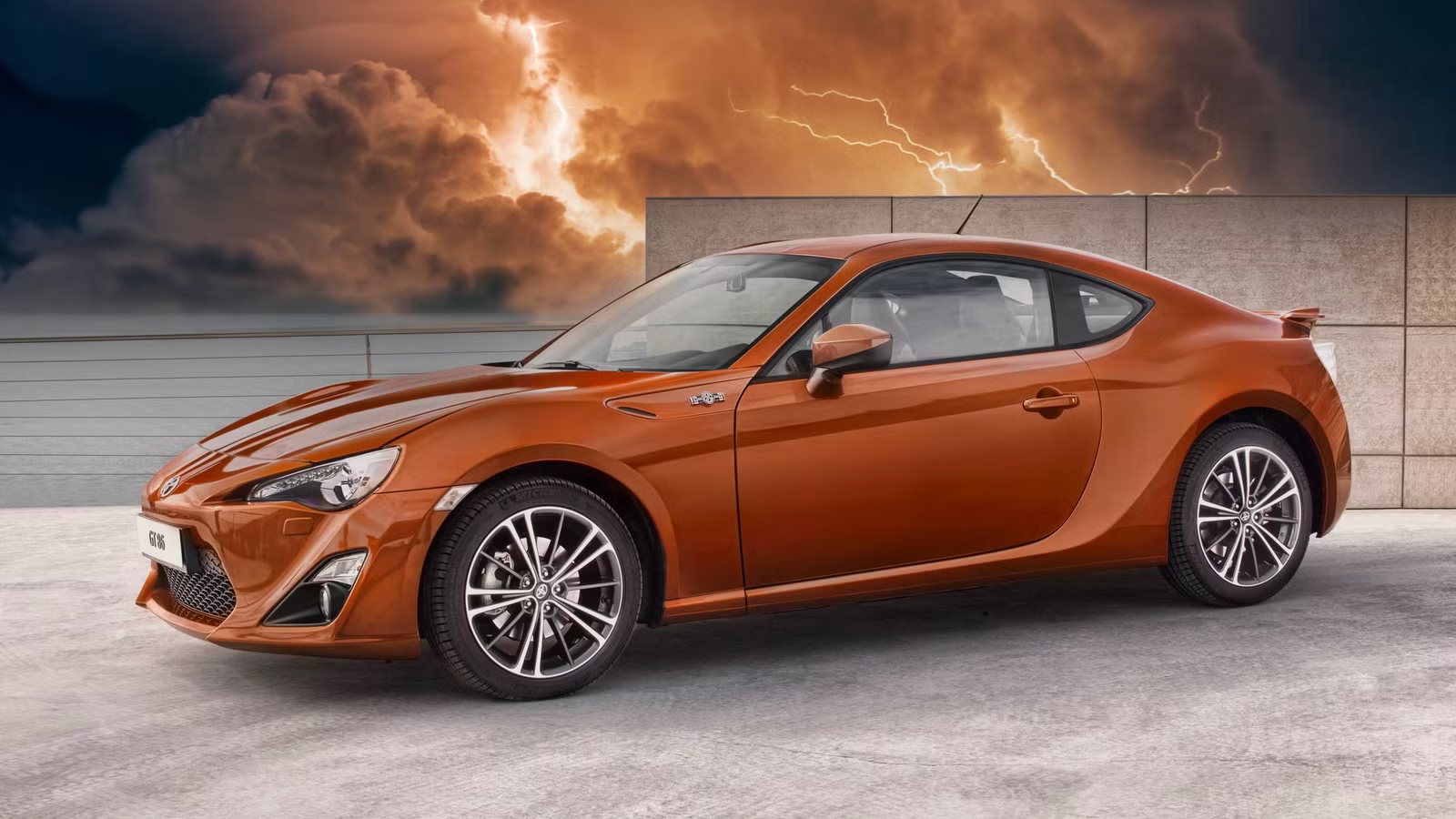
This purist philosophy found its perfect physical manifestation in a car that took the world by storm: the Toyota GT86. Produced from 2012 to 2021 (and sold as the Scion FR-S in various markets before evolving into the modern GR86), this compact coupe was built to do one thing: bring driving back to its absolute roots.
The Spiritual Successor To The Hachiroku (AE86)
Front 3/4 shot of a 2013 Toyota GT86Toyota
High-angle front 3/4 shot of 1985 Toyota AE86 Sprinter Trueno GT in black parked in parking lotBring A Trailer
The GT86 wasn’t built in a vacuum. It was engineered as the spiritual heir to the legendary 1980s Corolla AE86, the lightweight, rear-wheel-drive hatchback and coupe made world-famous by mountain racers (touge) and drift pioneers in Japan.
To achieve the razor-thin center of gravity needed to honor that legacy, Toyota partnered with Subaru to develop a compact, naturally aspirated 2.0-liter “boxer” flat-four engine. By laying the engine flat and mounting it as low and far back as possible, they created a machine with a center of gravity lower than many exotic supercars, all while keeping the price tag accessible to the everyday enthusiast.
Analogue Simplicity In A Digital Era
2020 Toyota 86 gear shifterToyota
Step inside the GT86, and you won’t find a giant, distracting touchscreen dominating your field of vision, or a confusing array of drive-mode buttons. Instead, you get three pedals, a beautifully upright steering wheel completely devoid of buttons, and a crisp, short-throw six-speed manual shifter.
Every control is physical. The clutch has a distinct, communicative bite point; the shifter notches into gear with a satisfying, mechanical clack; and a manual cable-pull handbrake sits exactly where your hand expects it to be. It is a delightfully analogue cockpit designed to eliminate distractions and help you focus entirely on the road ahead.
The Secret To Low-Speed Thrills: Fun Without The Speeding Ticket
2020 Toyota 86 rear 3/4 shotToyota
The magic of the GT86 lies in where it delivers its thrills. While a modern supercar requires three-digit speeds to start feeling alive, this lightweight Japanese coupe makes a trip to the local grocery store feel like an alpine rally stage.
The Genius Of Low-Grip Dynamics (The “Prius Tire” Paradox)
2020 Toyota 86 wheelToyota
When Toyota designed the GT86, they did something hilariously brilliant: they intentionally fitted the car with the exact same narrow, low-rolling-resistance Michelin Primacy HP tires found on the eco-friendly Toyota Prius.
To high-performance purists, this sounded like heresy. But it was a calculated masterstroke. Because the car isn’t over-tired with massive, sticky rubber, you don’t need to go 100 mph to find the limits of grip. At entirely legal speeds — say, taking a local roundabout at 25 mph — you can easily feel the tires begin to slip, giving you a safe, progressive taste of oversteer. Toyota designed this car to slide and play on the limit, making driving heroes out of ordinary folk at completely safe speeds.
Telepathic Steering And Chassis Communication
2020 Toyota 86 dashToyota
Without a massive, heavy engine weighing down the nose, the GT86’s electric power steering is incredibly sharp and communicative. It doesn’t filter out the road; it sings to you.
Every ripple in the asphalt, every change in road camber, and every micro-loss of traction is sent straight to your palms and the seat of your pants. You don’t guess what the car is doing; you know it. It is a level of telepathic communication that builds immense driver confidence, turning driving back into an active, rewarding sport rather than a passive commute.
Pure Joy Without The Ownership Drama
2020 Toyota 86 clusterToyota
A major problem with classic or exotic sports cars is that they often come with a dark side: temperamental electronics, oil leaks, and eye-watering maintenance bills. The GT86 completely bypasses this drama, offering a sports car experience that is as reliable as a standard family hatchback.
Bulletproof Japanese Reliability And Everyday Practicality
2020 Toyota 86 front seatsToyota
Underneath the sleek, low-slung bodywork is tried-and-true Japanese engineering. It starts every single morning, uses regular parts that don’t cost a fortune, and can easily be serviced by any local mechanic.
Even better, it is a highly usable daily driver. The rear seats fold entirely flat, creating a surprisingly cavernous cargo space. In fact, Toyota’s engineers explicitly designed the trunk space to fit four spare wheels and tires, allowing you to drive to a weekend track day, swap your tires, have a blast, and drive home in the same car without needing a support vehicle.
A Blank Canvas For Car Enthusiasts
A dynamic front-quarter tracking shot of a Toyota GT86 Blue EditionToyota
Perhaps the greatest joy of GT86 ownership is its thriving community. Because it was designed to be affordable and simple, it has become the darling of the automotive aftermarket.
Whether you want to keep it completely stock, bolt on a subtle cold-air intake and a throaty cat-back exhaust, or build a dedicated track weapon with adjustable coilover suspension and lightweight wheels, the GT86 is a blank canvas. It is a car that grows with you as a driver, adapting perfectly to your skills, tastes, and budget.
2020 Toyota 86 side shotToyota
The Toyota GT86 is a quiet, brilliant rebellion against the “more is always better” philosophy of modern car manufacturing. It stands as living proof that you don’t need active suspension, turbochargers, or a 500-horsepower engine to experience pure automotive bliss.
By stripping away the digital layers and the high-speed drama, Toyota created a modern classic. It is a car that rewards driver skill over deep pockets, turning every curve into a playground and proving that the best destination is simply the long, winding way home.









No Comments