
The Adventure Motorcycles Don’t Always Belong On Trails
Adventure motorcycles have grown into some of the most capable machines on the road, offering long-distance comfort, powerful engines, sophisticated electronics, and the freedom to explore beyond the pavement. But their increasing focus on off-road performance can make them seem unnecessarily specialized for riders who spend most of their time on the tarmac. A motorcycle doesn’t always have to conquer rocky trails to make an adventure worthwhile. Sometimes riders travel for hundreds of miles on paved highways before turning onto a slightly rocky stretch for their last few miles. Sometimes, an ADV just needs to be capable enough to handle this much.
When Adventure Motorcycles Become Too Focused On The Adventure
The Growing Appeal Of Off-Road Specialization

Adventure bikes have increasingly embraced their dirt-riding credentials. Long-travel suspension, 21-inch front wheels, aggressive tires, extensive body protection, and sophisticated off-road electronics are becoming familiar features across the category. Manufacturers have good reason to pursue this direction.
ADV riding has developed a strong following, and buyers increasingly want machines capable of tackling remote trails rather than simply looking ready for them. Bikes such as the KTM 890 Adventure R and the Yamaha Tenere 700 demonstrate how seriously manufacturers approach this brief, as both are compelling choices for riders who regularly leave the tarmac.
Why Tarmac Manners Still Matter

These days, more and more dirt roads are being paved. There are more highways leading to more offbeat destinations, places that at one time were nearly impossible to reach without a very capable motorcycle. Now, this doesn’t take away from the importance of a dirt-oriented ADV, but an ADV that performs well on the tarmac becomes all the more important. The bigger ADVs like the BMW R 1300 GS and the Ducati Multistrada V4 Rally offer useful examples of adventure bikes that place considerable emphasis on road performance alongside their off-road credentials.

The challenge, though, is to find the right balance. The bike should be able to perform well on dirt, but that shouldn’t become its whole personality. The bike doesn’t need to prove its worth on the trails just to be considered a good ADV. But those capabilities should complement the bike’s intended use.
Harley-Davidson Pan America 1250 Special Grants Adventure Without Conditions

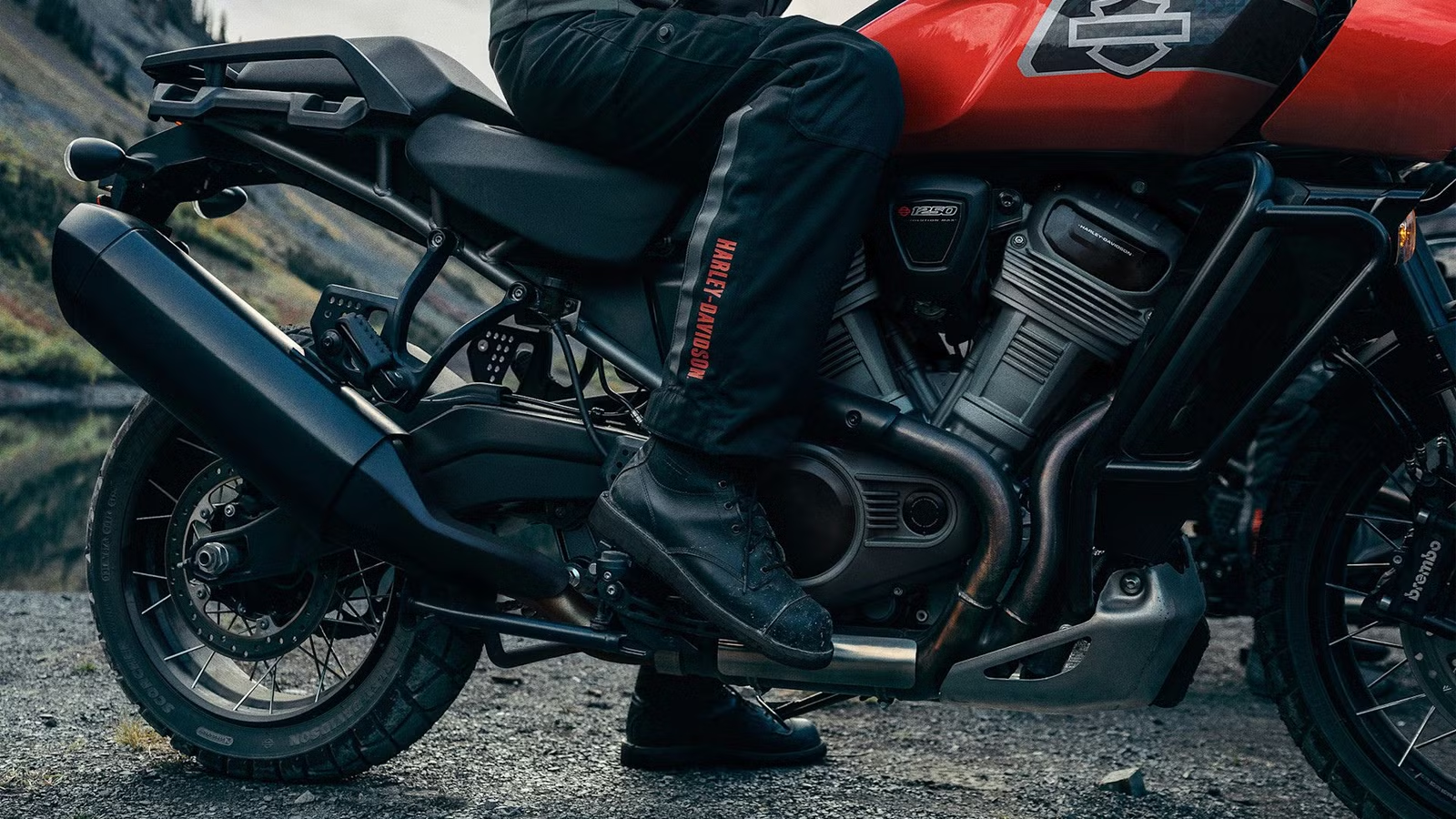
The Harley-Davidson Pan America 1250 Special is an interesting choice for this kind of motorcycle. It challenges expectations not just about motorcycles, but about Harley-Davidson, too. Harley is traditionally associated with heavyweight cruisers and touring machines, but the Pan America takes the company into a category where engine performance, suspension, and versatility matter more than the brand heritage alone.
The Pan America’s liquid-cooled V-twin, semi-active suspension, cornering-sensitive rider aids, and massive touchscreen make it more than a bike for occasional dirt-road excursions. These features give it the potential to be a rewarding long-distance bike even when the route consists entirely of asphalt.
The Pan America 1250 Has A Very Different Harley-Davidson V-Twin

At the heart of the Pan America is Harley-Davidson’s Revolution Max 1250 engine. This liquid-cooled V-twin displaces 1,252cc and produces 150 horsepower at 8,750 rpm and 94 pound-feet of torque at 6,750 rpm. These figures immediately place the Pan America among the BMWs and the Multistradas, and the engine is designed for high performance, unlike the brand’s traditional air-cooled engines.
There is substantial performance for highway overtakes and fast open roads, and the broad torque delivery gives the rider the flexibility needed when the pace slows down. This responsive performance is exactly what’s needed on tarmac: merging into fast-moving traffic is just as easy as hauling pounds of luggage strapped to the rear of the bike.
The Pan America’s Suspension Adjusts To The Ride

One of the Pan America’s strongest highlights is its suspension package. The front uses a 47mm inverted fork with electronically adjustable semi-active damping. The rear employs a linkage-mounted monoshock with automatic preload control and semi-active compression, rebound, and damping.
This setup matters more on the pavement than on the trails; potholes, bumps, cracks, and gravel can appear out of nowhere at speeds you may not be ready for. The semi-active suspension helps keep the bike composed in situations like this. It also maintains consistent sag no matter how the bike’s loaded. Be it two-up, two-up with saddlebags, solo, or solo with a top box, you get the same composed ride no matter what.
Adaptive Ride Height Is Perfect For The Streets
On a trail, or a loose gravel road, this doesn’t mean much. You sometimes need the ground clearance even when you’ve stopped. On the tarmac, though, Harley’s Adaptive Ride Height system lowers the bike by up to an inch the instant you come to a stop, and then returns to full height the moment the bike is moving again. This is an impressive piece of engineering for riders who are built a little closer to the ground. Whether you’re riding solo or two-up, it eliminates the this-bike-is-too-tall-for-me concern.
The Pan America’s Technology Stabilizes The Ride
Navigation Is Meant For The Roads

The Pan America’s tech pack is one of its strengths in the touring scene. A full-color 6.8-inch TFT touchscreen provides access to information and connected functions. It also provides navigation via Harley-Davidson’s mobile app. The screen is glare-resistant and tilt-adjustable, and the touch interface is tuned to handle taps and swipes even through a winter glove. Bluetooth connectivity pairs with compatible phones and headsets, and a USB-C port provides charging and instrument-update capability.
Rider Aids Enhance Safety
The Pan America uses a six-axis inertial measurement unit at the center of its safety suite. It tracks lean angle continuously and adjusts braking force and power delivery by feeding the data into the Cornering Enhanced ABS and Enhanced Traction Control systems. There are multiple riding modes, too, that allow the rider to adjust to different riding conditions.
The Harley-Davidson Pan America Comes With A Premium Price, But With Broad Capability
Price: $19,999

The Harley-Davidson Pan America is not an inexpensive way to enter the brand or the segment. The bike is a proper ADV with premium pricing at $19,999. But the price buys you equipment that is genuinely useful on the street. It isn’t the off-road hooligan that a lot of ADVs are turning into, but the Pan America is for the riders who know they are going to spend more time on the street than on the trails.
Source: Harley-Davidson

Related posts



Latest Post


No Comments