
10 Reasons We’d Pick The Indian Pursuit Over The Harley-Davidson Road Glide Limited
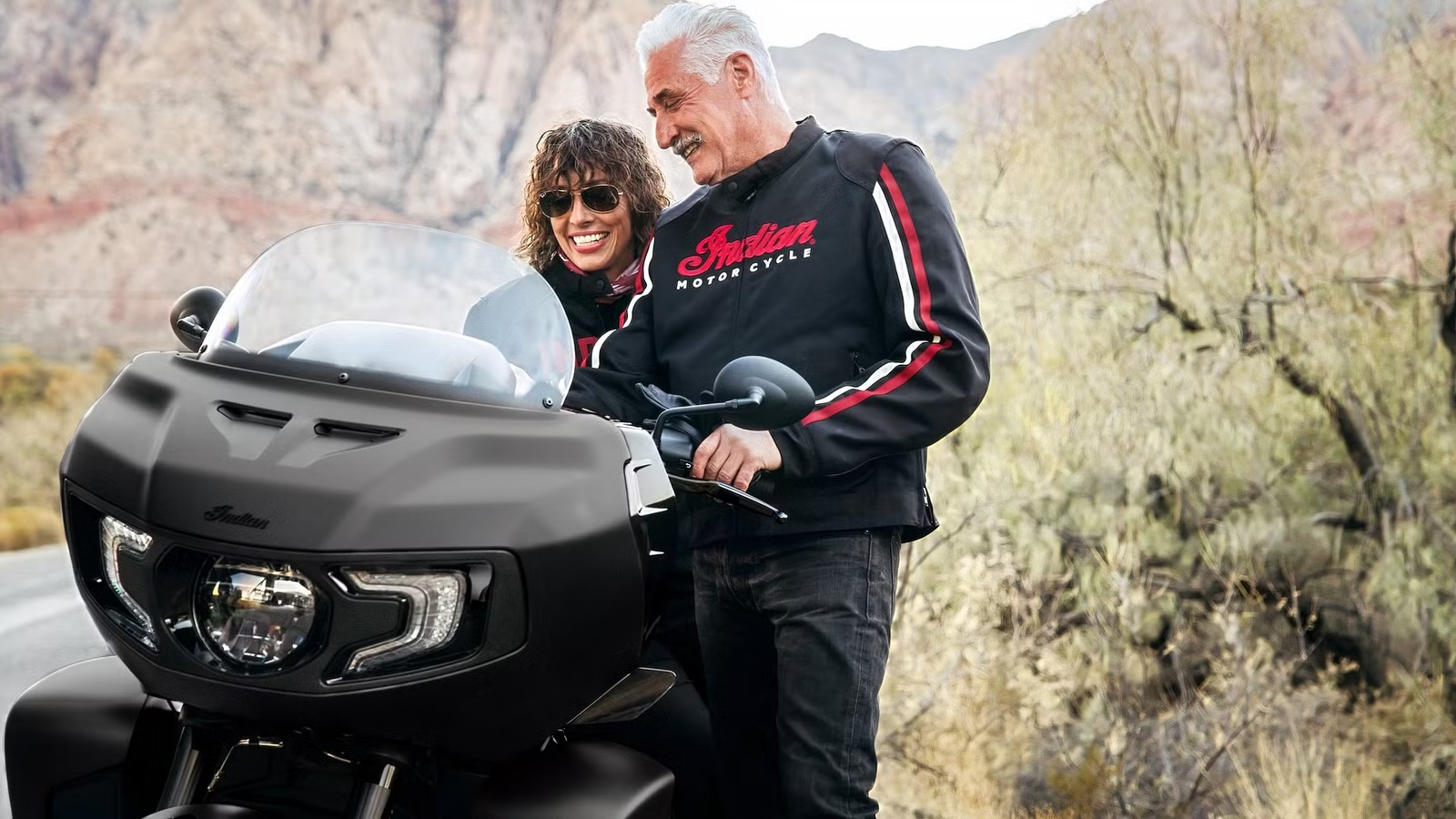
The rivalry between Indian and Harley-Davidson is almost as old as motorcycling itself. These two brands have always pushed each other across categories, be it in the cruiser or tourer world. As a result, both brands have several bikes that go neck-and-neck with each other. The Pursuit and Road Glide Limited are perhaps the biggest examples of that in 2026, as both aim to lure the touring fanatic who wants to spend days on the freeway. Between them, we’d spend our money on the Indian, and here are 10 reasons justifying that.
The Pursuit’s Design Is More Mass-Appealing

We start with a subjective take: the Pursuit Powerplus 112 is more handsome than the Road Glide Limited. Credit goes to the overall cohesion, along with the distinct triple-LED setup up top. The familiarity of the design helps, too, since the Pursuit has looked like this for quite some time. In contrast, the Road Glide Limited’s fascia is quite new (debuting in 2024) and tries to blend the old-school fairing design with new-age LED lights. We do like the attempt, but we’d prefer the Pursuit design-wise.
A Fully Liquid-Cooled V-Twin Powerhouse

Liquid-cooled engines boast several benefits over an air-cooled powerhouse. More power and cooler running temperatures are chief among these, but an underrated plus is the overall dependability. After all, a cooler engine means less stress on the internals and lower wear over the years.

If you’re someone who wants these things, then the Indian Pursuit should be your pick. It comes with the PowerPlus 112–Indian’s newest and largest fully liquid-cooled engine. In comparison, the Harley only has one air-cooled V-twin engine in the Limited. Both engines share rear cylinder deactivation technology.
The PowerPlus Has More Power Than The Milwaukee-Eight
With the liquid cooling advantage, the Pursuit comes out as the more powerful bike between the two. This is regardless of the powerhouse you choose. Talking numbers, the PowerPlus 108 is good for 122 horsepower and 128 pound-feet, while the PowerPlus 112 has 126 horsepower and 133 pound-feet.
Harley’s larger Milwaukee-Eight 117 only manages 106 horsepower and 131 pound-feet, meanwhile. Yes, you do get this torque slightly earlier in the RPM range on the Road Glide. But it’s a minor difference (3,600 RPM for the Indian vs 3,250 RPM for the Harley). Both bikes should have similar riding range, thanks to their 6-gallon tanks and comparable real-world efficiency figures (40-45 MPG).

Like the engine, the Road Glide’s underpinnings aim for simplicity rather than modernity. So you get telescopic forks and hand-adjustable rear shocks. The Indian, meanwhile, uses more up-to-date parts for extra convenience. Up top is a set of 43 mm USD forks, paired with an electronically adjustable monoshock at the rear. You can control the latter straight from the TFT, with varying settings for rider only, rider and pillion, rider and luggage, or rider, pillion, and luggage. On the Harley, you need to get off the bike and use the remote hydraulic adjuster.
More Suspension Travel, Lean Angle, And Fun

The Indian’s modern suspension also has more travel than its rival. It measures 5.1 inches at the front and 4.5 inches at the rear, which is considerably higher than the Harley’s 4.6-inch front and 3-inch rear travel. This also enables 5.4 inches of ground clearance and a maximum lean angle of 33 degrees. This is 0.3 inches and two degrees up from the Harley. The braking and wheels package is similar on both, though. The former comprises 19/16-inch alloy wheels, while the latter is headlined by two 320 mm front discs with Brembo calipers.
A Considerably Lower Saddle Height

Despite the taller ground clearance and higher suspension travel, the Pursuit somehow has a lower saddle height than the Road Glide. It measures 26.5 inches–a sizable 2.5 inches less than the Road Glide (we’re comparing the unladen seat heights here). That said, the Harley does have an advantage weight-wise, as it undercuts the Indian by 18 pounds. We think this difference is likely down to the addition of extra features.
Radar Technology Brings A Safety Advantage

Speaking of features, both bikes are neck-and-neck for the most part. A six-axis IMU, ride-by-wire, ride modes, cornering ABS, traction control, linked brakes, and drag-torque control are standard inclusions on both. However, the Indian edges ahead with its new radar package. This brings a rear radar, enabling blind spot detection and collision warning. These can be life-saving additions on such a large bike, particularly when you’re sitting on the freeway for hours and hours.
Electronically Adjustable Windscreen Adds To Advantage

As for creature comforts, the two bikes are again similar. Heated seats, heated grips, floorboards, fairing lowers, auxiliary lighting, cruise control, hill hold, TPMS, and all-LED lights are present as standard. Hard saddlebags and cubby storage with USB ports are also part of the package. Where the Indian edges ahead is in terms of overall sophistication. The windscreen is electronically adjustable unlike the Road Glide, and the pillion floorboards are adjustable, too. Harley’s instrument cluster is more modern between the two, though.
The Pursuit PowerPlus 112 Justifies The Moolah Better Than The Road Glide Limited

The Pursuit PowerPlus 112 range has two trims: $35,499 for the Limited PowerPlus 112 and $36,999 for the Darkhorse PowerPlus 112. In comparison, the Road Glide Limited comes in two trims with only one engine: $32,999 for the Chrome and $34,399 for the Black.
That means you can get the Limited PowerPlus 112 for ~$2,500 more than the Road Glide Limited Chrome. Considering the extras like liquid cooling, electronic preload, and radar, the value proposition seems better on the Pursuit 112 in our books. To make matters worse for the Harley, you can’t get any of these bits on the Harley. Not even as official accessories.
Indian Also Offers A Cheaper Pursuit

While we’ve talked about the PowerPlus 112 model here, Indian also has the Pursuit with the PowerPlus 108. It sells for a lower MSRP of $32,499 for the Limited PowerPlus 108 model and $33,999 for the Darkhorse PowerPlus 108, making the former $500 cheaper than the Road Glide Limited. That means the value proposition is even better here, since you still get most of the modern-day features (barring radar). Oh, and even the smaller 108 engine has more power than Harley’s 117. This is a blessing in disguise for touring fanatics who have budget constraints.
Source: Harley-Davidson, Indian Motorcycles

Related posts


Latest Post



No Comments