
10 Luxury SUVs That Give The Mercedes G-Class A Run For Its Money
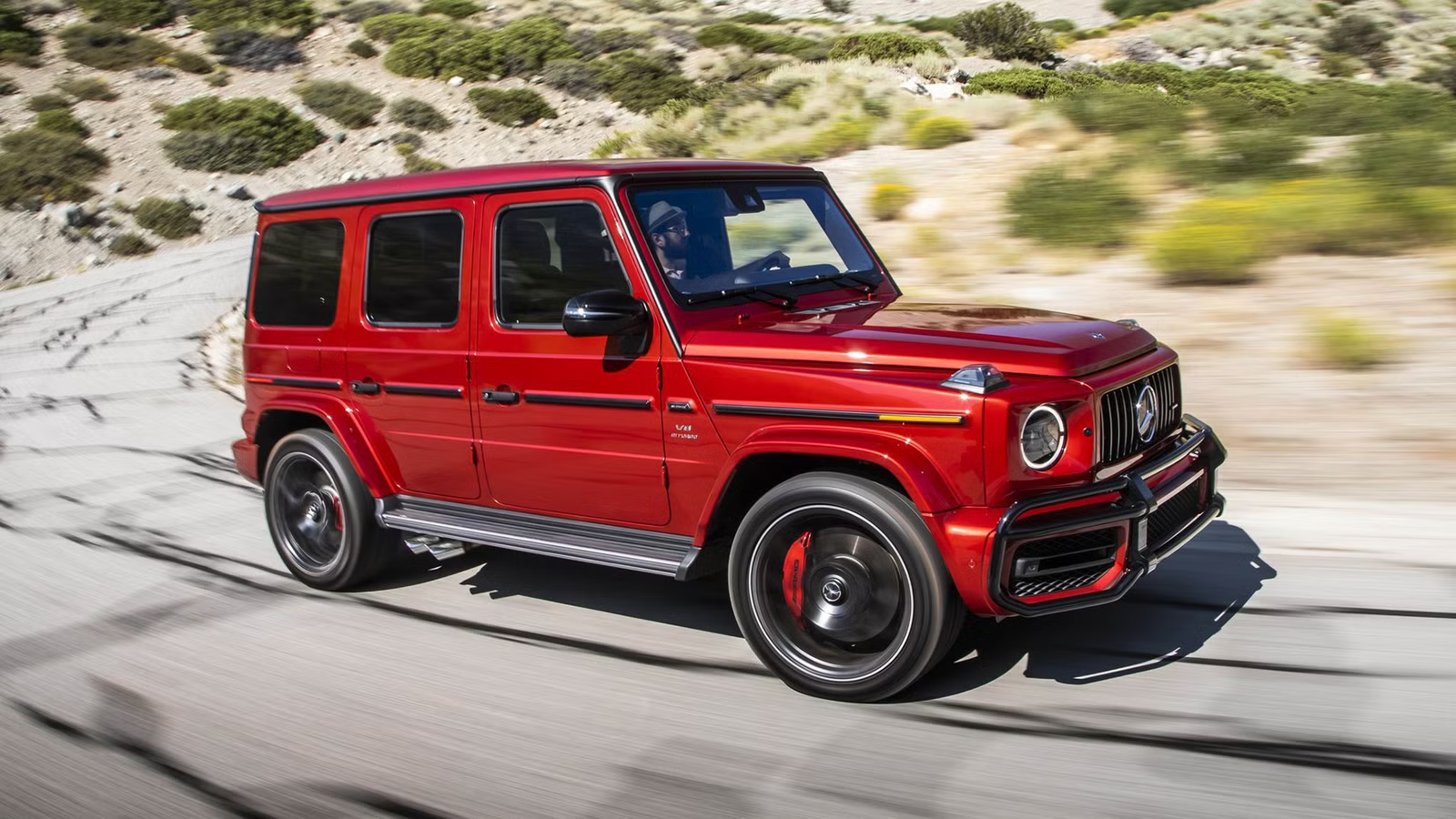
The Mercedes-Benz G-Class occupies a strange corner of the automotive world. It’s a vehicle whose boxy silhouette has barely changed since 1979, yet it commands six-figure prices and multi-year waiting lists in markets from Beverly Hills to Dubai. Part of that appeal is genuine, solid-axle off-road engineering, a cult following, and a shape that reads as “I’ve arrived” from three blocks away. But the G-Class isn’t unbeatable. Depending on what a buyer actually values — raw luxury, off-road grit, performance theater, passenger space, or sheer exclusivity — there’s a rival that arguably does it better. Here are ten that deserve a look before signing on the dotted line.
Land Rover Range Rover
The Obvious Status Rival

If the G-Class sells on presence and prestige, the Range Rover sells on the same qualities with a smoother finish. Land Rover’s flagship trades the G-Wagen’s slab-sided menace for understated elegance, but it matches — some would say exceeds — the Mercedes in cabin refinement, air suspension comfort, and badge recognition among people who actually cross-shop this segment.

The current generation, built on Land Rover’s MLA-Flex platform, offers a plug-in hybrid, a V8, and even a long-wheelbase SV variant with rear-seat theater screens and a champagne cooler. It’s less of a fashion statement than the G-Class, but among people who know cars, a top-spec Range Rover carries at least as much weight. For buyers who want the status without the trucklike ride, this is the easy switch.
The bigger advantage becomes apparent when the Range Rover is used as an everyday luxury vehicle rather than a statement piece. Its quieter cabin, sophisticated suspension, and broad selection of powertrains make it easier to tailor the SUV to a buyer’s priorities, whether that means efficiency, long-distance comfort, or outright performance. It also retains genuine off-road hardware, so choosing the more polished alternative does not mean abandoning the capability that helped establish the G-Class’s reputation in the first place.

Land Rover Range Rover Sport
The Athletic Alternative

The Range Rover Sport takes the same platform and leans harder into performance and agility, areas where the G-Class, despite recent chassis improvements, still feels like what it is: a body-on-frame off-roader wearing a tuxedo. The Sport’s standard air suspension and Dynamic Response anti-roll tech make it genuinely competent on a twisty road, and the SV variant’s twin-turbo V8 sends it to 60 mph in the mid-three-second range, quicker than a G63.

It also retains real off-road ability, with configurable terrain modes and a wading depth that embarrasses most luxury SUVs. For a buyer who wants G-Wagen-adjacent capability without sacrificing on-road manners, the Sport is arguably the more complete daily driver.
That balance is particularly important for owners who spend most of their time on pavement. The Sport feels designed around the compromises of modern SUV life, offering enough ground clearance and terrain technology for occasional adventures while remaining composed during commutes and highway trips. In other words, it doesn’t force buyers to choose between an imposing luxury SUV and something genuinely enjoyable to drive, which is one reason it makes such a strong alternative to the G-Class.
Lexus LX
Old-School Toughness With A Warranty

The Lexus LX is the anti-G-Class in one important sense: it’s built to be bulletproof rather than boutique. Underneath its plush cabin sits the same body-on-frame architecture and locking differentials found in the Land Cruiser, giving it legitimate low-range 4×4 credentials that rival the Mercedes’ three locking diffs. Where it wins outright is reliability reputation: Lexus consistently tops dependability surveys, while the G-Class has a well-documented history of expensive electrical gremlins once out of warranty.

The LX600’s twin-turbo V6 isn’t as theatrical as the G63’s AMG V8, but it’s smoother, more efficient, and backed by a dealer network that won’t blink at a service request. For buyers prioritizing decades of trouble-free ownership over drama, this is the sensible G-Wagen alternative.
There’s also a different kind of luxury at work here. The LX’s appeal is less about attracting attention and more about knowing the vehicle underneath the leather and technology was engineered to withstand demanding use. That makes it especially compelling for buyers who intend to keep an SUV for many years, where predictable running costs and long-term durability can matter far more than the novelty of owning the most recognizable vehicle in the parking lot.
Cadillac Escalade-V
Unhinged American Presence

Cadillac’s answer to the AMG G63 doesn’t bother with subtlety. The Escalade-V stuffs a supercharged 6.2-liter V8 producing 682 horsepower into a three-row SUV the length of a small yacht, then wraps it in enough chrome and LED lighting to be visible from orbit. It’s a completely different execution of the status-SUV formula: where the G-Class intimidates through boxy aggression, the Escalade-V dominates through sheer scale and volume.

It’s also dramatically more practical, with three rows of seating and a cavernous cargo hold the G-Class can’t match. It won’t out-crawl a G-Class on a rock trail, but for buyers who want to be the loudest, largest vehicle in any parking lot, few things compete.
The Escalade-V also makes a compelling case on sheer usability. Its larger cabin gives families considerably more room to spread out, while the available technology and long-distance comfort make it better suited to carrying passengers than the more compact G-Class. That distinction matters because buyers aren’t always choosing between two performance SUVs on a racetrack. For many, the vehicle has to function as a family hauler, road-trip machine and status symbol at the same time.
BMW XM Label
Polarizing By Design

BMW built the XM to be argued about, and it has succeeded. The Label variant pushes the plug-in-hybrid V8 powertrain to 738 horsepower, making it one of the most powerful SUVs sold anywhere, with a 0-60 time under four seconds. Its styling is divisive in the same way early reactions to modern G-Class updates have been divisive, love-it-or-hate-it grille treatments, illuminated kidney trim, and a silhouette unlike anything else in BMW’s lineup.

Where it genuinely challenges the G63 is outright performance and the sense of driving something deliberately extreme. It’s not trying to be a G-Wagen; it’s trying to be the automotive equivalent of a mic drop, and for shock value alone, it succeeds.
Its plug-in-hybrid architecture also gives the XM a different interpretation of performance luxury. Instead of relying solely on displacement and fuel consumption, the electric motor fills in the gaps left by the V8, delivering instant torque while allowing the vehicle to operate electrically for shorter trips. For a buyer attracted to the G-Class because of its outrageous presence and performance, that combination provides another way to stand out without simply buying another conventional V8 SUV.
Bentley Bentayga
Ultra-Luxury Beyond Mercedes’ Reach

The G-Class is luxurious, but it’s not Bentley luxury. The Bentayga pushes considerably further into bespoke territory, with hand-stitched leather, real wood veneers, and a Mulliner customization program that lets buyers specify nearly anything short of a different chassis. The W12-powered variants may be gone, but the Bentayga S’s twin-turbo V8 and the Bentayga EWB’s stretched wheelbase deliver a driving experience that prioritizes serenity over aggression.

It still handles moderate off-road duty respectably thanks to its Bentley Dynamic Ride system, but nobody buys one to go rock crawling. For buyers who’ve outgrown the G-Class’s utilitarian roots and want something that feels genuinely handmade, the Bentayga is the natural upgrade.
The Bentayga’s strongest argument, then, is what happens after the doors close. The G-Class makes occupants feel like they’re inside an automotive icon, while the Bentley focuses more heavily on making every journey feel like a private lounge. That difference becomes especially relevant for buyers who are chauffeured, frequently travel long distances or simply value craftsmanship and personalization above the rugged character that defines the Mercedes.
Aston Martin DBX S
A Sports Car In SUV Clothing

Where the G-Class channels off-road menace, the DBX S channels track-day aggression. Aston Martin’s flagship SUV uses a twin-turbo V8 tuned to 707 horsepower, paired with a chassis engineered by people who spend their careers on sports cars, not trucks. The result is body control and steering feedback that make the G63 feel like the two-ton brick it fundamentally is.

The DBX S won’t out-crawl a G-Class through a boulder field, but on a mountain road, it’s not close — this is an SUV built by a company whose entire identity rests on driving dynamics. For buyers who want G-Wagen-level exclusivity with genuine sports-car character, this is among the strongest arguments on this list.
That makes the DBX S particularly interesting for someone who sees an SUV as a replacement for a sports car rather than an off-roader. Its lower, more athletic character means it can deliver the emotional response of a performance coupe while retaining the elevated seating position and practicality expected from an SUV. If the G-Class represents an owner’s taste in rugged luxury, the Aston Martin represents it through speed, rarity and driving involvement.
Lamborghini Urus SE
Attention-Grabbing Performance Royalty

If the G-Class’s appeal is partly about being noticed, the Urus SE plays the same game with a supercar badge attached. Lamborghini’s plug-in-hybrid super-SUV combines a twin-turbo V8 with an electric motor for a combined output north of 800 horsepower, launching it to 60 mph in roughly three seconds, supercar territory in a five-door body. It draws stares the G-Class simply can’t match in markets where Lamborghini’s raging-bull badge still carries mythical weight.

It’s less rugged and far less off-road capable, but as a rolling status symbol built around outrageous performance, the Urus SE competes with the G-Wagen for a similar buyer: someone who wants everyone on the street to know exactly what just drove past.
The Urus SE also illustrates how dramatically the luxury-performance SUV market has evolved. Buyers no longer need to accept truck-based dynamics simply because they want an imposing vehicle with serious horsepower. The Lamborghini delivers supercar acceleration, high-end cabin appointments and everyday SUV practicality in one package, making it a compelling choice for someone whose definition of “special” is more about performance spectacle than mechanical ruggedness.
Ineos Grenadier
The Purist’s Answer

Here’s where the list gets interesting. The Ineos Grenadier is deliberately, unapologetically less luxurious than the G-Class, and that’s precisely its appeal to a specific buyer. Built by chemicals magnate Jim Ratcliffe explicitly as a spiritual successor to the old Land Rover Defender, the Grenadier uses a genuine ladder-frame chassis, solid axles front and rear, and BMW-sourced engines — with none of the tech-heavy distractions modern luxury SUVs pile on.

It’s arguably closer to what the original G-Wagen actually was in 1979 — a rugged military-adjacent utility vehicle — than the current six-figure, massage-seat G-Class is today. For buyers chasing authentic off-road character over showroom polish, the Grenadier makes a compelling, contrarian case.
It is also one of the few vehicles here that doesn’t try to disguise its compromises. The Grenadier is tall, heavy and utilitarian, with a driving experience that reminds occupants that its priorities are durability and terrain capability rather than effortless urban refinement. That honesty is part of its charm. Someone who looks at a G-Class and wishes Mercedes had kept more of its original rugged character may find the Grenadier far more satisfying than a newer luxury SUV with another layer of electronic intervention.
Toyota Land Cruiser
Heritage Without The Price Tag

The final entry is the biggest curveball, and intentionally so. The current Toyota Land Cruiser costs a fraction of a G-Class, yet it draws from the same well of off-road heritage and remains one of the most trusted expedition vehicles on the planet. It won’t match the G-Wagen’s cabin materials or its road presence, but its body-on-frame construction, low-range transfer case, and Toyota’s legendary reliability record make it a vehicle people genuinely drive across continents rather than to valet stands.

Land Cruisers are still found deep in the Australian outback and across East African safari routes, doing real work the G-Class rarely sees. For buyers whose priority is proven off-road capability over badge prestige, the case for saving six figures is hard to ignore.
There is another advantage that becomes difficult to ignore when ownership enters the equation, and that’s accessibility. A Land Cruiser is supported by Toyota’s enormous global footprint, making parts, servicing and expertise considerably easier to find in many remote regions than they would be for a highly specialized luxury SUV. That matters to the buyer who sees four-wheel-drive capability as something to actually use rather than simply advertise, and it reinforces why the Land Cruiser remains one of the most credible alternatives to the G-Class.

Related posts




Latest Post


No Comments