
This Yamaha Engine Sets An Aggressive Standard For Reliability
There are plenty of reasons to buy a motorcycle. You might fall in love with how it looks, enjoy the way it rides, or simply want something fast enough to put a grin on your face. Whatever makes you pull the trigger, the honeymoon period eventually fades, and more practical questions arise: How well will this motorcycle treat you over the years? Some shortcomings are easy to fix. Don’t like the paint? Get a wrap. Need more grip? There are plenty of tire options. Engine trouble, though, is a different story. So, what makes an engine worth trusting, and which manufacturer gets it right?
The Formula Behind A Bulletproof Motorcycle Engine

There isn’t a hard-and-fast manual or a set of commandments for building an engine that won’t give its owner sleepless nights. But there are a few general principles that can stack the odds in its favor. A simpler mechanical layout can mean fewer potential failure points and easier repairs. A sensible state of tune can leave an engine with some breathing room instead of squeezing every last bit of performance out of it.
Reasonable service intervals and predictable maintenance help, too. And when the same basic engine powers several motorcycles over the years, there’s a much bigger pool of real-world experience to draw from. Curiously, something seems to be in the water in the Land of the Rising Sun, where manufacturers have been ticking these boxes for decades.
Japanese Manufacturers Have Been Getting The Formula Right For Decades

There’s a reason Japanese motorcycles have a reputation for taking a beating and coming back for more. Decades of getting the fundamentals right have earned the country’s big four plenty of trust, and even the numbers back it up. Consumer Reports’ 2015 motorcycle reliability survey ranked Yamaha, Suzuki, Honda, and Kawasaki among the most reliable brands it studied, with estimated failure rates of just 11 to 15 percent for four-year-old bikes.

That is a strong track record, and riders have plenty of examples to point to. Take Suzuki’s 645cc V-twin, which has powered everything from the SV650 to the V-Strom 650, or Honda’s Gold Wing, a long-distance touring staple with a flat-six that’s been around for decades. Yamaha also has a standout in the FJR1300, a sport-tourer that built a following among riders who consider a few hundred miles a decent Sunday ride. And that’s not the only Yamaha engine to earn a loyal following for its durability.
Yamaha’s CP2 Engine Has Earned Its Reputation Over A Decade

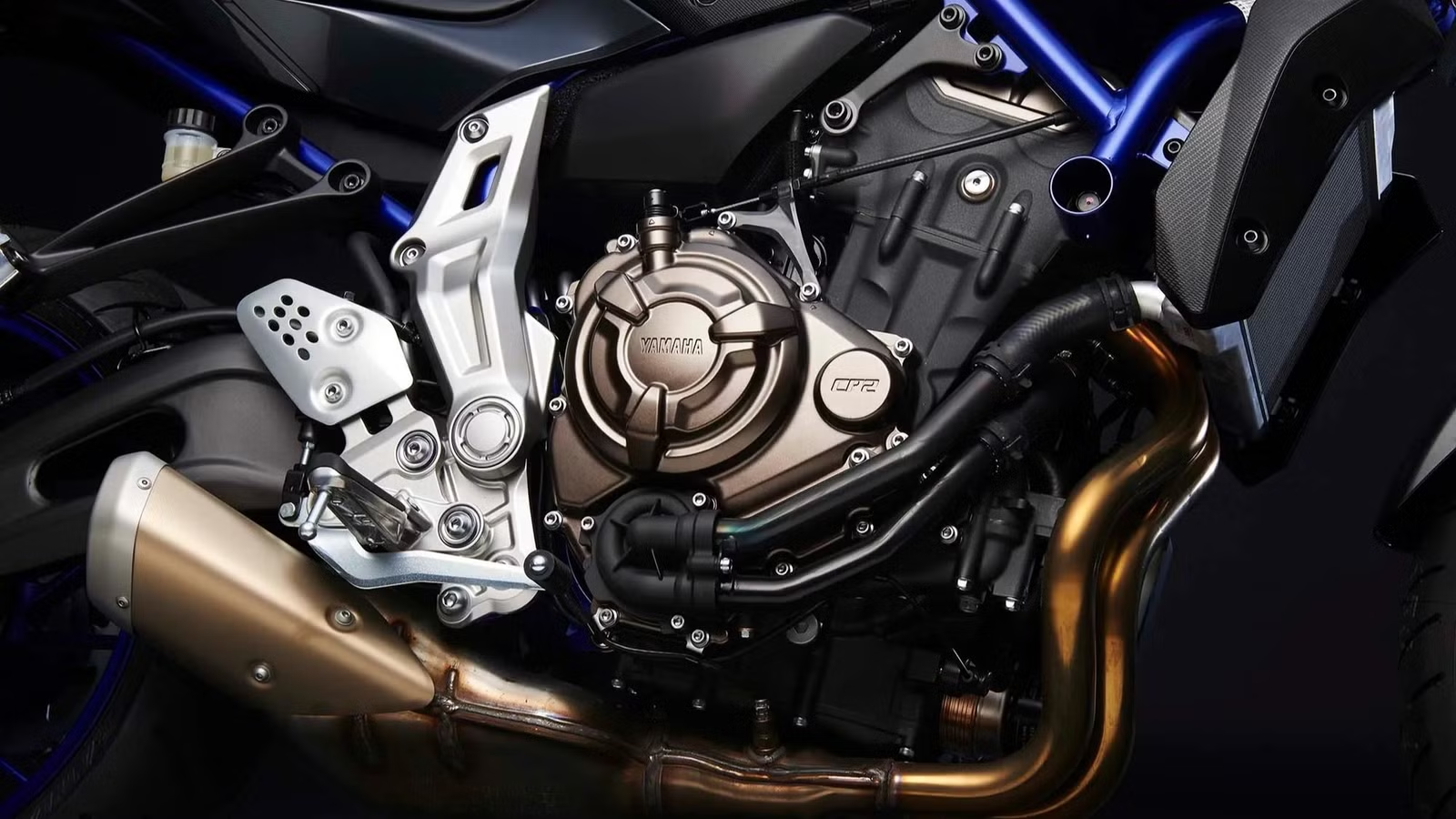
Meet Yamaha’s CP2, an engine that’s been around since 2014 and has become one of the company’s most recognizable modern powerplants. CP stands for Crossplane Concept, and Yamaha keeps the naming simple: the 2 denotes its two-cylinder layout, just as the CP3 is a triple and the CP4 a four-cylinder. No elaborate naming puzzle to solve, then. The CP2 debuted in the MT-07 as a 689cc, liquid-cooled, four-stroke, DOHC parallel twin with four valves per cylinder, and Yamaha has since put it to work across a growing range of motorcycles.
The CP2’s Reach Across Yamaha’s Lineup Keeps Growing

Recall the point about shared platforms providing more real-world experience to draw from. The CP2 is a textbook example. It debuted in the MT-07 naked bike before finding its way into the neo-retro XSR700 and the fully faired R7. Outside the US, Yamaha also uses it in the Tracer 7 sport-tourer. But perhaps the most interesting application is the Ténéré 700, where Yamaha’s choice of engine becomes particularly relevant to a story we’ll get to later.
The Engineering Choices Behind The CP2’s Longevity

The CP2 is a 689cc liquid-cooled parallel twin that produces around 72 horsepower and 50 pound-feet of torque in European-market versions of the MT-07, R7, and Ténéré 700. (Yamaha’s US website doesn’t publish official horsepower and torque figures for these models, so these are converted European-market figures rounded for convenience; output may vary by market and model year.)
Yamaha also points to a couple of design choices that help the CP2 make efficient use of its power. The six-speed transmission uses a triangular arrangement for its input and output shafts, which shortens the engine from front to back. Yamaha also offsets the cylinders slightly forward relative to the crankshaft, reducing friction between the pistons and cylinder walls.
Yamaha’s CP2 Survived A 64,000-Mile Off-Road Torture Test
An Australian adventure-riding company called RideADV had a Yamaha Ténéré 700 nicknamed Old Girl rack up more than 64,000 miles (103,000 kilometers), mostly off-road. According to the company, the bike needed very little engine work over that distance. RideADV changed the oil every 3,100 miles instead of Yamaha’s recommended 6,200-mile interval. Beyond that, it replaced one countershaft sprocket seal under warranty, three valve shims, and two spark plugs. The company reported no fuel-injection issues, with its owner noting that he hadn’t experienced fuel-related problems with any of his Yamahas in 15 years.
The CP2’s Reliability Isn’t Without Caveats

It’s difficult to find much to fault with Yamaha’s CP2, and you have to get pretty nitpicky to find meaningful compromises. The engine has a healthy midrange, but it does not offer the same top-end surge as some rival engines. That’s hardly surprising for a twin designed around accessible performance rather than the high-revving character of a supersport. Some riders also find it a little less refined than competing engines, particularly when it comes to vibration, though that’s subjective and depends on the motorcycle and rider.
As for reported problems, the available evidence doesn’t point to a clear pattern of widespread internal engine failures. Complaints tend to involve surrounding components, such as clutch behavior or fueling, and can vary by model and model year. Many owner reports are anecdotal and should be taken in context. Valve-clearance checks are also relatively widely spaced.
Sources: Yamaha Motor USA, Yamaha Motor Australia, Honda, Suzuki, Consumer Reports.

Related posts


Latest Post


No Comments