
The Japanese Adventure Bike That Does It All
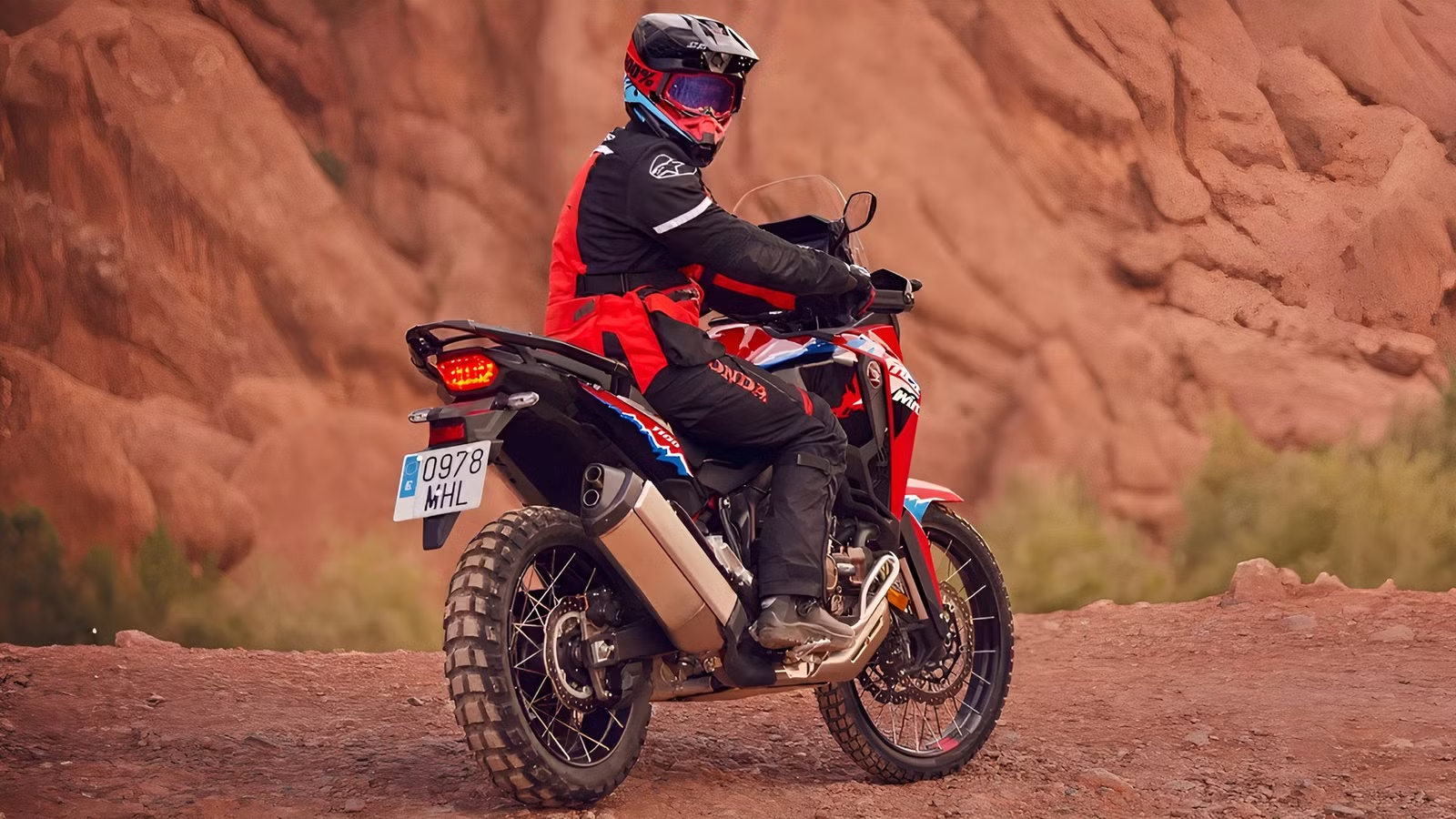
Adventure bikes are built to bridge the gap between tarmac touring and genuine off-road capability — but few truly nail both. Most tip the scales one way or the other, leaving riders to compromise. The holy grail is a machine that handles a morning commute, a weekend trail, and a cross-country tour with equal confidence. Add bulletproof Japanese reliability to that wish list and the shortlist gets very short, very fast. Fortunately, Honda has an answer.

The Honda Africa Twin DCT carries a legacy stretching back roughly four decades, goes toe-to-toe with heavyweights from BMW and Triumph, and offers a transmission setup that lets you ride a dune-conquering ADV with the ease of a scooter. Its liter-class parallel-twin is impressively flexible across the rev range, and the technology package is enough to make any gadget-minded rider grin. All of this arrives at a price that meaningfully undercuts its closest European rivals.
The Honda Africa Twin DCT Is An All-Rounder At Its Core
Price: $15,999
In the Africa Twin DCT, Honda combines a versatile parallel-twin engine, an easy-to-ride gearbox, an adaptive chassis, off-road-ready suspension, and a comprehensive suite of rider-assistance technology. The formula has it all. The flexible engine and gearbox combination make it a breezy urban runabout and a relaxed highway machine.

Then there is the chassis and suspension setup that elevates its off-roading capabilities. The generous ground clearance and large wheel sizes make clear that Honda intends the Africa Twin to be let loose on the less-traveled path. Tying all of these attributes together is an extensive electronics package that deeply integrates the engine, transmission, and rider-assistance features. A price tag under $16,000 for the complete package is genuinely hard to argue with. Let’s dive deeper.
Slim Enough To Offer Confidence-Inspiring Riding Dynamics
On Both Urban And Off-Roads

The first Africa Twin, the XRV650, was launched in 1988. Over more than 37 years it has evolved considerably, yet its design still echoes the original. Features like the dual-pot headlamp, the distinctive half-fairing, and the upswept exhaust are deliberate callbacks to that 1980s icon. Another visual constant across the generations is the slim profile. The Africa Twin is impressively narrow for a liter-class ADV that locks horns with giants like the BMW R 1300 GS.
This slender form factor pays real dividends off-road, where standing on the pegs and weighting the footpegs becomes far more natural. It is also no slouch on the touring front, with a sizable 5-gallon fuel tank handling mile-munching duties. With a claimed fuel economy of 48 MPG, the Africa Twin DCT offers a range of around 240 miles. It also offers close to 10 inches of ground clearance, allowing the Africa Twin to tackle challenging trails without hesitation.
Dimensions

|
Wheelbase |
62.0 inches |
|
Seat Height |
34.3 inches (Standard); 33.5 inches (Low) |
|
Curb Weight |
535 pounds |
|
Ground Clearance |
9.84 inches |
|
Rake |
27 degrees |
|
Trail |
4.5 inches |
|
Length |
91.73 inches |
|
Width |
37.8 inches |
|
Height |
58.5 inches |
Hardcore Underpinnings To Conquer Dunes And Munch Down Miles
Comes With Long-Travel Showa Suspension And Off-Road-Ready Wheels

The Africa Twin uses a semi-double-cradle main frame that balances rigidity and flex to handle rough off-roading and relaxed mile-munching alike. The subframe is a bolt-on aluminum unit that improves luggage-carrying capability while keeping overall weight in check. Heavy-duty Showa springs handle suspension duties, delivering 9.0 inches of front travel and 8.7 inches of rear travel, with both ends fully adjustable.

This, coupled with its 21-inch front and 18-inch rear wheels, helps this Honda ADV excel when the pavement ends. Honda also derived the Africa Twin’s rigid yet lightweight aluminum swingarm from the hardcore CRF450R motocross machine. Braking duties are handled by dual 310 mm discs up front and a 256 mm disc at the rear. The rotors feature a petal-style design and are paired with sintered brake pads for consistent stopping performance in all conditions.
Hardware Specs
|
Main Frame |
Steel Semi-Double-Cradle Frame |
|
Sub Frame |
Aluminum Bolt-On Sub-Frame |
|
Front Suspension And Travel |
Fully Adjustable 45 mm Inverted Forks; 9.0 inches Of Travel |
|
Rear Suspension And Travel |
Fully Adjustable Monoshock 8.7 inches Of Travel |
|
Front Brakes |
Dual 310 mm Discs With Four-Piston Calipers |
|
Rear Brakes |
Single 256 mm Disc With A Single-Piston Caliper |
|
Front Tire Size |
90/90-21 |
|
Rear Tire Size |
150/70R-18 |
Technology Plays A Vital Role In Making This Honda A Do-It-All ADV
DCT Gearbox And Its Various Riding Modes Are The Showstoppers Here

Technology is what binds the many strengths of this Honda ADV and truly makes it a one-garage-worthy motorcycle. The standout feature is its automatic gearbox. Honda pioneered this technology with the 2010 VFR1200F sports tourer — the brand’s first DCT-equipped motorcycle — and has refined it significantly ever since. Today, Honda offers the highest number of automatic motorcycles on sale of any manufacturer. The Africa Twin’s DCT six-speed gearbox delivers a twist-and-go riding experience reminiscent of a scooter — but it’s far from one-dimensional.
There are three gear-shifting modes: D (Drive), S (Sport), and MT (Manual). Drive is the default mode for riders who want a relaxed, fuss-free experience in the city or on the highway, prioritizing comfort and fuel efficiency. Sport mode is for those who want to grin behind the bars — it raises the rev limit and sharpens throttle response along with other parameters. For maximum involvement, Manual mode brings paddle shifters (small finger-operated toggles on the left handlebar) into play.

The Africa Twin DCT features ride-by-wire backed by a Bosch MM7.10 IMU that performs real-time six-axis measurement of roll, pitch, and yaw rate and angle. In practical terms, a network of sensors works in concert with features like Honda Selectable Torque Control (HSTC) to maximize accuracy and deliver seamless transitions between modes. The cockpit centers on a 6.5-inch touchscreen TFT display through which ride modes, entertainment, and connectivity features are all managed. The screen is customizable with three display layouts and background color options.
Notable Technology Features

- Cruise Control
- Throttle-by-wire
- 6.5-inch Touchscreen TFT display
- Honda Selectable Torque Control (HSTC)
- Dual Channel ABS With Switchable Rear ABS
- Apple CarPlay and Android Auto; Includes Voice Commands As Well
- Six Ride Modes (Tour, Urban, Gravel, Off-Road, and Two User-Defined modes)
Powered By A Versatile Parallel-Twin
That Is Also Used In A Cruiser Bike And A Touring Bike

The Africa Twin’s engine also powers the Rebel 1100 and the NT1100, albeit in different states of tune — a testament to its broad versatility. This 1,084cc parallel-twin is remarkably compact for a liter-class engine, and Honda has employed several clever engineering solutions to achieve that. Cylinder sleeves are made of aluminum to save weight, the water pump is housed within the clutch casing, and the thermostat is integrated directly into the cylinder heads.
These engineering choices keep the engine short and compact, which translates to weight savings and improved ground clearance — both critical for serious off-road use. The engine also serves city riding and long-distance touring well: peak power arrives at 7,500 RPM and peak torque at 5,500 RPM, giving the Africa Twin a strong low- and mid-range character. For highway cruising, producing peak power below 8,000 RPM means the engine feels relaxed even during sustained triple-digit runs.
Engine Specs
|
Engine Configuration |
Parallel-Twin; Liquid-Cooled |
|
Engine Displacement |
1,084 cc |
|
Bore X Stroke |
(92.0 X 81.5 mm) |
|
Compression Ratio |
10.5:1 |
|
Power |
100 HP |
|
Torque |
82.6 LB-FT |
Accessory Packs Uphold The Africa Twin DCT’s Versatile Nature
Offered With Four Accessory Packs

Honda offers more than 30 accessories for the Africa Twin DCT in America. Sorting through that catalog can quickly become overwhelming, so Honda has curated the options into four purpose-built packs. While each pack below is sold as a bundle, Honda also allows riders to mix, match, and add nearly any individual accessory from across the packs. The image above shows a configuration built using all available individual add-on accessories.
Rally Pack

This pack is designed to improve the off-road durability of the Africa Twin. It includes wide rally footpegs, engine guards, a radiator grille, and a foot shift lever for DCT-equipped models. Color-matched knuckle guard extenders and wheel stripes round out the visual and functional upgrades.
Adventure Pack

This pack addresses long-haul riding, with enhanced protection and added storage. The Africa Twin gains bodywork protection made from 25 mm stainless steel tubing that also houses dual fog lights for improved visibility at night. Honda adds a 4.5-liter tank bag that is spacious yet shaped to avoid interfering with on- or off-road riding. Slide tank pads provide extra grip during off-road sections and protect the fuel tank’s finish from knee scuffs.
Urban Pack

This pack prioritizes practicality and storage for city use. Its headline component is a top box, available in either a 58-liter plastic or a 42-liter aluminum version — the larger of the two can swallow two full-face helmets. Heated grip sets add comfort on cold mornings, while an accessory charging socket and a center stand round out the package.
Travel Pack

As the name suggests, this pack is built to maximize touring potential. It includes lockable hard-case pannier sets — either a 40-liter left and 30-liter right plastic pair, or a 37-liter left and 33-liter right aluminum pair — with a set of inner bags included with either option.
Additional accessories in this pack include upper and lower deflectors engineered to improve airflow around the arms, shoulders, and legs. The deflector system reduces wind fatigue and improves comfort at highway speeds. Honda also includes Comfort Pillion Footpegs to make two-up touring more enjoyable.
Source: Honda Powersports

Related posts



Latest Post


No Comments