The Honda Sedan That Ages Better Than Cars Twice Its Price
8 minutes reading
Saturday, 18 Jul 2026 18:00 0 61 autotech
Walk into any used car lot and you’ll notice something odd. Some sedans from six or seven years ago look and drive like they rolled off the line yesterday, while others, often wearing premium badges, feel tired, worn, and expensive to fix. This Honda sedan belongs firmly in the first camp. It’s not the flashiest sedan in its class, and it never tries to be. But peel back the marketing gloss on so-called luxury alternatives and this sedan quietly outperforms them where it actually matters. This holds true in durability, cost of ownership, and consistency over time. This is the story of why.
Not all aging is created equal. Two midsize sedans can leave the factory the same year, rack up similar mileage, and end up in completely different places a decade later: one still tight and rattle-free, the other creaking, leaking, and burning through its owner’s savings account. The difference usually comes down to a handful of unglamorous factors: how conservatively the drivetrain was engineered, how well the interior materials were chosen, and how forgiving the maintenance schedule is over the long haul.
Premium brands often get this backwards. Their sedans are engineered to impress on day one—silky air suspension, complex electronics, turbocharged engines tuned for peak refinement—but those same systems are frequently the first things to fail once warranty coverage runs out. Adaptive dampers leak. Air springs sag. Turbochargers that were pushed hard from the factory start burning oil past 60,000 miles. The car that felt like magic in year one can feel like a money pit by year seven.
2026 Hyundai Sonata Hybrid front shotHyundai
Mainstream sedans, by contrast, tend to be engineered with a longer view. They’re built to be sold in huge volumes to people who can’t afford surprises, which forces manufacturers to prioritize simplicity and proven components over cutting-edge complexity. It’s a less glamorous formula, but it’s the one that actually holds up.
The Honda Accord’s Reputation Was Built On More Than Just Reliability
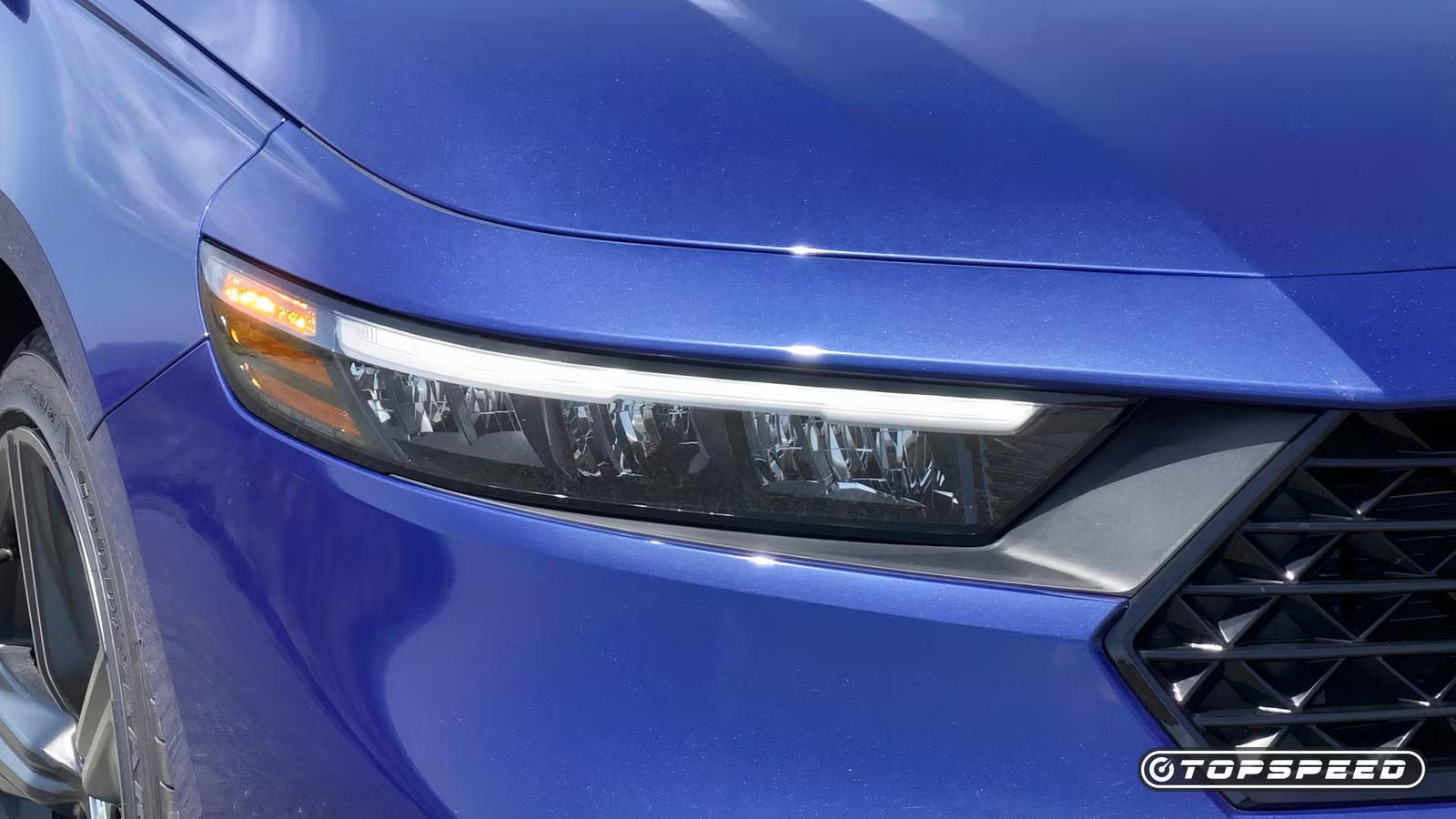
Honda Accord Hybrid Exterior FeatureLyndon Conrad Bell | Top Speed
It’s tempting to credit the 2026 Honda Accord’s staying power entirely to “Honda reliability,” as if that phrase alone explained everything. But reliability is really just the visible symptom of a much deeper set of engineering priorities that Honda has stuck to for decades.
The Accord has always been the sedan Honda uses to demonstrate that mainstream doesn’t have to mean mediocre. Where rivals cut corners in fit and finish to hit a price point, the Accord has consistently punched above its class in cabin materials, structural rigidity, and driving dynamics, without pricing itself into luxury territory. That’s a tightrope walk very few manufacturers manage successfully, and it’s the reason the Accord has picked up a long list of industry awards over the decades rather than just decent reliability scores.
There’s Also A Cultural Element To It
Honda Accord Hybrid rear 3/4 shotLyndon Conrad Bell | Top Speed
The Accord has built a kind of quiet trust with owners: the sedan people buy once and then buy again fifteen years later because the first one never gave them a reason to shop elsewhere. That kind of brand loyalty isn’t manufactured through marketing; it’s earned one uneventful 100,000-mile ownership experience at a time. And unlike some rivals that have quietly diluted their reputations chasing sales growth, Honda has largely kept the Accord’s fundamentals—a stiff chassis, a well-sorted suspension, and drivetrains built for the long haul—consistent generation after generation.
Engineering Choices That Keep It Comfortable, Efficient, And Dependable For Years
Honda Accord Hybrid EngineLyndon Conrad Bell | Top Speed
Under the skin, the current-generation Honda Accord makes a series of engineering decisions that read like a masterclass in long-term thinking rather than short-term flash. Start with the powertrains. The standard 1.5-liter turbocharged four-cylinder is intentionally tuned for durability rather than outright output: modest boost pressure, a robust timing chain instead of a failure-prone belt, and a cooling system sized with margin to spare. It won’t win any drag races, but it also won’t need a turbo rebuild at 70,000 miles the way some more aggressively tuned European fours can.
The more interesting story, though, is the Accord’s hybrid powertrain, a two-motor system that’s become one of the most underrated durability plays in the segment. Unlike hybrid systems that rely on a conventional stepped automatic transmission (a common wear point), Honda’s setup uses a single fixed-gear arrangement, with the engine and electric motors seamlessly handling the work of shifting. Fewer mechanical gear changes means less wear on the transmission itself, and the electric motor handles a significant share of low-speed driving, which reduces strain on the combustion engine during the stop-start city driving that ages most cars fastest. Owners routinely report hybrid Accords crossing 150,000 miles with nothing more than routine maintenance, a battery pack that’s proven remarkably resilient, and a combustion engine that’s barely been asked to work hard.
Then There’s The Cabin
Honda has resisted the temptation to load the Accord with delicate, failure-prone tech for the sake of a showroom “wow” moment. The infotainment system is intuitive rather than needlessly layered, physical climate controls remain (a detail owners increasingly appreciate as touchscreen-only rivals prove maddening to use and expensive to repair), and the switchgear is built to a tolerance that simply doesn’t rattle loose the way cheaper interiors do. It’s the kind of restraint that doesn’t photograph well in a press release but pays dividends in year eight of ownership.
The Ownership Costs That Make Premium Alternatives Hard To Justify
2024 Honda Accord Hybrid Touring Rear End shotHonda
This is where the “twice the price” comparison stops being a marketing line and starts showing up in real numbers. Take a seven-year-old Accord EX-L against a similarly aged BMW 3 Series or Audi A4, both of which cost roughly double what an equivalent Accord did when new. Routine maintenance on the Accord runs on a straightforward schedule: oil changes every 7,500 to 10,000 miles, no factory-recommended timing belt replacement (it’s chain-driven), and brake and suspension parts that are widely available and inexpensive because Honda builds so many of them. Annual maintenance costs for an Accord in this age bracket typically land in the $400-$600 range for routine service.
Compare that to a similarly aged 3 Series or A4. Independent repair data consistently shows German luxury sedans costing two to three times more annually to maintain once they’re out of warranty, and that’s before factoring in the failure-prone extras: air suspension components that can run $1,500–$2,500 per corner to replace, timing chain guides on certain engines that require pulling the front subframe, and electronic modules that fail quietly and expensively. A single major repair on an aging German sedan can easily exceed a full year of Accord maintenance costs.
Insurance Tells A Similar Story
Honda Accord Hybrid Exterior FeatureLyndon Conrad Bell | Top Speed
Because the Accord is cheaper to repair and its parts are abundant, insurers typically price premiums 15–25 percent lower than for comparable luxury sedans, even accounting for similar safety ratings. Resale value compounds the advantage: Accords depreciate more slowly in percentage terms after the five-year mark, because buyers shopping in the used market know exactly what they’re getting: a car that isn’t about to demand a four-figure repair bill. Add it up over a decade of ownership, and the Accord doesn’t just cost less upfront: it costs less every single year after that, while asking for less faith that nothing expensive will break.
Why This Sedan Continues To Be One Of The Smartest Long-Term Buys
Honda Accord Hybrid side shotLyndon Conrad Bell | Top Speed
The Accord’s real trick isn’t that it’s the most exciting sedan in its class—it’s that it never stops being a good decision. Every year it holds together, it reinforces the same message: sound engineering and restraint beat flash and complexity over the long run, especially when the flashy alternative costs twice as much to buy and maintain.
For anyone actually shopping, the sweet spot in the used market right now is a 2018–2021 Accord, ideally a 1.5T Sport or EX-L, or a hybrid Touring if you can find one with clean service records. Look for mileage in the 40,000–70,000-mile range, which puts you well past any early-ownership issues while leaving plenty of life left in the drivetrain. On a used purchase, pay close attention to the infotainment screen function (a known minor gripe on early 10th-gen cars) and ask for proof of on-schedule oil changes, since that’s the single biggest driver of long-term engine health. Do that homework, and you’ll walk away with a sedan that’s still got a decade of dependable driving left, for a fraction of what a comparable luxury badge would cost you to keep on the road.










No Comments