
Suzuki Built A Motorcycle In 1985 That Changed Everything Forever
Forty years on, it’s easy to take for granted what a modern sport bike can do — carve a canyon road with surgical precision, then pull freeway speeds without breaking a sweat. But that combination of outright performance and real-world handling didn’t always exist. For most of motorcycling’s history, riders had to choose one or the other, and the compromise was frustrating enough that many simply lived with it. Then Suzuki drew a line through the rulebook, and nothing was ever quite the same again.

At least, that was the case before Suzuki reinvigorated the sports bike scene. Seeing a market for a bike that could go fast and handle well, they set about creating something that took racing to the streets. And, in doing so, they irrevocably changed the future of sports bikes.
Race Bikes And Fast Bikes Were Separate
Since its 1949 founding, MotoGP has produced some of the most exciting bikes on the planet. Bikes made for outright speed, helping manufacturers and riders alike put their names on the map. They were fast and track-focused, but had a key problem — as good as these bikes were, regular riders couldn’t buy them.

All the way to the early 1980s, motorcycles largely followed a familiar design philosophy — termed Universal Japanese Motorcycle (UJM). It was characterized by “an upright, open seating position motorcycle powered by a carbureted, air-cooled engine wrapped in a steel-tube cradle-type frame, and at least one disc brake to bring it all to a stop”, and was kickstarted by the Honda CB750’s popularity in 1969.
Sports bikes did exist, but not in the manner in which you know them today. They were incomparable to the sports bikes riders would watch on track, both in terms of design and concept. Power for road bikes was mostly obtained by placing larger and larger engines into heavier and heavier frames, while race bikes focused on weight saving to help them gain performance.

Those big engines and big curb weights meant that road bikes were fast in a straight line but struggled with handling and cornering. At the same time, manufacturers were reluctant to invest in making race bikes for the road because of the complexity, cost, and perceived lack of interest.
The weight difference between race and road was considerable, too. The Yamaha YZR500 that Kenny Roberts rode to the 500 cc Grand Prix title weighed 287 lbs. By contrast, sports road bikes like the Ducati 500 SL tipped the scales at 397 lbs dry, and the Honda CX500 came in at 478 lbs dry. Weights climbed further for 750s — a 1980 Kawasaki GPZ750 was 483 lbs dry, yet was considered a market-leading sports bike of the era.
Suzuki saw a gap in the market for a race-ready, road-legal bike. They already had success on the track and a growing road bike lineup, so why not combine the two?
Race-Ready Performance For The Street Was Now Accessible

|
Engine Type |
Engine Displacement |
Power |
Torque |
Top Speed |
Weight |
|
Four stroke, inline four cylinder, DOHC, oil cooled |
749 cc |
106 bhp @ 10,500 rpm |
47 lb-ft @ 8,000 rpm |
160-mph |
388 lbs dry / 408 lbs wet |
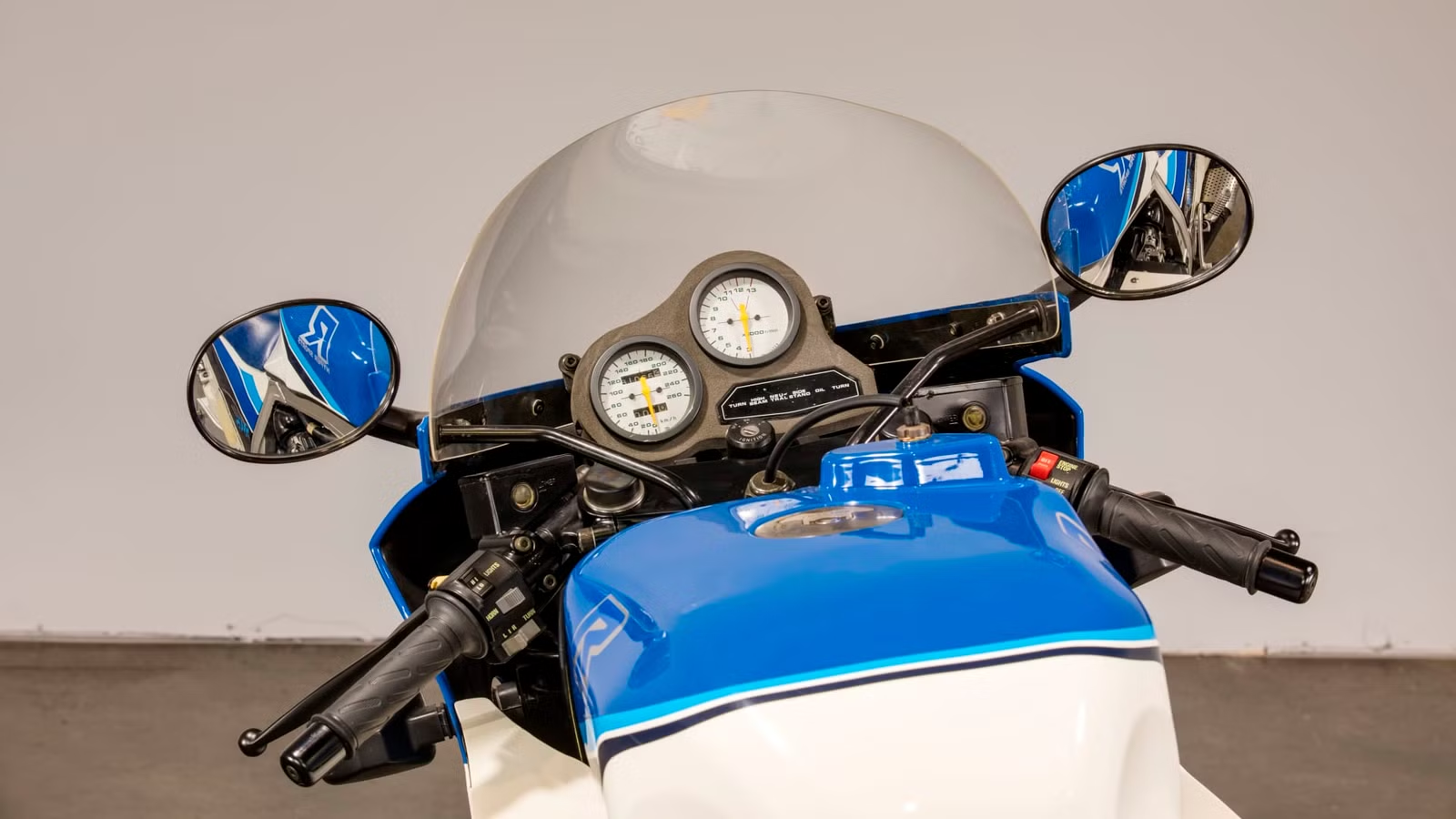
Suzuki hit the market with the GSX-R750 in 1985, and changed the game. Taking inspiration from their endurance racing program, the bike was based around the hugely successful XR41 — which won the 1983 FIM World Endurance Championship and Suzuka 8 Hours, among other victories. This made the GSX-R750 the first true “race replica” and, as such, it introduced several never-before-seen innovations.
The first was the sheer lack of weight. The bike came in at 388 lbs dry, making it lighter than even some 500s despite its greater displacement. This was a dramatic improvement over its predecessor — the 1982 Suzuki GSX750E — which weighed 504 lbs dry. Looking further afield, the 1983 Honda Interceptor VF750F is considered the spark that ignited the GSX-R750’s development, and it was a comparatively portly 481 lbs dry.
Suzuki achieved this lightness through extensive use of aluminum rather than steel, particularly on the frame, which weighed just 17.8 lbs. Other components were trimmed and lightened to shave ounces wherever possible, while Suzuki developed their Suzuki Advanced Cooling System (SACS) — a system where oil is used to cool the engine instead of traditional coolant — to avoid the added mass of water-cooling hardware.

While the lightness was a key part of the GSX-R750’s performance, the aluminum frame saved weight, improved stiffness, and helped it handle far more nimbly. But that wasn’t the only factor — the bike’s entire ergonomic package was rethought from the ground up.
In a clear departure from the typical UJM design, the GSX-R750 emulated its racing counterparts by improving aerodynamics with a full fairing, rear-set footpegs, and clip-on handlebars. This made not only the bike more aerodynamic, but the rider as well — placing them in a more aggressive position better suited to spirited riding.
This was combined with the bike’s purpose-built 750 cc engine. Designed specifically for the GSX-R750, it was lightweight, revved to 11,000 rpm, and didn’t have to motivate nearly as much mass — giving it a better power-to-weight ratio than some liter bikes of the day. It was capable of feats previously unheard of from a road-going motorcycle.

Unsurprisingly, reviews were glowing. The race bike for the road was reportedly almost indistinguishable from a real race bike, thanks to its lightness-aided performance, while its top-end capability put it on par with far heavier machines.
This all culminated in an incredibly sought-after motorcycle. Suzuki reported that over 5,700 units were sold between March and December in Japan alone in 1985, making it the best-selling bike in the country that year. Notably, that 1985 version wasn’t sold in the United States — American riders had to wait until it was imported in 1986 — but this did nothing to dent its popularity.
The GSX-R750 Also Changed How Sport Bikes Were Engineered
While the GSX-R750 is often remembered for its lightweight construction and race-replica styling, its real significance runs deeper. The bike fundamentally changed how manufacturers approached sport bike engineering. Instead of simply building powerful motorcycles and hoping riders could manage the weight, Suzuki demonstrated that performance should be built around balance.
Prior to the mid-1980s, many high-performance motorcycles were essentially upgraded standard bikes. Engineers would install a larger engine, reinforce the frame, and accept the resulting weight as an unavoidable compromise. The GSX-R750 flipped that philosophy entirely. Suzuki designed the motorcycle with racing principles in mind from the outset, prioritizing chassis rigidity, aerodynamics, and weight reduction alongside engine performance.
The aluminum twin-spar frame was particularly influential. While aluminum frames had appeared on race bikes before, Suzuki proved that the material could be mass-produced for road-going motorcycles. This shift toward lightweight alloy frames would soon become the industry standard for sport bikes throughout the late 1980s and 1990s.
Equally important was the GSX-R750’s focus on integrated design. The engine, frame, suspension, and rider ergonomics were all developed as part of a single performance package rather than as separate components bolted together. That philosophy would later shape the development of many legendary sport bikes, from the Yamaha FZR series to Honda’s later Fireblade models.
In many ways, the GSX-R750 didn’t just create the race-replica category — it also helped establish the modern blueprint for sport bike development, one where power, weight, and handling must evolve together rather than independently.
The First, But Not The Last

Suzuki revolutionized the bike market with the GSX-R750. It redefined what a sports bike was overnight, and started a lineage that continues today, more than 40 years later.
Not content with resting on its laurels after the initial success, Suzuki iterated on the design continually — making small tweaks here, minor changes there — and released the highly coveted GSX-R750RK variant in 1989. In order to compete in the freshly launched Superbike World Championship, Suzuki needed to homologate their bike, which they duly did, creating just 500 examples.
But Suzuki wasn’t the only manufacturer to recognize the hunger for race replicas. The WSBK’s homologation rules were responsible for bikes like the Yamaha FZR750R, the Honda VFR750R RC30, and the Kawasaki ZXR750, all of which appeared in the late 1980s — after Suzuki had already proved there was a genuine appetite for them.

The legendary Honda CBR900RR Fireblade pushed the market further still in 1992, blending the weight of a 750 with the power of a 1000 and continuing the relentless pursuit of race-ready road bikes. But that path had already been blazed by the GSX-R750.
The GSX-R750 was responsible for so much more than simply proving there was a market. It didn’t just tepidly stick a toe into the waters of road-going sports bikes — it threw everything it had into the water to prove that it could swim. And swim it did. While prices for that first run of bikes aren’t stratospheric — good examples can be found in the $7,000–$10,000 range — the rarer versions, in particular the GSX-R750RK, command considerably higher premiums.

But the GSX-R750’s legacy isn’t one of continued monetary value or collector cachet. Its entire identity is rooted in pushing the sports bike forward, testing limits, and embracing iteration. In doing so, it has kept its name alive for over four decades. And that’s a far more fitting legacy than having those first bikes sit untouchable behind a velvet rope.
Sources: Cycle World, Top Speed, Suzuki

Related posts


Latest Post


No Comments