
The Muscle Car With Corvette Power And Cadillac Comfort
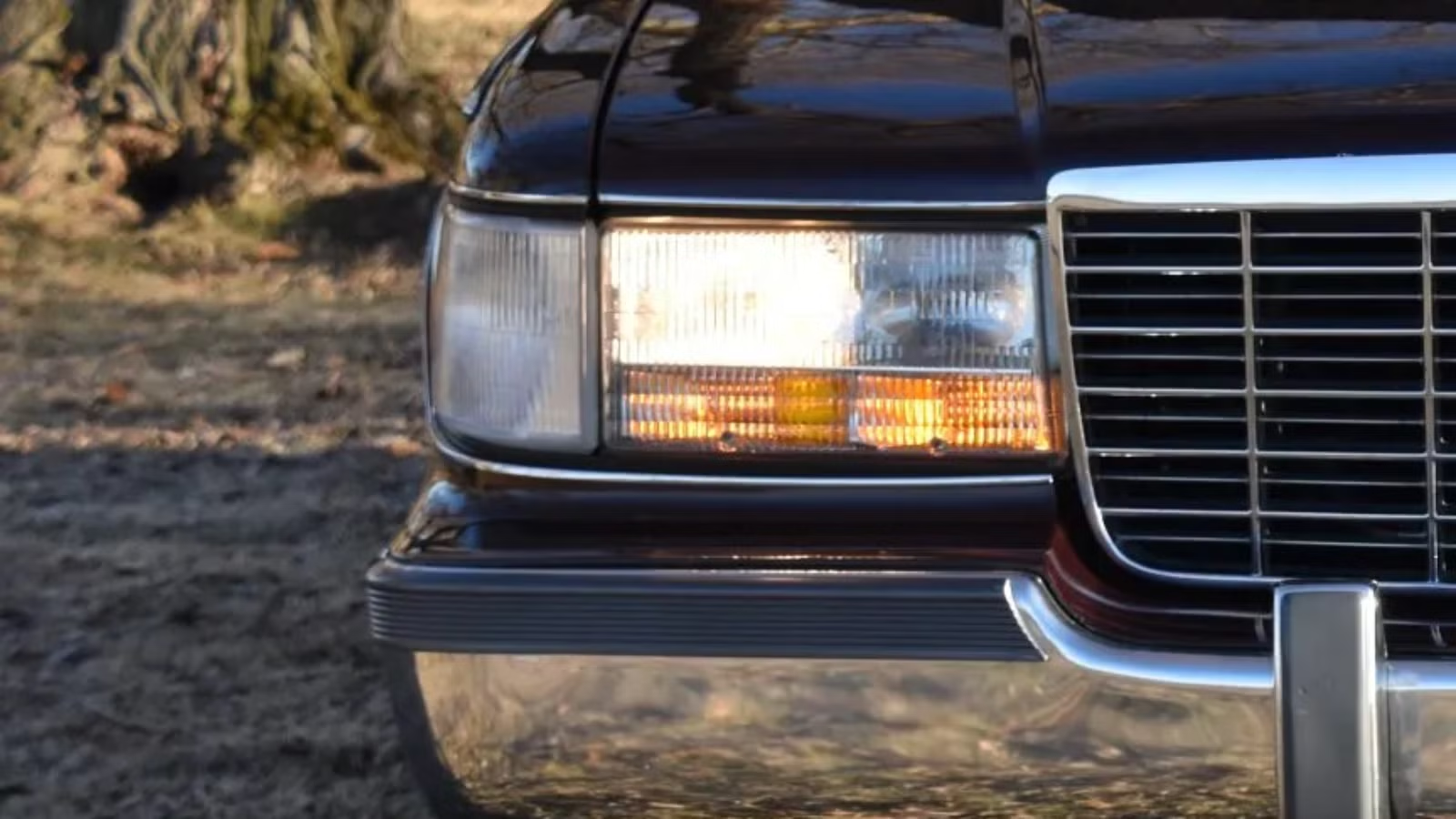
Muscle cars are supposed to be loud, stripped-down, and a little punishing. They rattle at idle, drone on the highway, and treat comfort as someone else’s problem. This one came with memory seats, automatic climate control, and a cabin quiet enough for a nap.

Under the very long hood of the longest car built in America sat a V8 borrowed from America’s sports car, softened just enough to behave in traffic. The company that built it sold it for only three model years before shutting down the entire line. Finally, collectors have started paying serious money for the best ones.
The Corvette V8 That GM Couldn’t Keep To Itself
Chevrolet gave the C4 Corvette a new heart in 1992. The Gen II LT1 was a 5.7-liter small-block V8 rated at 300 horsepower, and it pushed the base Corvette past the 300-hp mark for the first time in two decades. Even the name carried weight, reviving a badge Chevrolet had last used on the solid-lifter small-block of 1970. Reverse-flow cooling, which sent coolant through the cylinder heads before the block, allowed higher compression and made it the most advanced small-block Chevrolet had ever built.

By 1993, the Camaro Z28 and Pontiac Firebird carried a 275-hp version of the same engine, and a year later the LT1 reached GM’s full-size, rear-wheel-drive sedans and wagons.

The Impala SS became the most famous beneficiary, a cult hero built on its 260-hp LT1, while the Buick Roadmaster wagon became a favorite sleeper for people hauling kids and lumber at the same time. The Chevrolet Caprice 9C1 gave police departments a cruiser that could genuinely chase things, and that much of the story most enthusiasts already know.
One more car received the engine, and it is the one nobody expects. It was the biggest, softest, most formal sedan General Motors made, and it wore a wreath and crest on its grille instead of a bowtie. For three model years, the brand that defined American luxury quietly sold a muscle car.
The Cadillac Fleetwood Brougham Hid A Corvette Heart Under 19 Feet Of Chrome

In 1993, Cadillac introduced the Fleetwood Brougham. Cadillac had moved the model onto the rear-wheel-drive D-body platform for the second generation, reversing the industry’s march toward front-wheel drive, though that first year carried the old L05 350 with throttle-body injection and just 185 hp.
For 1994, Cadillac installed the Corvette-derived 5.7-liter LT1, rated at 260 hp, and paired it with GM’s new electronically controlled 4L60E four-speed automatic. One engine swap transformed the car’s entire character.

At 225 inches long, the Fleetwood was the longest production car built in the United States, stretching almost 19 feet from bumper to bumper on a 121.5-inch wheelbase and measuring 78 inches across.
Between 1993 and 1996, the Fleetwood commercial chassis also underpinned most American funeral coaches and limousines, which meant the same basic car served weddings, statehouses, and cemeteries alike.

Leather seating with memory adjustment, automatic climate control, electronic level control, and Twilight Sentinel headlamps came aboard alongside standard anti-lock brakes, traction control, and dual airbags. The Brougham trim layered on a padded roof treatment, additional chrome, and even softer seating.
For 1995, an integrated chassis control system read the road surface to manage how the anti-lock brakes and traction control engaged on rough pavement.
The stand-up ornament, the wide chrome grille, and the formal roofline promised a stately procession rather than a quarter-mile pass, with nothing hinting at what sat under the hood. That contradiction is exactly what makes the car so interesting three decades later.
The Detuned LT1 Still Hit 60 mph In Eight Seconds

The Fleetwood’s LT1 shared its core architecture with the Corvette engine. Both used the same 5.7-liter displacement, the same reverse-flow cooling, and the same sequential-port fuel injection introduced for 1994. The differences came down to materials and tune.
In the Corvette, the LT1 produced 300 hp and 340 lb-ft through aluminum cylinder heads, a four-bolt-main block, and 10.5:1 compression. The Fleetwood’s version ran cast-iron heads, a two-bolt-main block, and a milder camshaft, which brought output to 260 hp at 5,000 rpm and 330 lb-ft of torque at 3,200 rpm.

Period testing put the 4,450-lb sedan at roughly 8.0 to 8.5 seconds from 0–60 mph, with the quarter-mile arriving in the mid-16-second range and top speed electronically limited to around 108 mph. For a formal luxury sedan wearing whitewall-friendly 15-inch wheels, those figures embarrassed plenty of smaller, sportier machinery.
The EPA rated the combination at 17 mpg in the city and 25 mpg on the highway, respectable numbers for a car this large, and the 4L60E’s overdrive fourth gear kept the V8 loafing at highway speeds.

In its period road test, the big Cadillac could still tow 7,000 pounds, a rating unlocked by the optional V4P trailering package and delivered by the engine’s deep well of low-rpm torque. No other American luxury sedan of the era paired that kind of pulling power with a leather-lined cabin, which explains why so many Fleetwoods spent their lives towing boats and Airstreams. The rating even matched what many half-ton pickups of the day could manage.
It Ran The Muscle Car Playbook Line By Line
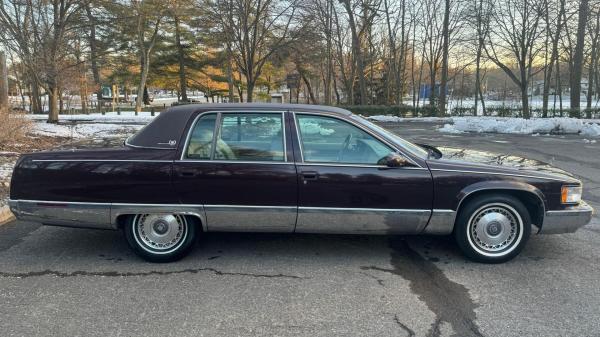
Many would dismiss the idea of classifying the Fleetwood as a muscle car, but it is as much of one as any of the modern four-door performance Cadillacs. Admittedly, calling the Fleetwood a muscle car sounds absurd until you examine the recipe closely. The original formula, the one Pontiac wrote with the 1964 GTO, was never about lap times or light weight. It called for a performance-model V8 dropped into an ordinary full-size body, driving the rear wheels.

The Fleetwood follows that playbook line by line as a muscle sedan. It took the engine from GM’s halo sports car, placed it in the biggest body the company made, and sent the power rearward through a conventional automatic. It simply ran the formula in velour and burl walnut instead of vinyl buckets. The Impala SS used the identical 260-hp LT1 and nobody hesitates to call it a four-door muscle car, yet the Cadillac carried the same engine in a longer body and somehow escaped the label.

Reviewers at the time described a true land yacht with gobs of comfort that could cruise quietly at any speed, while its acceleration ran close enough to contemporary performance sedans to surprise anyone who lined up beside it at a stoplight.
Muscle cars were always about effortless, excessive power in everyday clothing, and no car ever wore more everyday clothing than a Fleetwood Brougham. The comfort completes the formula rather than undermining it. The Fleetwood did not fail the muscle car test just because it took the test in a tuxedo instead of Carhartt jackets and Dickies work pants.
A $12,300 Fleetwood Just Pulled Six Figures At Auction

Driver-quality Fleetwoods traded for used-commuter money for years, and plenty still do. Classic.com puts the average 2nd-gen Fleetwood sale at $16,756, a figure that spans everything from tired daily drivers to preserved garage queens.
A low-mile LT1 Brougham sold at a Pennsylvania estate auction for $12,300, then ignited a bidding war at Barrett-Jackson Scottsdale that carried it into six figures. At Mecum Kissimmee, an 817-mile triple-black 1996 with the factory Astroroof brought $52,800.
The LT1 cars are the ones collectors chase, and the 1996 model year carries extra weight as the final one. Loaded examples with the Astroroof or the V4P trailering package tend to draw the strongest bidding.

The Opti-Spark distributor sits low behind the water pump and fails when moisture gets in; the 4L60E transmission wears under hard use; and the market rewards originality and documentation far more than modifications.
Millennials drive 31% of insurance quote requests for the final Fleetwood, per Hagerty’s policy data, with Gen X close behind at 29%. The rival Lincoln Town Car skews older at 34% Boomer, and the Impala SS leans on Gen X at 40%, which leaves the big Cadillac with the youngest and most even spread of interest.
Production ended in 1996, and Cadillac never built a full-size, rear-wheel-drive sedan again. That finality, plus the Corvette hardware hiding under all that chrome, is why the last big Cadillac keeps climbing in value. It remains the only muscle car you could order with a vinyl roof.
Sources: Hagerty, Barrett-Jackson, Classic, Chevrolet, Cadillac

Related posts



Latest Post


No Comments