
Hyundai And Kia Want Your Car’s Bumper To Generate Electricity
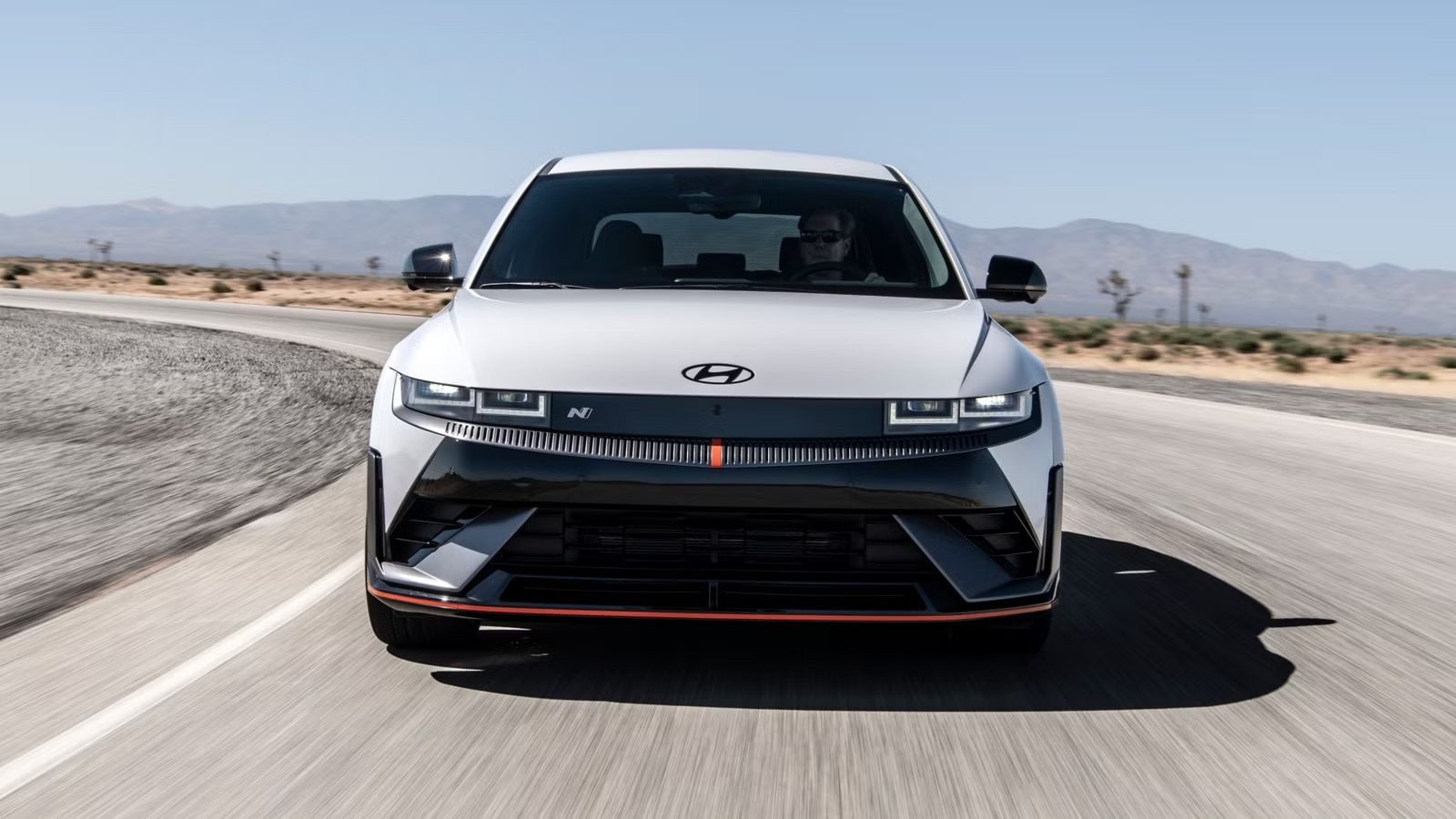
The Hyundai Motor Group, which includes Kia, maintains a powerful presence in the U.S. automotive market. Both brands are aggressively expanding their electric car portfolios to capture significant market share. In the first half of 2026, the South Korean duo achieved record-breaking sales performances in the U.S. market.

Electrified models now account for one-third of total sales for Hyundai Motor America. The American-assembled Ioniq 5 and the 2026 Hyundai Ioniq 9 are driving high demand thanks to their performance and versatility. Kia America matches this momentum with record-setting sales for its EV9 and EV6 models. The two brands establish themselves as leaders in electric mobility technologies through their dedicated Electric Global Modular Platform, which benefits from class-leading 800-volt architectural charging speeds and exceptional vehicle packaging.
The EV Shift Continues To Face Challenges In The U.S.
Several persistent challenges affect electric vehicle ownership in the U.S. in 2026. Key changes over the last year have slowed down the total progression to full electrification for many brands, despite some remaining dedicated to the technology. Consumers face a fractured public charging infrastructure that often suffers from unreliability and geographic gaps. High initial vehicle purchase prices and elevated auto insurance rates strain average consumer budgets.

Driving range anxiety also remains a significant hurdle, particularly during extreme winter weather conditions where lithium-ion battery efficiency drops sharply. Additionally, long-term vehicle ownership economics present a mixed outlook. Rapid vehicle depreciation rates and uncertain residual values after five years cause buyers to hesitate. These macroeconomic pressures force automakers to find new ways to extract maximum driving range from existing battery capacities without increasing vehicle weight. Hyundai’s new patent filing won’t solve this issue alone, but it certainly will help with overall practicality and usability.
Hyundai Plans To Recover Lost Energy With Turbine Generators

A new technical solution to the ongoing issue of range anxiety has emerged from the United States Patent and Trademark Office under patent application publication number US 2026/0168477 A1. The patent outlines a vehicle wind power generation system designed and submitted by Hyundai Motor Company, Kia Corporation, and SHB Automotive Module Company. The architecture integrates an electric generator directly behind a specialized grille assembly in the front bumper frame of the vehicle.

The system utilizes an internal air channel that directs oncoming airflow into a dedicated turbine enclosure. A series of movable shutter flaps is located at the entry point of the grille to control exactly how much air enters the system. When the vehicle moves, the air pushes through the open flaps, spins the internal turbine blades, rotates the generator, and produces electricity. The air then exits through a vent path located at the bottom or the rear of the vehicle body.

Hyundai’s turbine system operates within the strict boundaries of physics rather than attempting to create a perpetual motion machine. Generating electricity at sustained highway speeds introduces aerodynamic drag that cancels out any power generation benefits. The extra kinetic energy required to push the vehicle through the air exceeds the energy the turbine recaptures. To resolve this issue, the EV control system closes the movable shutter flaps at high cruising speeds. Closing the flaps presents a smooth surface intended to optimize the drag coefficient. The system actively opens the shutter flaps during ideal driving scenarios where harvesting energy is more thermodynamically favorable, such as low-speed urban driving, long downhill descents where you would typically coast, and mechanical braking cycles.
How Hyundai Will Apply This Technology To Existing And Future EVs

Integrating this technology into existing and future Hyundai and Kia electric vehicles includes connecting the bumper generator to the high-voltage or low-voltage electrical architecture. The harvested energy supplies power to internal climate control systems, onboard infotainment displays, and advanced driver assistance systems.
Powering these auxiliary systems directly reduces the electrical drain on the primary lithium-ion traction battery pack. Furthermore, the system offers a static charging function. When you park the vehicle outdoors, the control system can open the shutter flaps to catch natural ambient wind. If you park the vehicle facing into a strong breeze, the wind spins the internal turbine and delivers a continuous trickle charge to the battery system while the car sits idle.
Hyundai And Kia’s Other Noteworthy EV Innovations

Hyundai and Kia both benefit from a strong track record of developing standout aerodynamic features that surpass key industry rivals. Hyundai previously introduced Active Air Skirt technology to manage high-speed air turbulence. The AAS system installs hidden rubber air skirts between the front bumper and the front wheels.
The system deploys the skirts automatically at speeds above 50 MPH to cover the front portion of the rotating tires. This action reduces the overall vehicle drag coefficient by 0.008, which translates to an immediate 2.8 percent reduction in aerodynamic drag. Hyundai also utilizes active air flaps and wheel air curtains on production models like the Ioniq 6, helping the EV achieve an industry-leading drag coefficient of 0.21.
How Hyundai’s Innovation Can Positively Shape The EV Landscape

Integrating active aerodynamic flap systems requires balancing efficiency gains against financial, structural, and mechanical liabilities. While these systems optimize the vehicle drag coefficient to improve internal combustion fuel economy and extend electric vehicle driving range, they will introduce engineering trade-offs that affect the overall feasibility of an EV.
Active aerodynamic assemblies significantly increase initial production costs compared to traditional fixed body panels. Designing complex air channels that are adjustable and consist of multiple components requires extensive computational fluid dynamics modeling and physical wind tunnel validation. Injection molding tooling costs for articulated polymer flaps, specialized housings, and internal air ducts require high capital investment.
Moving away from passive body components also requires adding dedicated hardware. Some necessary equipment engineers will have to add, as described by the patent, include a bespoke electronic control unit calibration, electromechanical linear actuators, brushless DC electric motors, wiring harnesses, and position sensors. This total material and production cost burden makes integration difficult for entry-level, price-sensitive vehicle segments. Consequently, premium segments and electric vehicles that cover long ranges on a single charge absorb these integration costs more effectively by baking the component expense into higher base retail prices.

Every added mechanical component also conflicts with automotive weight reduction initiatives, which are critical for offsetting the heavy battery packs found in electric vehicles. A complete active flap system adds noticeable weight to the front end of the vehicle. This mass includes the electric drive motors, mechanical linkages, reinforcement brackets, and the shutter frames. Hyundai’s engineers will have to employ advanced engineering polymers, lightweight composites, or aluminum alloys to minimize this weight penalty.
Adding five to fifteen pounds of hardware directly at the leading edge of the front bumper can alter front-to-rear weight distribution metrics if left unmanaged. The design team must prove that the aerodynamic efficiency gains at highway speeds successfully overcome the rolling resistance penalty caused by the extra component weight.

Positioning movable components at the front of a passenger EV exposes the system to a harsher operating environment on the car, making long-term reliability risks a primary concern for field quality engineers. There are also fundamental changes required for safety purposes. Front-mounted flaps endure constant exposure to road debris, stones, pressure washing, heavy rain, mud, and road salt. In northern climates, packed snow and ambient moisture freeze inside the flap hinges, causing mechanical binding or total physical blockage.
Common field issues include stripped actuator gears, broken plastic pivot levers, corroded electrical connectors, and shorted motor wiring harnesses. When an active flap gets stuck or an actuator loses communication with the vehicle control unit, the onboard diagnostics system triggers a warning light or diagnostic trouble code. While a stuck flap rarely causes an immediate mechanical breakdown, the resulting warning light requires dealership diagnosis and service labor, driving up long-term warranty expenses for the automaker and post-warranty maintenance costs for the vehicle owner.
Fans Are Rare But Present In Modern Cars

The concept of using turbines to manage vehicle airflow dates back to historical racing innovations and exists in modern niche supercars. Automotive designer Gordon Murray introduced the Brabham BT46B Fan Car to Formula One in 1978. The car utilized a rear-mounted fan driven by the engine to pull air from beneath the chassis, which created an immense vacuum effect for extreme cornering downforce.
Murray later returned this technology to the Gordon Murray Automotive company. The fan reappears on the T.50 supercar. The T.50 utilizes a 3.9-liter naturally aspirated V-12 engine paired with a 400mm rear-mounted electric fan. While the T.50 fan operates to maximize aerodynamic downforce and engine cooling rather than generating electricity, it shares the fundamental engineering principle of routing high-velocity vehicle airflow through an internal turbine system to alter vehicle performance dynamics.
Sources: U.S. Patent & Trademark Office

Related posts



Latest Post


No Comments