
The Harley Touring Bike That Makes 500-Mile Days Feel Effortless
A 500-mile ride rarely goes bad because the motorcycle lacks horsepower. It goes bad because wind noise slowly wears you down, the seat that felt supportive at mile 50 becomes unforgiving at mile 350, and a slightly awkward reach to the handlebars turns into aching shoulders. Even the frequency of fuel stops matters because every interruption requires slowing down, maneuvering a heavy bike, and rebuilding momentum. That is why a 500-mile day remains one of the clearest tests of a touring motorcycle. Specifications describe capability. Ten hours on the road reveal whether the entire machine works together.
The Real Test Isn’t The Spec Sheet, It’s The Clock

Five hundred miles sounds like a number you could plan around. Divide it by an average speed, add a couple of stops, and you’ve got a schedule. The problem is that a 500-mile day isn’t measured in miles — it’s measured in hours, often eight or nine of them, depending on traffic and how many times you have to stop and shake the pins and needles out of your hands. That’s a long stretch for anything to keep feeling “fine.” Wind blast that’s a non-issue on a 40-minute commute becomes a real source of fatigue by hour four. A seat that felt supportive at the dealership starts making its presence known well before lunch.
This is where a lot of otherwise capable bikes fall short. Standard cruisers leave riders leaning into 80 mph of open air with nothing to block it, and sport-tourers often trade comfort for cornering clearance the moment the road straightens out. Dedicated baggers, particularly the good ones, are built around a different assumption: that the rider is going to be up there for a very long time, and everything from the fairing to the seat foam needs to account for that.
The Road Glide Hits the Sweet Spot In Harley’s Touring Lineup


The 2026 Harley-Davidson Road Glide starts at $25,999, placing it near the center of Harley-Davidson’s Grand American Touring range. It sits above the Street Glide in price while remaining well below the more extensively equipped Road Glide Limited and CVO models. At that price, the Road Glide delivers the essentials of Harley’s long-distance formula without automatically adding a top case, passenger backrest, heated seating, or the heavier luxury equipment associated with the Limited.
Its foundation is familiar: a large-displacement V-twin, floorboards, lockable hard saddlebags, a low seat, substantial wind protection, and relaxed ergonomics. Yet the current Road Glide is more sophisticated than its traditional silhouette suggests. It includes selectable ride modes, a 12.3-inch Skyline OS display, embedded navigation, modern rider aids, and a revised chassis package intended to make the motorcycle easier to manage. But the feature list doesn’t explain why this bike actually works on long days. That starts with the fairing — and why its attachment point matters more than its shape.
The Sharknose Fairing Is Engineered to Disappear At Highway Speed
Frame-Mounted Vs Fork-Mounted Fairings

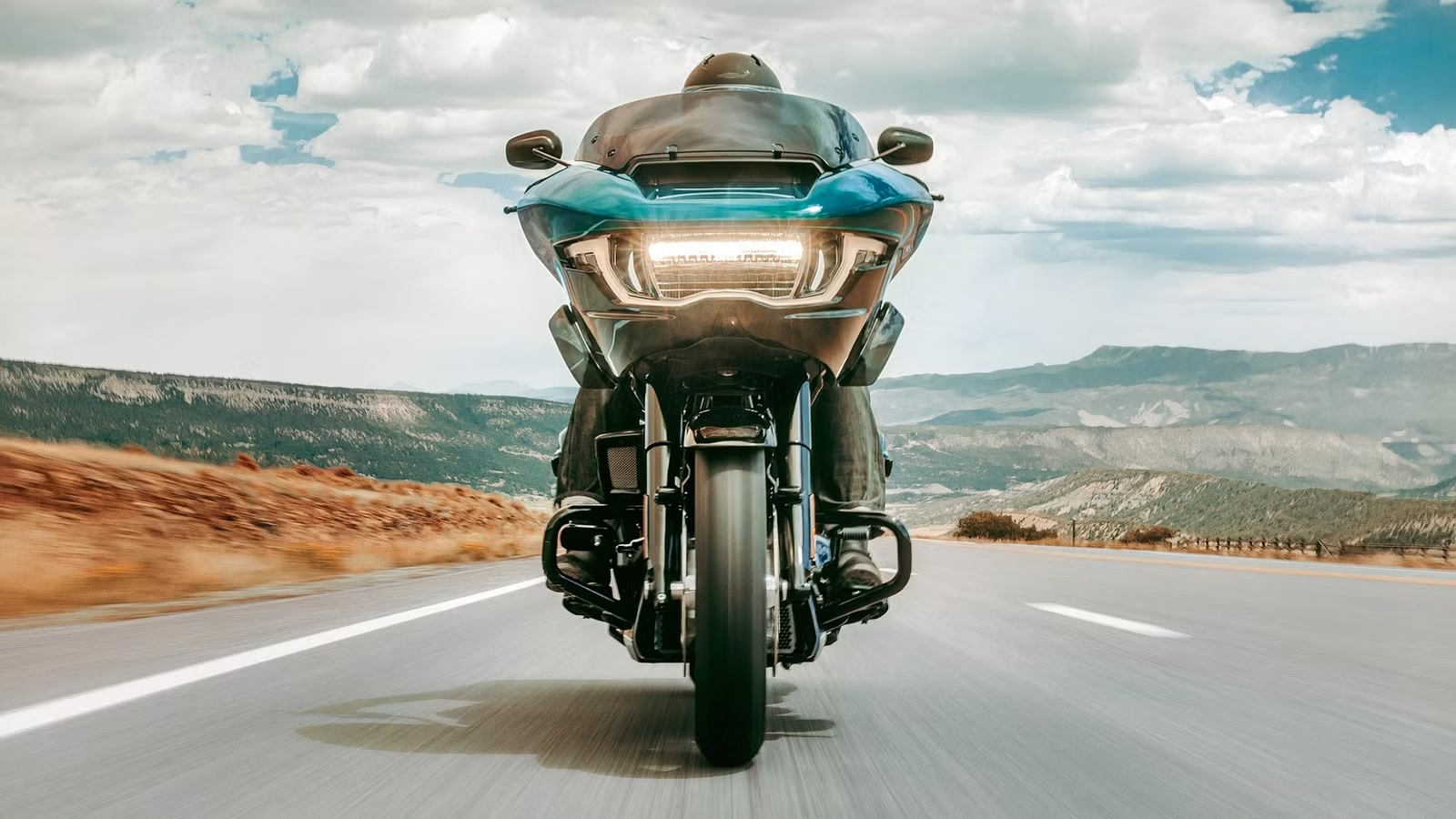
The Road Glide’s defining feature is its fixed Sharknose fairing. Unlike the Batwing fairing fitted to the Street Glide, the Road Glide’s fairing is attached to the motorcycle’s frame rather than turning with the handlebars. That difference becomes increasingly valuable as speed and wind pressure rise. A fork-mounted fairing moves with the steering assembly, so aerodynamic loads acting on it can be felt more directly through the handlebars.
The effect is not necessarily troublesome, especially under normal conditions, but gusts and turbulent air from large trucks can introduce additional steering feedback. Because the Road Glide’s fairing is supported by the frame, much of that load is kept away from the handlebars. Reviewers have pointed out that the rider does not have to manage the mass of the fairing every time the front end changes direction, even though they still feel the weather.
How Harley’s CFD Work Kills The Low-Grade Neck Workout You Never Signed Up For

Harley didn’t just bolt a fairing to the frame and call it a day, either. The currentSharknose was shaped using computational fluid dynamics to manage where air goes once it hits the front of the bike, and the payoff is a trio of “Splitstream” vents that redirect airflow around the rider’s helmet instead of letting it churn into turbulence. Helmet buffeting is one of those problems that feels minor in short bursts and becomes exhausting over time — a low-grade neck workout that never really lets up.
Low-RPM Highway Cruising Is the Real Trick Behind A 500-Mile Day
The Milwaukee-Eight V-Twin Muscle

The 2026 Road Glide is powered by Harley-Davidson’s liquid-cooled Milwaukee-Eight 117 V-twin. This engine produces a claimed 105 horsepower at 4,600 rpm and 130 pound-feet of torque at 3,250 rpm. Those figures are substantial, but the location of the power matters more than the peak output. Harley says the torque arrives low enough in the rev range to support relaxed highway riding, decisive overtakes, and steady climbs without making the rider continually work through the transmission.
The Milwaukee-Eight 117 also uses liquid-cooled cylinder heads to improve thermal management. That cannot remove every trace of heat from a 117-cubic-inch V-twin, particularly when the motorcycle is stationary in summer traffic. It can, however, help regulate engine temperatures during slow sections and hot-weather riding, when excess heat around the rider’s legs becomes another source of fatigue.
What The Milwaukee-Eight 117 Contributes Between Stops

The Road Glide carries a six-gallon tank and returns an estimated 44 mpg, which works out to roughly 260 miles of realistic range per tank. Split that against a 500-mile day, and the arithmetic is almost boring: two fuel stops, not four or five. Every stop means slowing down, hunting for an exit, killing momentum, then rebuilding it. Two stops instead of four isn’t just less time at the pump — it’s meaningfully less mental overhead across a full day.
Interstate Refinement And Electronic Controls

A six-speed Cruise Drive transmission with tall overdrive gearing keeps engine speed low at highway pace, cutting down on vibration through the pegs and bars over hours of riding. Selectable Ride Modes — Road, Sport, Rain, and a custom setting — let riders dial in throttle response and traction control instead of living with a one-size-fits-all tune. And standard cruise control does something simple but significant: it takes the right hand off constant throttle duty. Multiply that relief by eight or nine hours, and it’s more than just a minor convenience.
An Ergonomic Position You Can Actually Dial In
Small Adjustments, Fewer Corrections Over Hours

The Road Glide’s handlebars offer 27 degrees of adjustability, letting riders roll them forward or back to find a reach that actually fits, instead of adapting to whatever position the factory defaulted to. Add a 26.6-inch laden seat height and a one-piece seat shaped to spread pressure evenly, and the bike is quietly closing the gap between a position that’s comfortable at mile one and one that’s still comfortable at mile 300.
The floorboards add another advantage. Unlike fixed foot pegs, they allow the rider to move each foot forward or backward during the ride. That small amount of movement can reduce stiffness in the knees, hips, and ankles without requiring highway pegs or a major change in posture. A riding position that’s 90 percent right at sunrise can become a real problem by mid-afternoon. Small, dialed-in adjustments are what keep that last 10 percent from turning into a distraction.
The Weight You Only Feel When You’re Not Moving

The Road Glide weighs 838 pounds in running order. There is no useful way to pretend that it is light. Its mass becomes obvious when lifting it off the side stand, backing out of a sloped parking space, performing a tight U-turn, or paddling around a fuel station. Once moving, however, the same weight that demands attention in a parking lot contributes to the bike’s planted highway character.
The 64-inch wheelbase and low center of mass help it track steadily, while the fixed fairing keeps aerodynamic loads from making the steering feel unnecessarily heavy. Harley-Davidson also equips the Road Glide with 19-inch front and 18-inch rear cast-aluminum wheels. The company says the lighter wheel design helps improve maneuverability, particularly compared with heavier rotating components.
Source: Harley-Davidson

Related posts

Latest Post


No Comments