
The Forgotten Yamaha 250 Racer That Won Daytona Before The TZ Existed
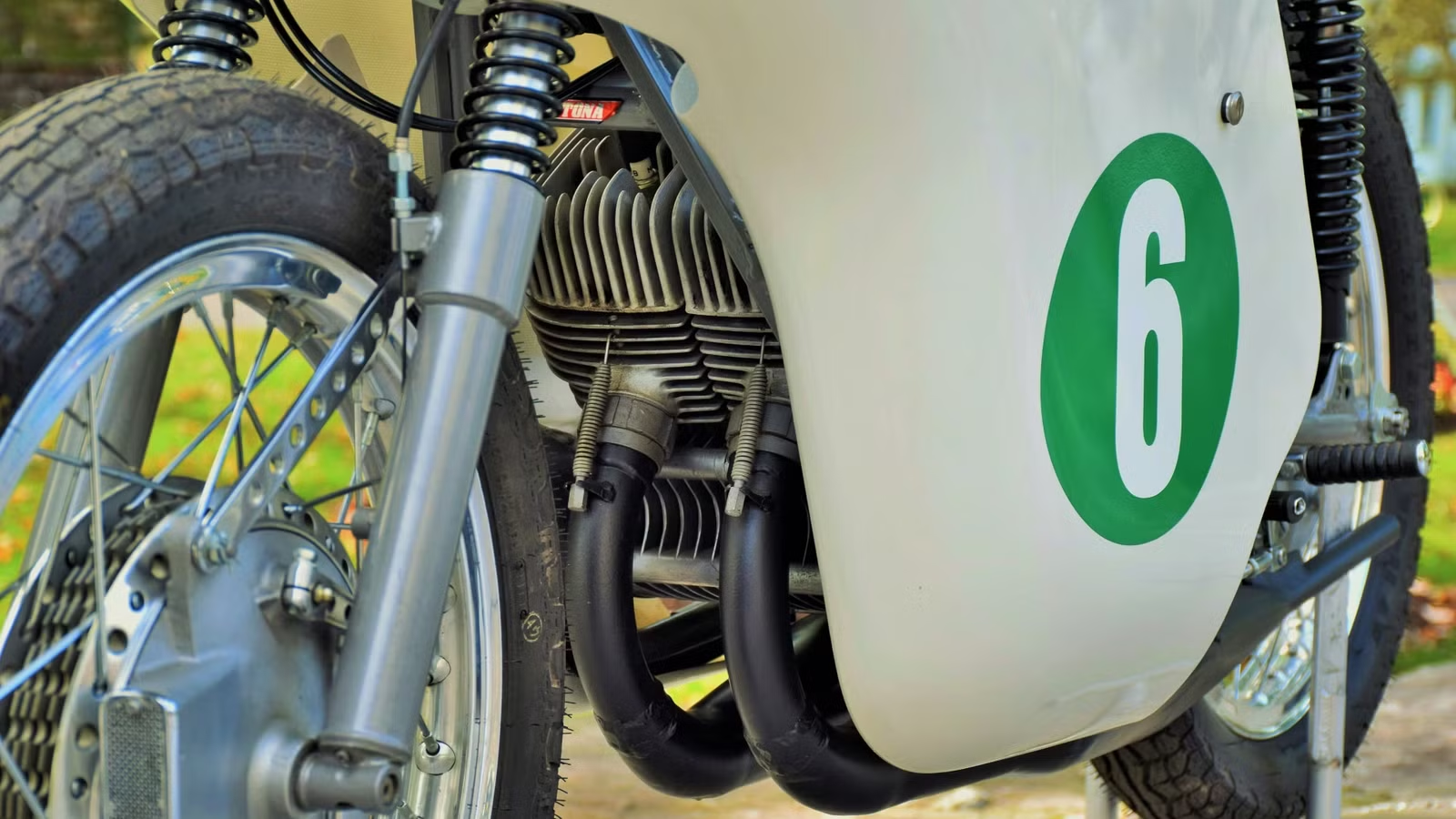
Customer bikes have typically been seen as a step below “proper” factory machinery. Cost concerns mean they typically don’t have the same level of development as factory bikes, nor do they have the same level of engineering. They might be good as a passable race bike but, if you’re going up against factory teams, you shouldn’t really expect to win. That was true until Yamaha created one of the most exciting, capable 250 cc machines of the 1960s and helped privateer teams to take wins at incredibly high levels.
Before the TZ Era, Yamaha Was Already Building Giant Killers

While Yamaha’s TZ era, which started in the early 1970s, established the brand as a performance powerhouse, it wasn’t the start of Yamaha’s winning streak that actually started as soon as they started making bikes. The Yamaha YA-1, a 125 cc ultralight, won its very first race (the 1955 Mount Fuji Ascent Race), while its YDS series would take wins globally. Yamaha’s aggressive two-stroke development, coupled with its willingness to take learnings from the track and port them to its road bikes, ensured that it could rapidly iterate and improve. It even delved into the world of customer racing support, something many other brands didn’t do, and allowed privateers to buy its racing machines. It even won on the world stage, with British rider Phil Read taking four 250 cc Grand Prix Motorcycle Racing championship titles and one 125 cc title aboard Yamahas, en route to 500 cc titles with MV Agusta.
 91 autotech
The Forgotten Honda Twin That Made The CB750 Possible Eight Years Early
A tiny overhead-cam Honda lit the fuse for Japan’s superbike era years before the CB750 got the glory.
Daytona’s Lightweight Classes Became A Battleground For Global Manufacturers

From its beach and dirt origins at the turn of the century, the Daytona 200 had become one of the biggest tests of a motorcycle by the late 1960s. Though not the biggest motorcycle race in the world (that honor arguably sat with the Isle of Man TT), it was the premier one-day event, and certainly the largest in the Americas. This offered brands a chance to display their machinery to the US market directly, and led to brands like Harley-Davidson, Norton, and Triumph fighting for class honors. While the larger-displacement categories received the most attention for the overall win, the lower-displacement classes allowed manufacturers to compete on much smaller budgets. It would be here that Yamaha focused its efforts in 1967, developing a bike that would go on to become its racing blueprint.
The Yamaha TD1C Was The Customer Racer That Put Yamaha On Top

|
Engine |
Power |
Top Speed |
|
247 cc two-stroke |
38 HP |
128 MPH |
Manufacturers rarely let their best work slip into the hands of customers. You see it everywhere — factory teams and privateers may run the “same” equipment, but the factory team always has an edge. This makes the TD1C even more interesting, as, despite being a competitive 250 cc machine capable of winning, it never had a factory team behind it.
Released in 1967, the TD1C was a customer-only machine and the final in the TD1 line of customer racers. It was a 247 cc machine, but that is roughly where the similarities between Yamaha and Europe’s offerings ended, as the Japanese bike did things somewhat differently. Starting with the engine, the TD1C was an air-cooled parallel twin two-stroke, while European bikes like the Aermacchi Ala d’Oro 250, Benelli 250 Grand Prix, and Moto Morini 250 Bialbero were four-stroke twins. This helped the Yamaha to extract more power and hit higher revs than the more complex four-strokes.
Peak power arrived high in the rev range (around 7,000 rpm), which meant constant gear changes were required. No problem for the Yamaha, though, as it had an eight-speed gearbox (still uncommon today, let alone in the mid-1960s). These extra gears didn’t come at the expense of weight, though, as the bike retained a nimbleness that would prove effective on track.

That is because, despite being a customer racer (and its success relying entirely on the skill of the riders who chose to buy one), it was still a formidable track weapon. The bike’s power and famous Yamaha reliability helped it to win multiple domestic championships in France, and a modified bike took Derek Chatterton to the British 250 cc National Championship. But while national championships are good, its crowning glory was at Daytona.
By the late 1960s, the Daytona 200 had become a powerful marketing tool. Manufacturers released Daytona-specific models to commemorate victories, as the old “win on Sunday, sell on Monday” proved true. Yamaha understood this and, while the TD1C was a customer bike, partnered with American and one-time Grand Prix Motorcycle Racing race winner Gary Nixon to provide a factory-supported entry into the 100-mile 250 cc support race. Nixon would not only win the race aboard the Yamaha, but would become the first person ever to complete “the double” — taking the outright 200 win on a 500 cc Triumph.
Its Combination Of Speed, Simplicity And Affordability Changed The Game

The TD1C had three things that riders needed — mechanical simplicity, Grand Prix performance, and relative affordability.
The power (which was 8 hp more than the TD1-B predecessor) meant it could compete with even factory-backed teams in the right circumstances, but it remained accessible enough for club-level riders, with a top speed of around 130 mph. Meanwhile, its air-cooled engine was relatively easy to maintain between meetings, which reduced both downtime and expense.
The price also helped riders get into the bike (prices of the time are disputed, but the TD1B retailed at $1,147 ($11,436 today). This somewhat modest price lowered the barrier to entry for many, though with only 320 units produced, it remained a coveted option.
This not only proved the efficacy of the Yamaha, but also that of the racing 250 cc as a class. As the 1960s wore on, more and more manufacturers dropped the more complex four-cylinders in favor of two-cylinders, hastening the rise of two-cylinder machines in racing.
The Honda Motorcycle That Secretly Birthed The Superbike Era
Before superbikes became a category, Honda built the machine that changed everything forever.
The TD1C Laid The Foundation For The Legendary TZ Dynasty

The TD1C wasn’t a TZ, but it paved the way for what the TZ era would become. It showed that there was a market for Grand Prix performance in customer-racer form and factory-level engineering without factory support. It also showed that the two-cylinder, two-stroke format was one that could be both commercially and competitively successful, and while the TZ would have some improvements like liquid-cooling and reed valves by the end of its run, the early work by the TD1C enabled the TZ to fly.
The TD line also established Yamaha as a serious competitor. Winning big-name races instantly put Yamaha on the map for young hopefuls wanting to get into racing without a big budget, and the bike’s reliability made it a straightforward choice.
The TD1C became the prototype for Yamaha’s customer-racing approach. Yamaha would iterate on it with the TZ series, adding increasingly sophisticated elements as development progressed, but the TD1C proved that a simple, powerful bike was more than enough for the masses. And in doing so, it helped shape Yamaha’s legacy to this day.
Sources: Classic-Motorbikes.net, Moto-Collection.org, WebBikeWorld, American Motorcyclist, Mecum

Related posts



Latest Post


No Comments