
The Forgotten Nissan Wagon With Two Spark Plugs Per Cylinder
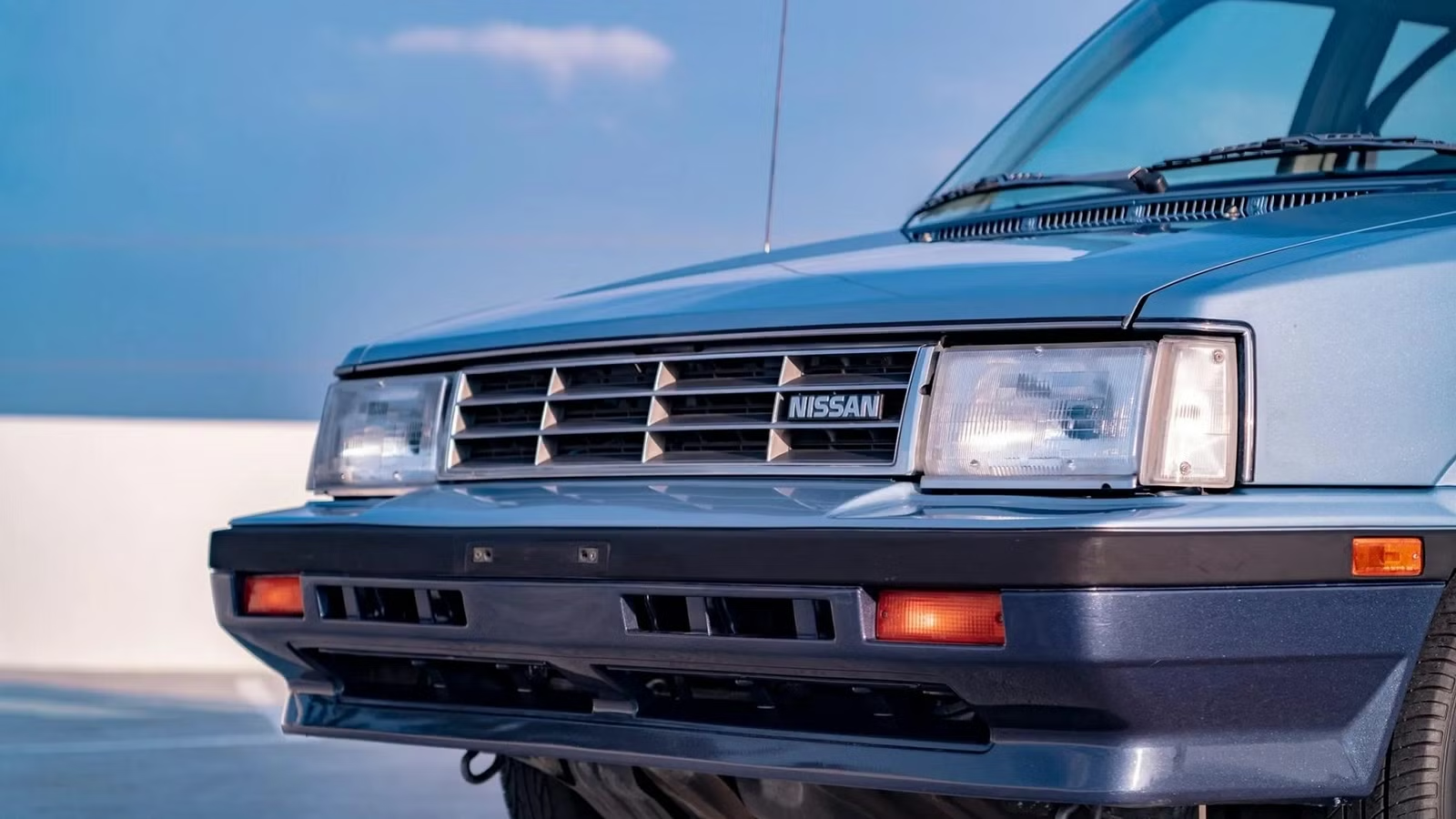
Eight spark plugs usually sound like V8 business. In one odd Nissan, though, they belonged to a four-cylinder family box with the profile of a backyard shed and the urgency of a toaster oven. Under its flat hood sat a head-scratcher of an engine: two spark plugs per cylinder, four cylinders, eight chances for a parts-store clerk to ask, “Are you sure?”

That strange setup made this forgotten family hauler a perfect snapshot of the mid-1980s, when automakers used clever, awkward, and sometimes overbuilt fixes to solve dull problems. But why did Nissan give a plain people mover such a fussy cylinder-head setup, and why was the body just as unusual? All the answers are below.
The 1980s Forced Automakers To Get Creative With Ordinary Engines
By the middle of the 1980s, car companies had to solve several problems at once. Emissions rules pushed them toward cleaner burn and tighter fuel control. Fuel economy rules pushed them toward leaner, smarter, lighter cars. Buyers still wanted cheap transportation with room for kids, groceries, and whatever mystery smell lived in the soccer bag. The era rewarded clever solutions and also punished engineers who tried to solve every problem with displacement, because gas prices, regulators, and insurance forms had already taken away that easy option.

Those solutions were not what gearheads look for when modifying their cars. The three-way catalytic converter and oxygen-sensor closed-loop fuel control had become core tools for cutting hydrocarbons, carbon monoxide, and nitrogen oxides from gasoline cars by the early 1980s. Federal fuel economy standards also pushed passenger-car fleet averages toward 27.5 mpg by the 1985 model year. That meant engineers had to pull more cleanliness and mileage from the same humble iron blocks, often without making the car expensive, fragile, or too strange for a showroom. Fuel injection, swirl ports, dual ignition, exhaust gas recirculation, and early computers all became part of the ordinary-car toolbox.
Japanese automakers faced another twist in the United States: import limits. In 1981, Japan agreed to voluntary export restraints on cars sent to the U.S. market, which made every imported model carry more weight on the sales floor. A practical compact had to haul, sip fuel, satisfy regulators, and look like a sensible answer to a household budget. Fun, in that world, often meant “it starts every morning.” Wild stuff.
Nissan’s Most Ambitious Engine Took 20 Years To Build And 767,000 Recalls To Destroy
Nissan spent over 20 years building something no one else would attempt, and the result didn’t unfold the way anyone expected it to.
This Wasn’t A Sports Wagon, And That Makes The Engine Even Stranger

That background makes one boxy Nissan seem even odder. Two spark plugs per cylinder sounds like something a brochure would brag about on a performance engine. Enthusiasts hear “twin spark” and think about Alfa Romeo, quicker burn, exotic cylinder heads, maybe a clever way to wake up a high-strung motor. Nobody expects that kind of detail in a tall family appliance with sliding doors, a big glasshouse, and the visual punch of a file cabinet.
The car played the role of a sleeper in reverse. A normal sleeper hides serious speed under boring paint. This thing hid unusually busy engineering under boring paint, then delivered the kind of acceleration that made merge lanes feel like oral exams. The engine bay had more ignition hardware than expected, but the driver did not get more power. The drama mostly happened when someone had to buy plugs. But enthusiasts love cars that make no sense, and this one made no sense in a way that involved service parts, emissions strategy, and family access. Truly, a three-course meal for the obsessive car enthusiast.
The Japanese Sports Car The Collector Market Forgot To Inflate
Thought you’d missed the boat when it comes to JDM classics? Think again.
The 1986 Nissan Stanza Wagon Is A Forgotten Wagon With Two Spark Plugs Per Cylinder

|
Engine |
Power |
Torque |
0-60 MPH |
Top Speed |
|
2.0-liter inline-4 |
97 hp |
114 lb-ft |
13.7 seconds |
99 mph |
The mystery box was the 1986 Nissan Stanza Wagon. Nissan sold the same basic vehicle as the Multi in Canada and as the Prairie in other markets, where it had already begun its strange life as a tall, flexible people mover. In the U.S., the Stanza badge made it sound related to a normal compact family car. That undersold the weirdness by about one full sliding door.
Under the hood sat Nissan’s CA20E, a 2.0-liter, single-overhead-cam inline-four with multiport fuel injection. It was not a CA20DE, despite the way the internet sometimes rewards confident wrongness. The CA20E used a simple two-valve head, and some versions used Nissan’s NAPS-X dual-plug layout. In U.S. Stanza Wagon trim, spec listings put output at 97 horsepower and 114 lb-ft of torque. That was enough to move the family, but not enough to move the soul, unless the soul packed light. The motor had a cast-iron block and an aluminum head.

The two-plug idea made sense once speed left the room. Nissan used the extra spark to improve the burn inside the cylinder, which helped the engine meet emissions needs and use fuel more cleanly. The goal was faster combustion by shortening the flame travel inside the chamber. The Stanza Wagon’s CA20E used the same basic logic to make an ordinary engine behave better under 1980s rules.
The rest of the vehicle matched the engine’s “wait, what?” energy. The Stanza Wagon had a tall roof, a stubby footprint, dual sliding rear doors, and no traditional center pillar between the front and rear openings. That pillarless construction gave the car access more like a van than a wagon. It lived in the blurry zone between wagon, van, and the early idea of a compact crossover before marketing departments had polished that phrase into showroom furniture.
The Body Was Just As Strange As The Engine

The body was as important as the engine, because the Stanza Wagon used the sliding doors and open side structure to make a small vehicle act big. With both doors open, passengers could climb in without the usual sedan gymnastics. Parents could reach kids, bags, and dropped crayons without folding themselves into a question mark. The first-generation Prairie used sliding doors on both sides and no central pillar, a setup Nissan claimed was unseen on any other passenger vehicle at the time.
The space numbers still make the idea look clever. With the seats folded, owners could get about 80 cubic feet of cargo room, a huge figure for something with roughly a 99-inch wheelbase. For context, that meant the vehicle parked like a compact but swallowed gear like it had been studying van behavior after school. The exterior looked like a box because the interior needed the box. Sometimes, honest design looks awkward because it is too busy being useful. Modern buyers now accept tall roofs, upright tailgates, low load floors, and command seating as normal crossover traits. The Stanza Wagon tried many of those ideas before the market had a neat badge for them.

Of course, packaging magic always sends a bill. Removing the normal B-pillar helped access, but it also made the structure unusual, and owners and reviewers have long noted the flexible feel of the body. The tall glass, high seating, and flat-sided shape gave the driver a great view and the car a cheerful appliance vibe. Push it hard, though, and the suspension and body reminded everyone that Nissan built it for errands, not apexes. The cornering attitude could be summarized as “please stop asking.” None of this ruins the concept, though, it just shows how early the experiment was. Before computers, exotic steel, and modern crash structures could clean up the tradeoffs, Nissan had to make the big opening work with 1980s tools.
The design lineage also deserves a careful look. This was not simply a Japanese copy of the Chrysler minivan formula. The thinking traced back to Giorgetto Giugiaro’s 1978 Lancia Megagamma concept, an Italdesign project that pushed height, flat-floor packaging, comfort, and interior volume over the long-low look of the 1970s. The safer label for the Stanza Wagon is not “first minivan” – it is a proto-crossover, tall-wagon experiment, or compact MPV with ideas that aged better than its acceleration.
The Most Affordable New ICE Euro Coupe With Over 500 Horsepower
There’s one new German coupe that sits at the top of the affordable 500-plus-hp pecking order on the European front, and it might just surprise you.
The Stanza Wagon Was Slow, Weird, And More Important Than You Think
The most interesting thing about the 1986 Stanza Wagon is not speed, value, or beauty. It has none of those in excess, and beauty may need a committee meeting. Its real charm comes from the way Nissan attacked boring problems with real imagination. Emissions? Add another spark event. Cargo access? Remove the middle pillar and fit sliding doors on both sides. Family use? Build upward instead of outward. That approach feels very 1980s in the best way.
That mix makes the twin-plug CA20E feel like a period-correct hack. Engineers had to clean up combustion before modern variable valve timing, direct injection, and dense engine computers became normal. Two plugs per cylinder added cost and service fuss, but it gave Nissan another way to light the mixture and manage emissions. It was ingenious in the way duct tape on a moon mission is ingenious — it worked because someone had to make it work.
So this forgotten Nissan deserves a second look. It could not outrun much, and it probably never made a teenager tape a poster to a bedroom wall. Yet it packed a twin-spark emissions solution, van-like access, compact dimensions, optional four-wheel drive, and early tall-wagon logic into one nerdy little family hauler. It solved dull problems in memorable ways. That may not make it fast, but it makes it worth remembering.
Source: Nissan, Hello Road

Related posts



Latest Post



No Comments