
The Motorcycle That Quietly Offers The Best Value In Its Segment
Modern motorcycles, like anything else, have become more specialized over the decades. Today’s customer demands race-derived products for the motorcycles they ride on the street. On the face of it, these are opposing things. Motorcycles designed for a racetrack are high-strung and are expected to be serviced after every race, whereas street bikes have a service schedule and speed limits to stick to. However, this demand for bigger, better, faster vehicles has meant that manufacturers now offer motorcycles with premium components and ever-bigger horsepower figures, and this in turn means prices that have an ever-higher number.
The Naked Bike Segment Is a Microcosm of This Problem

The naked bike segment illustrates the problem clearly. Historically, a naked bike was a simple, stripped-down machine whose main purpose was utility on a daily basis and easy repairability. Today, it has transformed, and the best examples of naked bikes are track specials with a different seating position and not many other changes. You only have to look at the BMW M 1000 R and the Ducati Streetfighter V4 and their winglets to know that these aren’t stripped-back or everyday motorcycles.

Then, there’s value. This can mean different things to different people, but the general definition is getting the most features or performance for the money, or even getting a motorcycle from a higher displacement class for less. This is easier said than done, particularly for liter-class nakeds. After all, the extravagant tech and performance isn’t cheap to produce. Look hard, though, and you will find some hidden gems that manage to do so.
Honda Has Always Been A Champion Of Value

If you’re looking for such a high-value bike, you’re most likely going to find it with the wing badge on the tank. Honda has been the best at making high-value products over the decades, no matter what class or target audience it is aiming for. When it decides to make a completely value-driven product, you can be assured that that’s what you’re going to get, and what it offers for the price is going to surprise you. A prime example of that has been some of its recent offerings, like the CB750 Hornet, CB1000 Hornet SP, and XL750 Transalp. Now, another one quietly joins the party and decimates its competition.
The Honda CB1000F Quietly Offers The Best Value In Its Segment

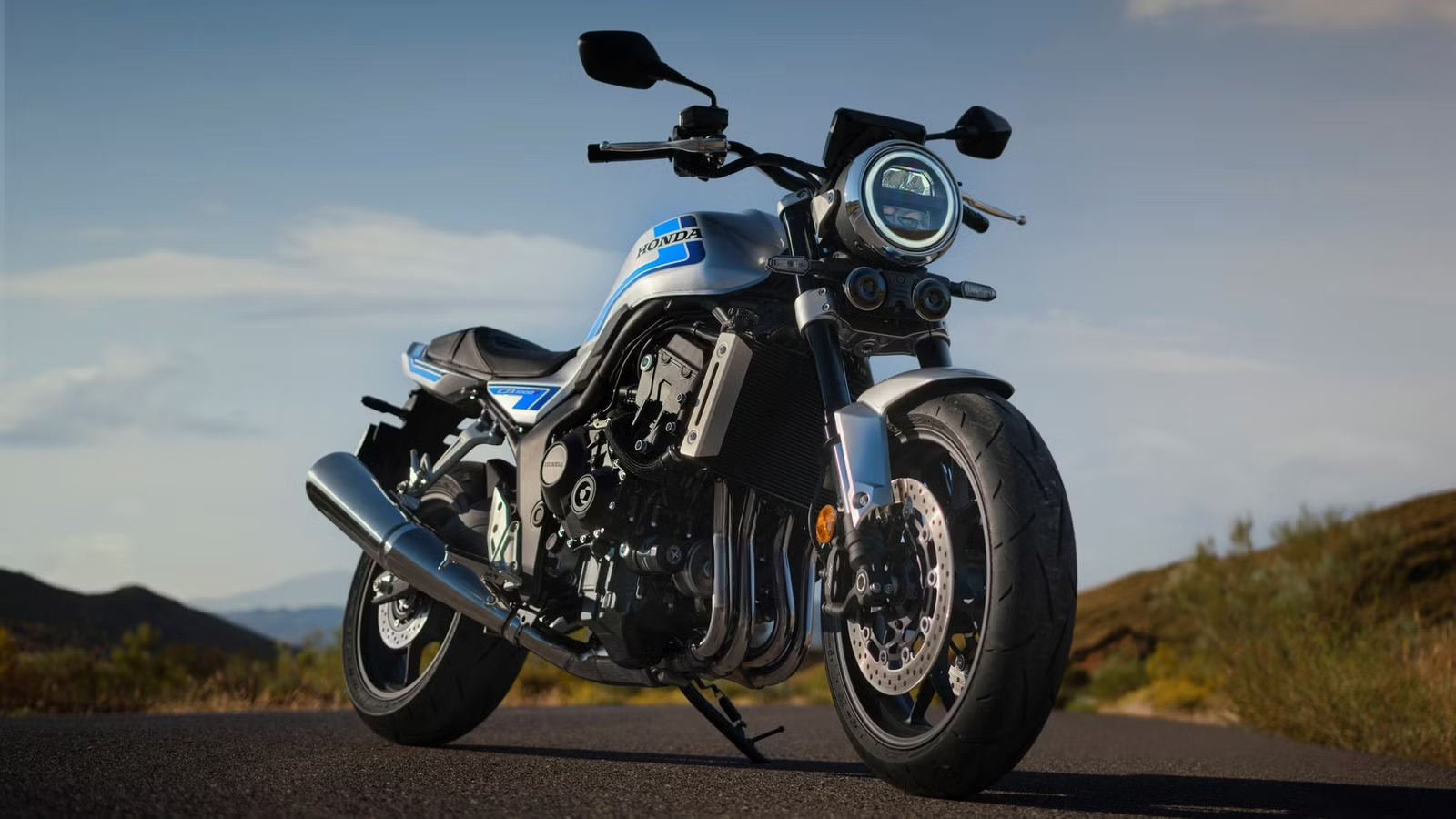
Honda’s CB1000 Hornet SP is a roadster that nails the balance between affordability and high-end feel. Seriously — look at the price tag, and you’ll be surprised that a product with a rear shock that is usually reserved for track-day specials costs as little as it does. The CB1000F takes things two steps further by going for the retro look and keeping things even simpler. This has helped it drop its price to compete with premium middleweight bikes while still offering Honda’s legendary quality of construction, reliability, and ownership costs. It is definitely the motorcycle that quietly offers the best value in its segment.
Scarcely Believable MSRP At Under $11,000

The CB1000F is priced at $10,599, which is the exact same price that Yamaha asks for its XSR900. Sure, the Yamaha is a premium product, but it still remains a middleweight option, whereas the Honda is a liter-class, inline four-cylinder machine. If you look at the other competition around a similar price point, the Triumph Speed Twin costs nearly a thousand dollars more. Similarly, that CB worries the Kawasaki Z900RS and BMW R 12 as they fall into a similar expensive bracket. And while the Suzuki GSX-8T has a very similar price tag, it is not anywhere close to the Honda when it comes to performance. The Honda simply crushes everything else.
This Engine Focuses On Torque Rather Than Power

The CB1000F’s engine is similar to the surprisingly fast and fuel-efficient CB1000 Hornet. So you get 999 cc, a bore and stroke of 76 mm and 55.1 mm respectively, and an 11.7:1 compression ratio. Honda has changed the internal parts, though, for a different sort of power and torque delivery that suits the retro looks. The changes include different camshafts, a longer intake funnel that is narrower, and a new airbox.
The result is 122 horsepower at 9,000 RPM and 76 pound-feet of torque at 8,000 RPM. Power is sent through a six-speed manual gearbox with an assist and slipper clutch and a chain final drive to the rear wheel. Honda has made gears three to six taller than the Hornet’s, which means this is a more relaxed motorcycle with better fuel efficiency at cruising speeds.
A Simple Steel Chassis Pairs Up With Showa Suspension

The CB1000F features a steel trellis frame much like the CB1000 Hornet’s. But the subframe is longer and more horizontal to accommodate a one-piece seat, making it a perfect retro bike for enthusiasts. While this indicates that pillion comfort will be better on the CB1000F, it’s important to point out that these subframes are welded on. The swingarm also differs from the Hornet’s, and the link-type rear shock is mounted differently.
Speaking of which, Showa provides the suspension at both ends, featuring 41 mm inverted front SFF-BP (Separate Function Fork – Big Piston) forks and a rear shock, both with adjustability. The brakes consist of twin 310 mm discs at the front with radial-mount four-piston Nissin calipers, and a 240 mm rear disc with a Nissin caliper as well. These are mounted on 17-inch aluminum alloy wheels with radial tubeless tires.
The Weight Is Over 470 LBs
This is where you realize why the CB1000F is so affordable. Honda quotes its wet weight as 472 pounds, which is significantly heavier than the XSR900, but impressively, it is still a few pounds less than the Z900RS. The rest of its dimensions are quite conventional, with a seat height of 31.3 inches, a wheelbase of 57.2 inches, and a ground clearance of 5.3 inches. The new retro tank holds 4.2 gallons of fuel.
The Addition Of A Six-Axis IMU Is A Pleasant Surprise

The CB1000F might look retro, but it features a modern 5-inch TFT instrument cluster equipped with Bluetooth and navigation as standard. Additional standard equipment includes keyless ignition, all-LED lighting, and backlit switchgear. The options list features practical items, including a quickshifter, center stand, and luggage options, making it the most balanced choice of 2026. Interestingly, just like the Yamaha XSR900, the headlight cowl and bar-end mirrors from the Sport Pack that convert it into a proper cafe racer are not available here.

In a surprising turn of events, the CB1000F features a six-axis IMU, while the more premium and sportier CB1000 Hornet SP does not. This adds cornering-enabled functionality wherever applicable. The rest of the electronic parameters remain similar, offering traction control, ABS, engine brake control, and power modes. There are five ride modes: three are factory presets, and two are user modes that let you mix and match settings to suit your preferences.
No Real Competition With The Same Combination Of Specs And Price

There are a surprising number of products that occupy the same space as the CB1000F. Even more surprisingly, none of them occupy the same combination of specs and price as the Honda. The BMW R 12 is an often-overlooked product, but it is also a premium one, so it does not play the value game with a base price of $13,145. Whereas, the Suzuki GSX-8T has an almost identical price, but its performance puts it squarely in a segment below. These are the three motorcycles we will have to eliminate.

A left-field choice is the Triumph Speed Twin 900 that retails for $11,495. What you get here is not just a retro-looking bike, but it feels retro in a good way with its parallel-twin engine and its 270-degree firing order. Triumph does not skimp on equipment, however, so you get a product that is equal parts exotic, retro, and modern. Since it is a twin-cylinder engine, it depends on its torque rather than a high horsepower figure.

There is also the Kawasaki Z900RS priced at $12,899. This follows the same format as the CB1000F. It has a six-axis IMU, which explains some of the premium Kawasaki asks for. However, it is down on power and is heavier than the CB1000F, so it is not necessarily the best choice if you do not want the CB1000F. We cannot deny, though, that the Z900RS Cafe looks the business among all these bikes available in the United States.

The main competition for the CB1000F, then, is the Yamaha XSR900, a product that perfectly captures Yamaha’s DNA. We can say this with confidence because Honda has priced its product exactly the same as the XSR, down to the dollar. This makes a little less power at 117 horsepower, but it also weighs 25 pounds less. It also has better cycle parts, with an aluminum twin-spar chassis, and the crossplane three-cylinder engine lends itself very well to a wide torque spread. But for pure power, cylinders, and overall retro looks, the Honda cannot be beat.
Source: Honda PowerSports

Related posts


Latest Post


No Comments