
The Forgotten Lincoln Land-Yacht With A BMW Turbodiesel Under The Hood
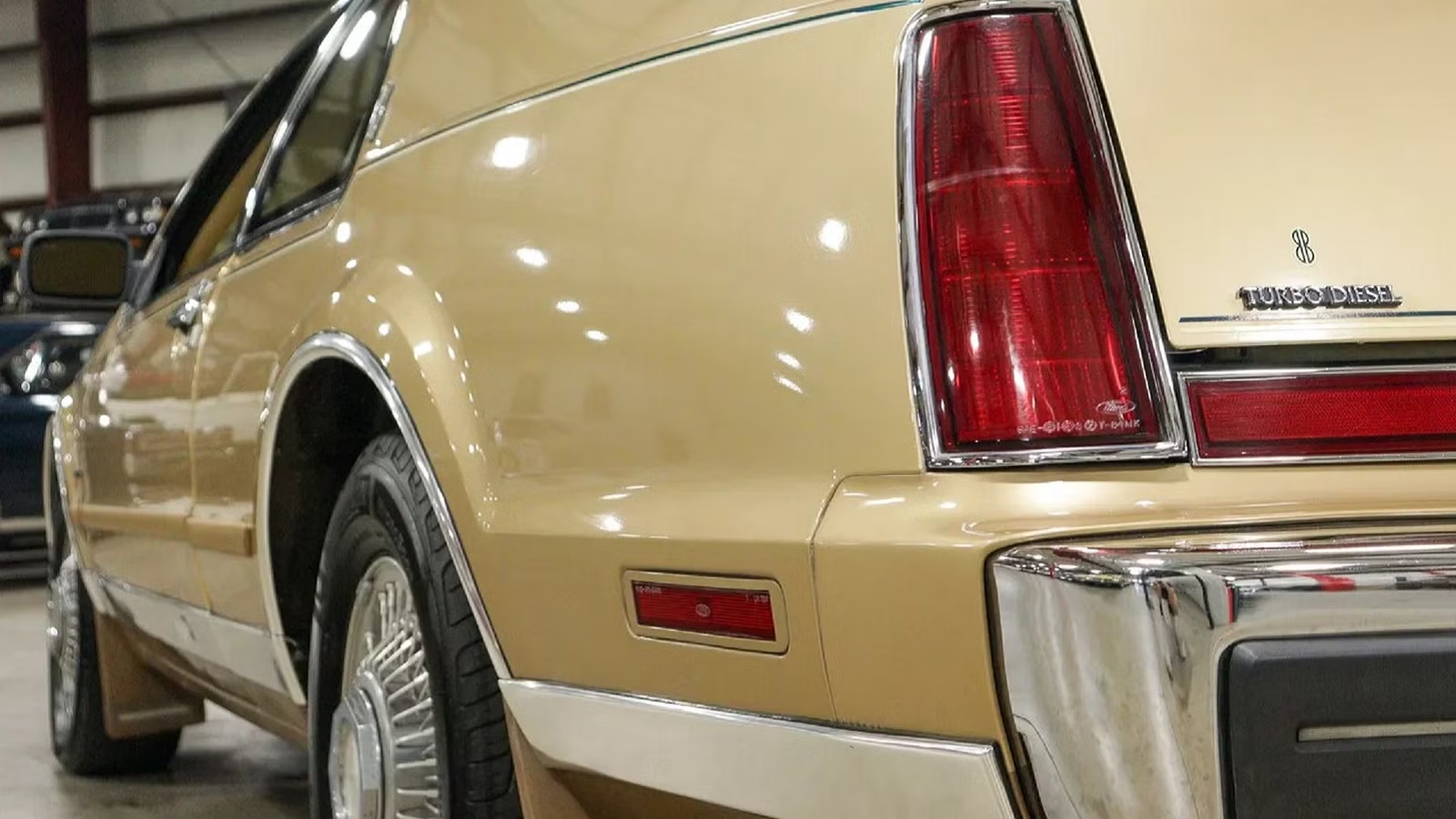
American luxury cars once had a simple formula: big body, soft seats, long hood, and plenty of cylinders, but then fuel economy started crashing the party. Suddenly, engineers had to figure out how to keep a prestige car feeling expensive without feeding it gasoline like a small yacht. One Detroit brand tried an especially odd solution, reaching across the Atlantic for hardware that seemed completely out of character. The result was slower, more efficient, mechanically fascinating, and so unusual that many enthusiasts still have no idea it ever left a showroom.
America’s Luxury Cars Suddenly Had A Fuel-Economy Problem

The 1970s changed the rules for American luxury cars. The 1973 oil crisis made fuel supply and consumption national concerns, and another oil shock arrived near the end of the decade. A giant sedan with a thirsty V8 could no longer exist in a world where gasoline prices, lines at filling stations, and fuel economy regularly made the news. Detroit could still sell size and comfort, but engineers now had to make those qualities coexist with a much smaller appetite. Congress added extra pressure through the 1975 Energy Policy and Conservation Act, which created Corporate Average Fuel Economy standards. Passenger-car CAFE climbed from 18 mpg for 1978 to 27 mpg for 1984 and 27.5 mpg for 1985.
That last part was actually very important because CAFE looked at a manufacturer’s fleet, not simply one car at a time. An efficient model could help offset another model that drank fuel like the company credit card had no limit. Downsizing, overdrive transmissions, better aerodynamics, smaller engines, and electronic fuel management all became useful tools. Diesel offered another route – a compression-ignition engine could squeeze more miles from a gallon while retaining the low-rpm pulling power that suited a large, relaxed luxury car.
Mercedes-Benz had already shown that wealthy American buyers would tolerate diesel noise in exchange for range and efficiency.

Its diesel models became especially important in the United States after the fuel crises. Diesels accounted for more than 70 percent of its U.S. sales in 1980. The company even sold a turbodiesel S-Class specifically to markets including North America. Diesel therefore had premium credentials – it smelled like a truck stop, perhaps, but it could wear leather seats without getting thrown out of the club.
Ford Went Looking Overseas For An Engine Its Own Lineup Didn’t Have

Ford faced an awkward problem. Lincoln needed better fuel economy, but the company did not have an obvious compact passenger-car turbodiesel that combined useful torque, acceptable refinement, and dimensions suitable for a luxury-car engine bay. Simply converting a familiar American V8 carried risks that were already becoming painfully obvious elsewhere in Detroit. A sophisticated six-cylinder diesel from Europe made more sense, especially if another manufacturer had already spent the money teaching it some manners. The choice also had to fit Lincoln’s image – a four-cylinder diesel might save fuel, but a sewing machine under a long luxury-car hood would have been a tougher sales pitch.
Ford’s answer came from BMW’s engine operation in Austria. The arrangement had deeper roots than the finished cars suggest. BMW’s Austrian arm signed a supply agreement with Ford Motor Company on May 12, 1981, with Ford becoming its third outside customer. After the American company approved the diesel, the first engines headed toward the United States in 1983.
The eventual package went much farther than bolting a foreign engine to familiar Detroit hardware. Ford paired the European six-cylinder turbodiesel with a ZF four-speed automatic rather than the Ford AOD used with its gasoline V8. Engineers also specified far shorter 3.73:1 rear gearing, versus roughly 3.08:1 gearing found in comparable V8 versions, so the modest diesel could get a heavy luxury car moving with less drama. Lincoln also added extra sound insulation, a retuned suspension, a high-output electrical system, extra cooling hardware, and diesel-specific fuel equipment. The ingredients sounded more Bavaria than Dearborn, even though the grille still belonged in an American executive parking lot.
The 1984 Lincoln Continental Really Did Have A BMW Turbodiesel

The mystery car was actually two cars. For the 1984 and 1985 model years, buyers could order the BMW-sourced M21 2.4-liter turbodiesel inline-six in the four-door Lincoln Continental and the new Continental Mark VII coupe. The engine traced its architecture to BMW‘s M20 gasoline straight-six family, but BMW strengthened major components for diesel duty, including reinforced connecting rods, pistons, valves, cylinder-head parts, and a seven-bearing crankshaft. The basic design used a cast-iron block, a single overhead camshaft, swirl-chamber indirect injection, and a turbocharger. Lincoln rated the package at about 114–115 horsepower and 154–155 lb-ft of torque. BMW itself had launched the same basic 2,443-cc engine in the 524td, its first production diesel automobile.
The transmission made the combination even more interesting. Gasoline Continental and Mark VII models used Ford’s four-speed AOD behind the 5.0-liter Windsor V8. Diesel cars instead received the ZF 4HP22 four-speed automatic, complete with overdrive and a lockup torque converter. Then came the 3.73:1 rear axle – that ratio gave the BMW engine extra leverage because 155 lb-ft had a lot less work ethic than the V8’s roughly 250 lb-ft. The shorter axle could not create horsepower, but it could multiply torque at the wheels and keep the engine nearer its useful range. Lincoln also went to unusual lengths to civilize the installation – the Mark VII gained extra engine-bay insulation, diesel-specific cooling equipment, and even a dual-outlet exhaust arrangement associated with the turbo system.

Of course, nobody should mistake that engineering effort for speed. Sources place 0–60 mph somewhere around 13.5 to 14.5 seconds, with variations depending on body style and test method. The contemporary 5.0-liter V8 only made about 140 horsepower, so the gasoline car was hardly preparing for Le Mans either, but it had far more torque and felt less strained. The diesel package also added roughly 400–500 pounds, though that figure varies by model and specification.
Fuel economy supplied the real reason for tolerating all that patience. Modernized EPA data for the 1984 Continental diesel shows ratings as high as 21 mpg city, 29 mpg highway, and 24 mpg combined, compared with about 16 mpg combined for the V8 versions. The cars also carried a 22.2-gallon fuel tank. Multiplying 29 mpg by that capacity gives an idealized highway range of roughly 644 miles before allowing for a sensible reserve. More impressively, period owners and enthusiast sources sometimes report 30 mpg or more on highway trips, which pushes the theoretical number even higher.

The catch appeared on the window sticker — Michigan’s official 1984 price schedule lists a base Continental at $21,769 and its turbo-diesel counterpart at $23,004; equivalent Mark VIIs show the same $1,235 difference. Depending on equipment and how contemporary sources described it, the premium often gets rounded toward $1,500. Either way, customers had to spend more money to accelerate more slowly. What an irony.
The Timing Could Hardly Have Been Worse

Lincoln had solved an early-1980s problem just as that problem started losing urgency. U.S. gasoline prices softened through the middle of the decade, then collapsed in 1986. EIA records show regular gasoline sold through company outlets averaging around 90 cents per gallon by late 1984 and generally remaining below a dollar during 1985. By late 1986, the same series had fallen to roughly 54–55 cents. Now imagine a buyer looking at the diesel’s extra purchase price and suddenly needing far more miles to recover that money through fuel savings. A 600-mile cruising range still looked impressive, but cheap gasoline made the V8’s thirst much easier to forgive.
Diesel also carried baggage that no BMW badge on the engine could erase. General Motors had sold huge numbers of passenger-car diesels around the turn of the decade, most notoriously the Oldsmobile-developed 5.7-liter V8. Owners reported serious problems involving fuel systems, head gaskets, internal durability, and maintenance. A 1988 Transportation Research Board study found that U.S. diesel-car sales had climbed from less than 1 percent of new-car sales in 1976 to about 6 percent in 1981, then crashed back below 1 percent by 1985. The researchers tied that collapse to weaker diesel-fuel savings and the real and perceived problems of GM’s early 5.7-liter diesel.

Lincoln dropped the BMW option after 1985. Exact production remains surprisingly hard to pin down – some published accounts put total diesel Continental production around 1,500 cars or fewer, while Mark VII references commonly repeat a figure of roughly 2,300 diesel coupes. Other retellings combine the two cars differently, producing estimates that approach 3,000. What matters here is the scale: beside the tens of thousands of regular Continentals and Mark VIIs built in those years, BMW-powered examples represented a tiny minority.
Lincoln’s Leftover BMW Engines Found An Even Stranger Second Life

Curiously, the M21’s American adventure did not end with Lincoln. In 1986, the same 2.4-liter BMW turbodiesel appeared in the Vixen 21 TD, one of the strangest motorhomes ever built in the United States. Former DeLorean engineer Bill Collins helped create the low, aerodynamic Vixen around the idea that a motorhome could fit into a normal garage, handle more like a large car, and deliver extraordinary fuel economy. Its fiberglass body stood only about six and a half feet tall, and a rising roof provided extra room when parked. Behind the cabin sat the familiar BMW straight-six, now asked to move an entire house rather than a leather-lined luxury car.
While many sources claim Vixen simply bought surplus M21s left over from Lincoln’s canceled diesel program, the surviving history is less tidy. A detailed account of Vixen’s development says Collins initially pursued an Isuzu diesel, then explored an engine from VM Motori. During that search, he learned that BMW’s Austrian operation had arranged to supply Ford with its 2.4-liter six for Lincoln, and Vixen ultimately used the same M21 family. The same powerplant linked a BMW 5 Series, two American luxury cars, and a low-slung Michigan motorhome. That is wonderfully strange.

That odd family tree explains why the BMW-powered Lincolns deserve more attention than their sales numbers suggest. The engine never turned the Continental sedan or Continental Mark VII into a hidden performance model – it did something more historically interesting. For two model years, Ford sold American luxury cars with a BMW turbodiesel straight-six, a ZF automatic, special 3.73 gearing, diesel-specific cooling and insulation, and a mechanical character unlike almost anything else in Lincoln history.
Today, shared platforms and multinational powertrains barely raise an eyebrow. In 1984, a Lincoln with an Austrian-built BMW diesel under its hood was genuinely bizarre. It remains a small rolling artifact from the moment Detroit tried to solve an American fuel problem with a remarkably German answer.
Source: Ford, Lincoln, BMW, Vixen

Related posts



Latest Post


No Comments