
The Naked Bike That Quietly Outshines Fully Faired Rivals
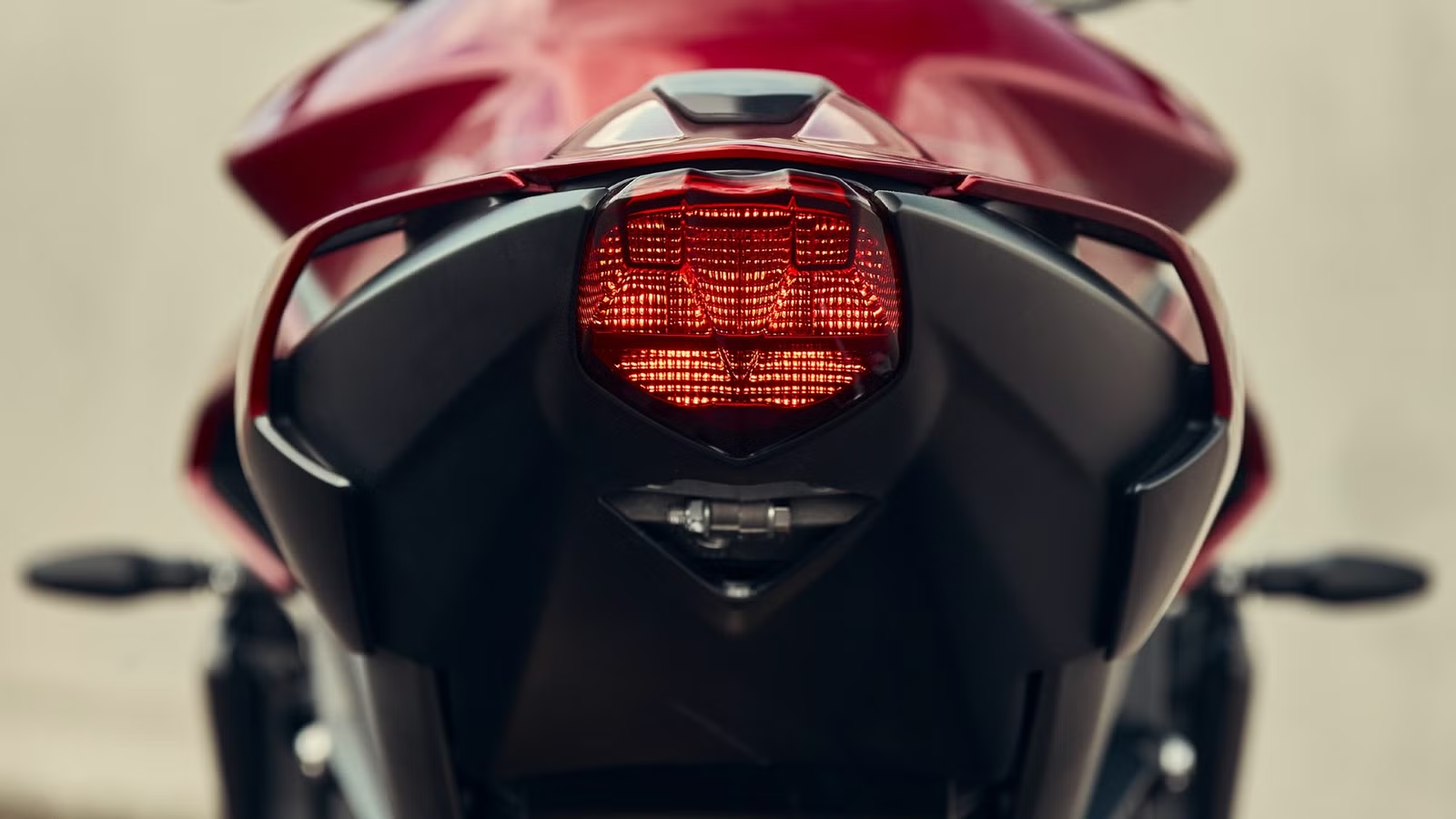
Fully faired sport bikes still own the fantasy. They look faster standing still, they dominate track-day photos, and they carry the sort of visual drama that makes riders forgive sore wrists, hot seats, and insurance quotes that arrive wearing boxing gloves. Fairings make a bike look serious before the engine even fires, and for a lot of riders, that theater is still half the appeal.

But the funny thing about real-world speed is that it rarely cares about posters. It cares about confidence, leverage, throttle response, braking feel, suspension control, and whether the rider can stay relaxed long enough to actually use the performance. That’s where the best modern naked bikes have become a bit dangerous to the old sports bike hierarchy. They may not always win the visual shouting match, but some of them are better at the riding part.
Sports Bikes Still Win The Poster War
There’s a reason fully faired machines still pull people across showroom floors. They borrow their attitude from racing, wrap the rider behind sharp bodywork, and make even a grocery run look like an out-lap at a national-level track day. The proportions are dramatic, the clip-ons mean business, and the whole package sells a very specific dream. It tells the rider they are buying a little slice of paddock life, even if most of that life will happen between traffic lights and potholes.

That dream is powerful because it’s not completely fake. A good sports bike is still one of the purest ways to experience a motorcycle at speed. The front-end feel, the stability, the aerodynamics, and the commitment built into the riding position all make sense when the road is smooth, the corners are linked, and the rider has the space to let the bike breathe. In the right environment, a focused sports bike can be magic. The problem is that most riders don’t live in that environment.
But Their Biggest Strength Can Also Be Their Biggest Compromise

The same things that make sports bikes look and behave like race machines can also make them tiring when the road stops cooperating. Low bars load the wrists, tall pegs fold the knees, and the bodywork that looks so good in a spec sheet can trap heat around the rider when traffic slows to a crawl. Add higher insurance costs, expensive bodywork, and a riding position that keeps asking if you’ve booked a chiropractor yet, and the fantasy starts billing by the mile.
None of that means fully faired bikes are bad. It just means their strengths are narrow by design. They’re built to reward commitment, speed, and focus, which is great until the ride includes stop signs, rough pavement, school-zone traffic, or a 40-minute commute through bumper-to-bumper congestion. The best sports bikes are still brilliant, but they often ask the rider to meet them on their terms. Modern naked bikes have gotten very good at flipping that arrangement around.
Naked Bikes Have Stopped Being The Sensible Backup Plan

There was a time when naked bikes felt like the cheaper, friendlier version of something sharper. You got less bodywork, easier ergonomics, and usually a softened engine or simpler hardware to keep everything civilized. That formula still exists, but it no longer defines the class. The best middleweight nakeds now bring serious suspension, advanced electronics, strong brakes, and engines that don’t need a racetrack to start making sense.
What makes this shift more interesting is that the best examples aren’t trying to cosplay as basic commuters. They’re quick, technical, and genuinely capable, but they don’t punish the rider for using them outside ideal conditions. That balance is hard to pull off. Build one too soft and it loses the bite that makes it exciting. Build one too sharp and it becomes a sports bike with less wind protection. The sweet spot is a very small target, which makes it even more impressive when a bike lands right in the middle.
The Triumph Street Triple 765 RS Quietly Outshines Fully Faired Rivals

That bike is without question the Triumph Street Triple 765 RS, and the reason it works so well is not that it tries to imitate a fully faired sports bike. It outshines many of them by refusing to play the same game. For a current MSRP of $13,545, the RS brings a 765 cc liquid-cooled, 12-valve, DOHC inline-three making 128 horsepower at 12,000 rpm and 59 pound-feet of torque at 9,500 rpm. It uses a six-speed gearbox with Triumph Shift Assist, chain drive, and ride-by-wire fueling.
|
Engine |
765 cc liquid-cooled, 12-valve, DOHC inline-three |
|
Output |
128 horsepower at 12,000 rpm, 59 pound-feet at 9,500 rpm |
|
Transmission |
Six-speed manual with wet multi-plate clutch, Triumph Shift Assist, chain final drive |
|
0 to 60 mph |
Around 3.2 seconds (estimate based on independent testing of recent Street Triple RS models) |
The numbers are serious, but the layout is what gives the bike its edge. Instead of chasing the peaky personality of a supersport inline-four or the thumpy simplicity of a twin, the triple lands somewhere more interesting. It has enough low and midrange urgency to be useful on the street, but it still rewards revs in a way that makes the last part of the tach worth visiting. That is the whole trick. It can be playful at normal speeds without becoming boring when the rider starts pushing.
Its Moto2 Connection Is More Than Marketing Fluff
Triumph loves mentioning the Moto2 connection, and in this case, the name-dropping actually makes sense. The company’s 765cc triple architecture has real racing relevance, but the Street Triple 765 RS doesn’t need to pretend it’s a race bike with a license plate to benefit from it. The engine’s character is the real story. It revs cleanly, pulls with purpose, and has a distinct triple-cylinder rhythm that gives it more personality than the usual middleweight spec-sheet arms race.

That matters because the RS feels special without acting precious. It doesn’t need to be ridden flat-out to be entertaining, and it doesn’t become some nervous little gremlin when the road gets imperfect. The power delivery gives the rider room to work, and the throttle response feels more like a conversation than an argument. This is where the bike starts to make fully faired rivals look a bit one-dimensional. It has the pace, but it also has the patience.
The Hardware Makes The Argument Even Stronger

The RS badge isn’t just a sticker with gym confidence. Up front, the bike gets fully adjustable 41mm Showa Big Piston Forks with 4.5 inches of travel, while the rear uses a fully adjustable Öhlins STX40 piggyback reservoir monoshock with 5.2 inches of travel. Braking comes from dual 310mm floating front discs with Brembo Stylema four-piston radial monobloc calipers, backed by a 220mm rear disc with a Brembo single-piston caliper.
The electronics package also does a lot of quiet heavy lifting. The RS gets optimized cornering ABS, optimized cornering traction control, front wheel lift control, road, rain, sport, track, and rider-configurable riding modes, plus a five-inch TFT display, lap timer, and a switchable optimized cornering ABS setup depending on mode. It rolls on 17-inch cast aluminum wheels with a 120/70 ZR17 front tire and a 180/55 ZR17 rear tire, wrapped in Pirelli Diablo Supercorsa SP V3 rubber.

|
Frame |
Aluminum beam twin-spar frame, two-piece high-pressure die-cast rear subframe, gullwing swingarm |
|
Suspension |
Fully adjustable 41mm Showa Big Piston Fork, fully adjustable Öhlins STX40 piggyback rear shock |
|
Brakes |
Dual 310mm front discs with Brembo Stylema four-piston radial monobloc calipers, 220mm rear disc with Brembo single-piston caliper |
|
Wheels and Tires |
17-inch cast aluminum wheels, 120/70 ZR17 front and 180/55 ZR17 rear Pirelli Diablo Supercorsa SP V3 tires |
|
Wet Weight |
414 pounds |
The Surprise Is That It Makes More Sense Than The Flashier Choice
The surprise isn’t that the Street Triple 765 RS is fast. A naked bike with 128 horsepower, premium brakes, sticky tires, and a proper chassis was never going to be slow. The surprise is how complete it feels without needing the costume. It gives the rider genuine performance hardware, real track-capable electronics, and a motor with a strong identity, but it doesn’t demand that every ride become an endurance contest in the name of looking serious.
That is why it quietly outshines fully faired rivals. It may not have the same visual theater, and it probably won’t win the bedroom-wall poster war against a sharp supersport. But it delivers the part that actually matters once the helmet is on. It’s fast, controlled, engaging, and easier to live with than the flashier choice.
Source: Triumph

Related posts


Latest Post


No Comments