
The Forgotten Dodge Sport Truck Rarer Than Most Mopar Muscle Cars
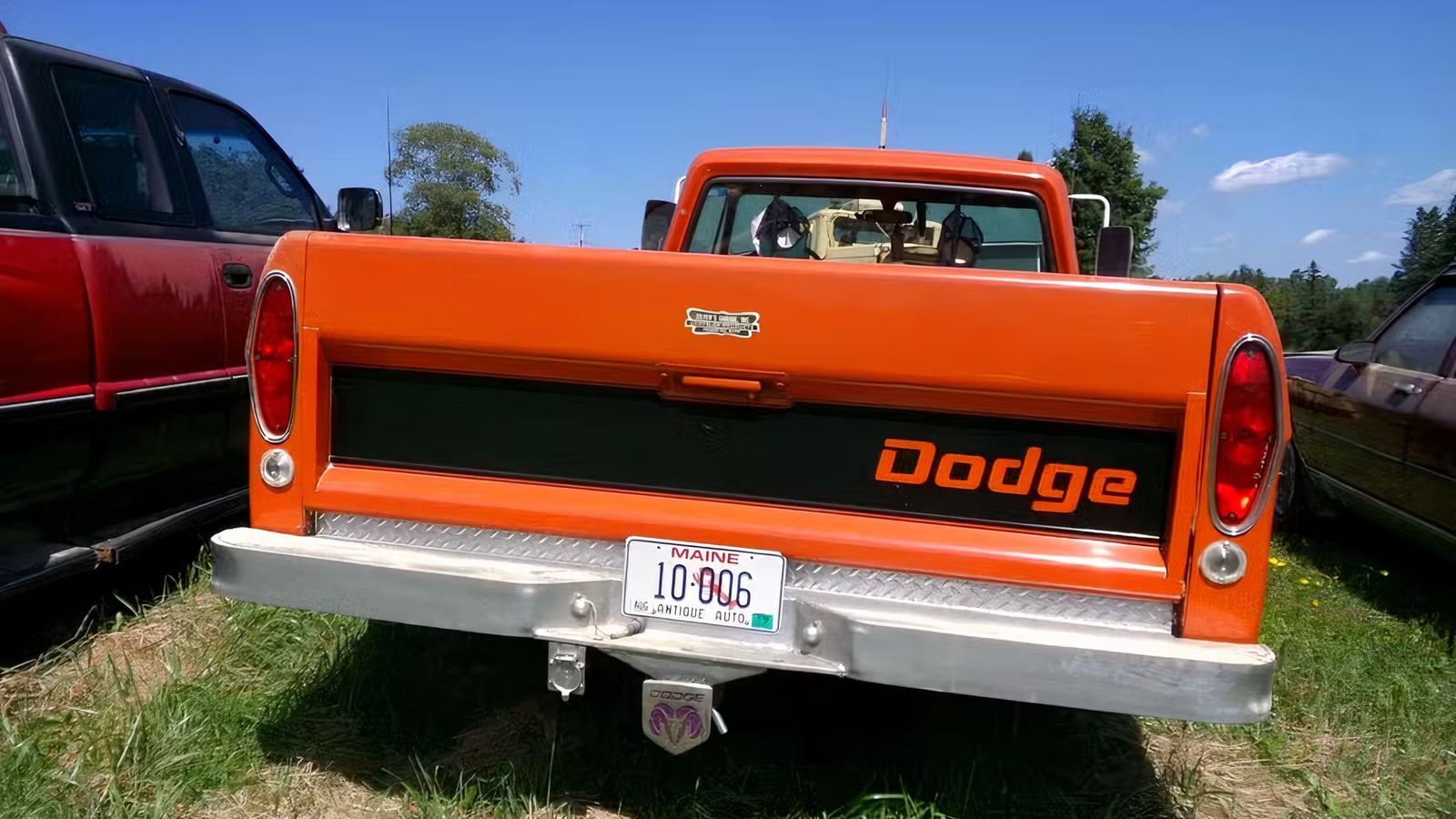
Mopar and flashy trucks go hand in hand these days. Through beasts like the Ram TRX and even the upcoming Ram Rumble Bee, Mopar understands that doubling down on machismo is an incredibly effective strategy for selling trucks. Still, make no mistake, Ram might be better at this tactic now, but it’s not something Mopar/Dodge/Ram/whatever they go by this week hasn’t been doing for decades. Join us as we detail a TRX before it was a gleam in a modern engineer’s eye.
The D Series: A Ram Before the Ram

The second-generation Dodge D100 was as close to a modern Ram analog as Mopar built during the mid-to-late 1960s and early 1970s. With a wheelbase of 115 inches on the short bed and 128 inches on the long bed, the D100 was every bit the match for the Ford F-Series or the Chevy/GMC C/K. Heavy-duty leaf springs in the front and back kept heavy loads stable at speed, and solid beam front axles on rear-drive models meant the same applied off the tarmac as well. In short, it was a road tractor just as much as it was a pickup truck.
Under the hood, a base D100 packed the same 225-cubic-inch slant-six 225-cubic-inch slant-six engine at the entry level. Other mainstays like the LA-based 318 and B-based 383 gas V8s were also around, as well as a bulletproof three-speed automatic gearbox as the most common transmission option. By all measures at the time, the D100 served a markedly uncool purpose in the world. There was no indication whatsoever that the D100 was remotely desirable, or something people actually chose to drive for any reason but necessity.
Even so, a curious thing happened around the late 1960s. In a move that must’ve baffled Dodge/Mopar’s marketing department, they found that their customers were starting to use D100 pickups as a personal lifestyle vehicle. In short, they were among the first of what we’d call pavement princesses today. Rather than writing off its customers as completely bonkers and calling it a day, Dodge decided to lean into the trend wholeheartedly. When they did, they accidentally set the tone for how Dodge would market trucks on and off for the next half century.

Turning a Workman’s Truck Into Something “Cool”
All the credit in the world to Dodge, because it understood a profound truth about its customer base that the rest of the industry was sometimes slow to adapt to. In short, they liked bold, aggressive, and mildly controversial nomenclature, the kind of stuff that made the parents of young baby boomers cringe. In most instances, this marketing strategy was applied heavy-handedly to Dodge’s muscle cars.
After all, what other brand would be willing to slap names like “Swinger,” “Demon,” and “Super Bee” at a time when America still had a de-facto morality police dividing the generations? Couple the naming scheme with 440s and 426 HEMIs of all stripes, and Dodge cemented itself as a cool brand among cool brands during the first muscle car wars. Well, Dodge had the wherewithal to apply the same practice to the D100 pickup.
Certainly, it was easier than re-engineering the whole vehicle into some muscle car facsimile with a truck bed in the rear. A bold, stylish graphics package was developed for the D100, complete with similar body striping you’d find across some of the greatest Mopar muscle cars of the era. They even employed The Andy Griffith Show actor Don Knotts to dress up like a cowboy and aggressively market the new trim as something objectively cool. All that was left was to give the new trim a name, and what they came up with rolled right off the tongue.
The D100 Dude: Awesome Name, and an Awesome Truck

As surprising as it sounds, the phrase “Dude” was perceived as something of a taboo word in the early 1970s. It was commonly associated with leather jacket-wearing, blue jean-rocking streetwise youths. People who would rather do things like drink beer and protest the Vietnam War than get a job or conform. With that in mind, Dodge was taking quite the gamble slapping that name across the bed sidewalls of a couple thousand D100s. Available in colors like Sub-Lime Green, Plum Crazy Purple, and Panther Pink, you could legit buy a D100 Dude with the same paint job as a Charger or a Challenger.
Knowing the legend that those two muscle coupes were forging at the time, even a passing resemblance by a pickup truck might as well have made national news. An aggressive lateral C-stripe running along either flank was the best tell-tale sign of a Dude in your presence. Depending on the paint code chosen, the graphic came in either white or black, making a surprising impact on the overall character of each truck. An optional textured vinyl roof was another clear indicator of a Dude in your midst, along with chromed wheel covers and cowboy-coded regalia that oozed old-school machismo.
Beneath the hood, the Dude wasn’t a muscle car in disguise like a lot of modern performance trucks are. At that time, all the modifications were strictly cosmetic, intended to convey an ethos of coolness that the Dude was not expected to back up with high-speed drag racing. In total, it’s estimated that between 1,500 and 2,000 D100 Dudes were built, mostly in 1970 with a handful more built in 1971. That makes it among the rarest Mopar trucks ever to see the light of day, and considerably more valuable than a standard D100. Knowing this, seeing one roll past the auction block is an exceptionally rare event.
A Lesson for All Dodge Trucks Going Forward

You may lament the fact that the humble pickup truck is far more of a lifestyle vehicle or a low-effort token of masculinity than a utility machine these days. You might find that the D100 Dude was the start of a nasty trend that culminated in dealership lots being chock-full of overpriced luxury trucks across America. You wouldn’t be faulted for thinking this. Still, in the name of objectivity, it’s hard to say the Dude is an egregious offender in the same way a 2026 Ram 1500 Tungsten is.
At its heart, the Dude just needed to LOOK like it was worth a million bucks to people walking past it in a parking lot. It never claimed to be luxurious, fast, powerful, or even halfway decent to drive. It was still a road tractor in every way that mattered; at its heart, it was still a proper pickup truck. The cowboy motifs along the flanks weren’t misappropriating the people who drove them; they really were genuine working-truck owners, not posers who never take their trucks across a grassy field.
If Dodge ever wanted to bring back the Dude nameplate in any capacity beyond a SEMA show truck, it belongs on a base Pentastar V6 Tradesman truck, not a Tungsten or a TRX. Frankly, the notion that Stellantis would even try at all is somewhat laughable. Simply put, there’s more profit to be made elsewhere, at the high end of things. That’s simply the way things are now.
Sources: Dodge, Mopar Blog, Gregg Auctions

Related posts


Latest Post


No Comments