
The Forgotten AMC Muscle Car With Corvette-Killing Power
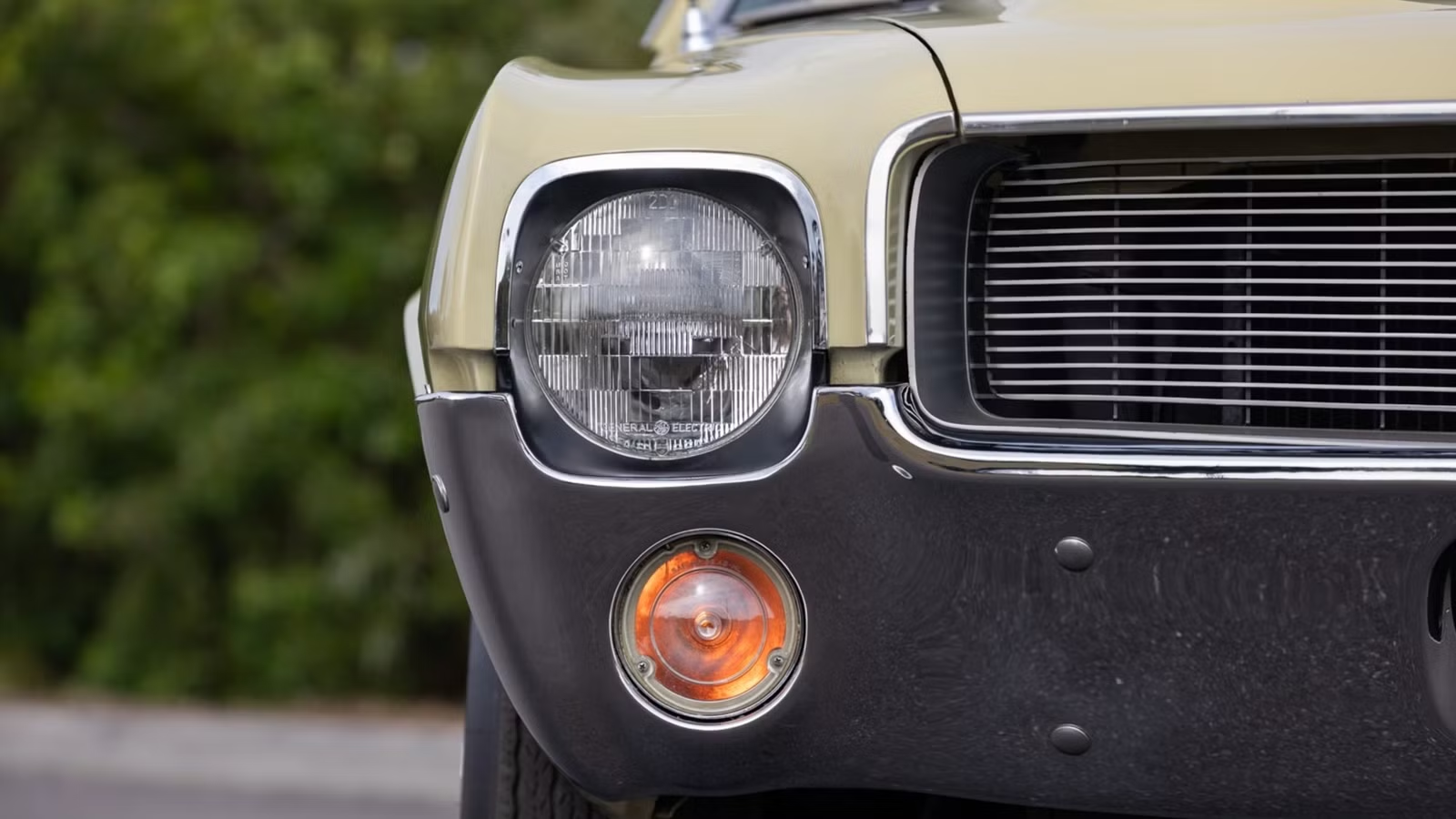
Sleeper alert! Collectors are missing an AMC muscle car built to rival the Chevrolet Corvette simply because it’s not loud. It could be purchased with a subtle look, letting it blend into the background next to rivals with vibrant paint, racing stripes, and spoilers. It probably doesn’t help that the AMC brand didn’t have a reputation for high-power performance. But AMC took a massive swing at competitors when this coupe arrived, trying to rule the racing segment.
AMC Wanted To Shed Its Boring Reputation

It turns out that American Motor Corporation (AMC) did give a D*%# about its bland reputation, so it wanted to build a muscle car to attract a new generation of buyers. The brand had a conservative image and a reputation for building boring, economy cars. AMC became famous for its reliable family sedans and economy cars like the Rambler.
But in the late 1960s, the muscle car segment was exploding, and younger drivers were drawn to high-performance coupes with rebellious attitudes. So, it was time to drop its grocery-getter image by tackling the Chevrolet Corvette. This was a swing for the fences, especially because the Chevy Corvette was already established as a major icon.
The Corvette debuted in 1953 and quickly rocketed to fame. In the 1960s, its lore only grew as it starred in the hit TV show, Route 66, as a symbol of youth, freedom, and adventure. It checked all the boxes thrill-seekers were looking for. On top of that, significant rivals like the Ford Torino GT and Chevelle SS were chasing the larger intermediate segment.


To really compete and create a new brand image, AMC needed to prove its grit by outracing larger-block rivals with stout power. AMC executives also decided to undercut rivals by providing a more affordable American-made option. However, as you can probably guess, there were a few problems with its recipe for success.
The 1968 AMC AMX Went After The Chevy Corvette

The 1968 AMC AMX is a lightweight, muscle car that was directionally positioned against the Chevy Corvette. At the time, it served as the only other American-made, steel-bodied, two-seat high-performance coupe on the market. Unlike rival pony cars, this racer didn’t offer any V6 engines and made its claim to fame with exclusive V8 power.
Its flagship engine is the 390 cubic-inch (6.4-liter) V8 engine with 315 hp and 425 lb-ft of torque. This car can accelerate from 0 to 60 mph in about 6.6 seconds and finish a quarter mile in roughly 145 seconds with a trap speed of 100 mph. Overall, the AMX has a top speed of around 130 mph.
The 1968 Corvette packed a punch with multiple power engines to consider. But the 327 cubic-inch (5.4-liter) V8 is the AMX’s most direct rival, with 300 hp and 360 lb-ft of torque. It helped the Corvette accelerate from 0 to 60 mph in around 7.5 seconds and complete a quarter mile in 15.4 seconds at 94 mph. Its top speed hovers around 130 mph.

The AMC AMX 390 had an original MSRP of about $3,500 or less, depending on optional equipment like the Go-Package. Meanwhile, the 1968 Chevy Corvette 327 Sport Coupe started at around $4,663, allowing the AMX to undercut its pricing by over $1,000. But the Corvette convertible only rang in at $4,320.
The AMC AMX 390 Tried To Shed Its Boring Reputation

The AMC AMX 390 is a true contender with its lightweight block that features thin-wall casting to be 100 pounds lighter than Ford’s 390 engine. It has a heavy-duty forged steel crankshaft, connecting rods, and larger rod bearings to withstand high-stress performance situations. The engine could be paired with a Borg-Warner T-10 four-speed manual transmission or a “shift command” three-speed automatic.
It was based on the Javelin, but its platform was shortened by 12 inches, allowing it to weigh in at about 3,100 to 3,400 lbs and be more agile with nimble cornering against larger rivals. Plus, it has a heavy-duty rear suspension with trailing arms that act as traction bars to prevent axle hop under hard accelerations.
Before the AMX 390 came out, AMC Performance Manager Carl Chakmakian convinced world speed record holder Craig Breedlove to test its limits. Breedlove took it to Bonneville Salt Flats, where it reached 189 miles per hour in a United States Auto Club-sanctioned run. Then two AMX models set 106 class-based world speed and endurance records at the Goodyear track in Texas.

The car got the attention of critics, at least. The American Society of Automotive Engineers named it the best-engineered car of the year. But at the same time, the Chevy Corvette was winning endurance racing and being advertised as a favorite sports car of astronauts during the space race.
But The AMC AMX 390 Was Ignored

The 1968 AMC AMX offered incredible speed for a bargain compared to its rivals, but it never became very popular. One problem could be attributed to its plain style. It matches the look of the larger Javelin with the same doors, rear trunk lid, and fenders with a clean look. The car lacks aggressive scoops, body cladding, and side pipes.
Fighting the Corvette name, which was already established as “America’s sports car,” was a massive uphill battle. AMC couldn’t shake its reputation for building practical, budget-friendly cars. Chevrolet had a massive dealer network to place the Corvette and a higher production volume to keep it visible on the road as a growing pop culture icon.
AMC struggled with a smaller dealer network and advertising budget. Plus, shortening the Javelin’s wheelbase forced them to omit the rear seat, which turned out to be a practical feature buyers wanted. The AMX also failed to offer a convertible body style. It only sold 19,134 models before being discontinued in 1970 due to low sales.
Surviving AMC AMX 390 Models Are Sleeper Bargains

Collectors are overlooking the AMC AMX 390 as an extremely rare underdog that serves as a high-performance sleeper model. It’s unclear how many models still survive today, but they can be scooped up for a fair price. Models in project or fair condition typically sell for between $10,000 and $20,000.
Then models in good condition that have been well-maintained will fetch about $25,000 to $35,000. Rare models in pristine condition have a massive value range of between $35,000 and over $90,000. Features that fetch higher premiums include models from 1970, as only 4,116 units were produced.
1968 Chevy Corvette 327 models in project condition that need mechanical or cosmetic work sell for between $25,000 and $32,000. Then clean models in good condition cross the auction block for between $35,000 and $55,000. Examples in pristine condition sell for about $55,000 to over $80,000.
Source: How Stuff Works, Top Speed, Hagerty

Related posts


Latest Post


No Comments