
Studebaker’s Overlooked Coupe Predicted Muscle Before Detroit Did
In 1957, rock ‘n’ roll was in full swing, Russia’s Sputnik satellite was running circles around the Earth, and America was hungry for horsepower. The same year Elvis Presley was topping the charts singing about being all shook up, American automakers were shaking things up under the hood. They were building the engine blocks that would serve as the foundation for the horsepower wars of the mid-to-late 1960s.

This brief era of performance before the muscle car saw incredible engineering gains that set the pace and foreshadowed what was to come. 1957 was the year everything was kicked into high gear with rock ‘n’ roll, the Space Race, and Cold War paranoia providing automakers with a seemingly endless supply of inspiration when it came to power and design.
Before Muscle Cars, Big V8s With Bigger Fins
A decade before muscle cars donned Looney Tunes graphics and magnesium wheels, American performance cars came loaded with big V8s and bigger fins. In 1957, two prime examples of chrome-laced street machines were the 1957 Chrysler 300C flexing a new 392 cubic-inch FirePower Hemi producing 375 horsepower, and the sleek Ford Thunderbird F-Code packing a 300-hp supercharged 312 V8.
That same year, Chevrolet fitted Rochester “Ram Jet” mechanical fuel injection to its newly developed small-block 283 V8 (debuted in 1955) for the Bel Air and Corvette C1, while coining phrases like “Posi-Traction.” Meanwhile, Oldsmobile released its 300 hp J-2 version of its 371 Rocket V8 with a triple two-barrel Rochester carburetor setup that Pontiac would refer to as Tri-Power for their own engines.
With all these high-performance breakthroughs, some cars were bound to get lost in the mix and be overlooked. Particularly one full-size sports coupe that started out in life powered by Packard and ended up with an in-house-developed supercharged V8.
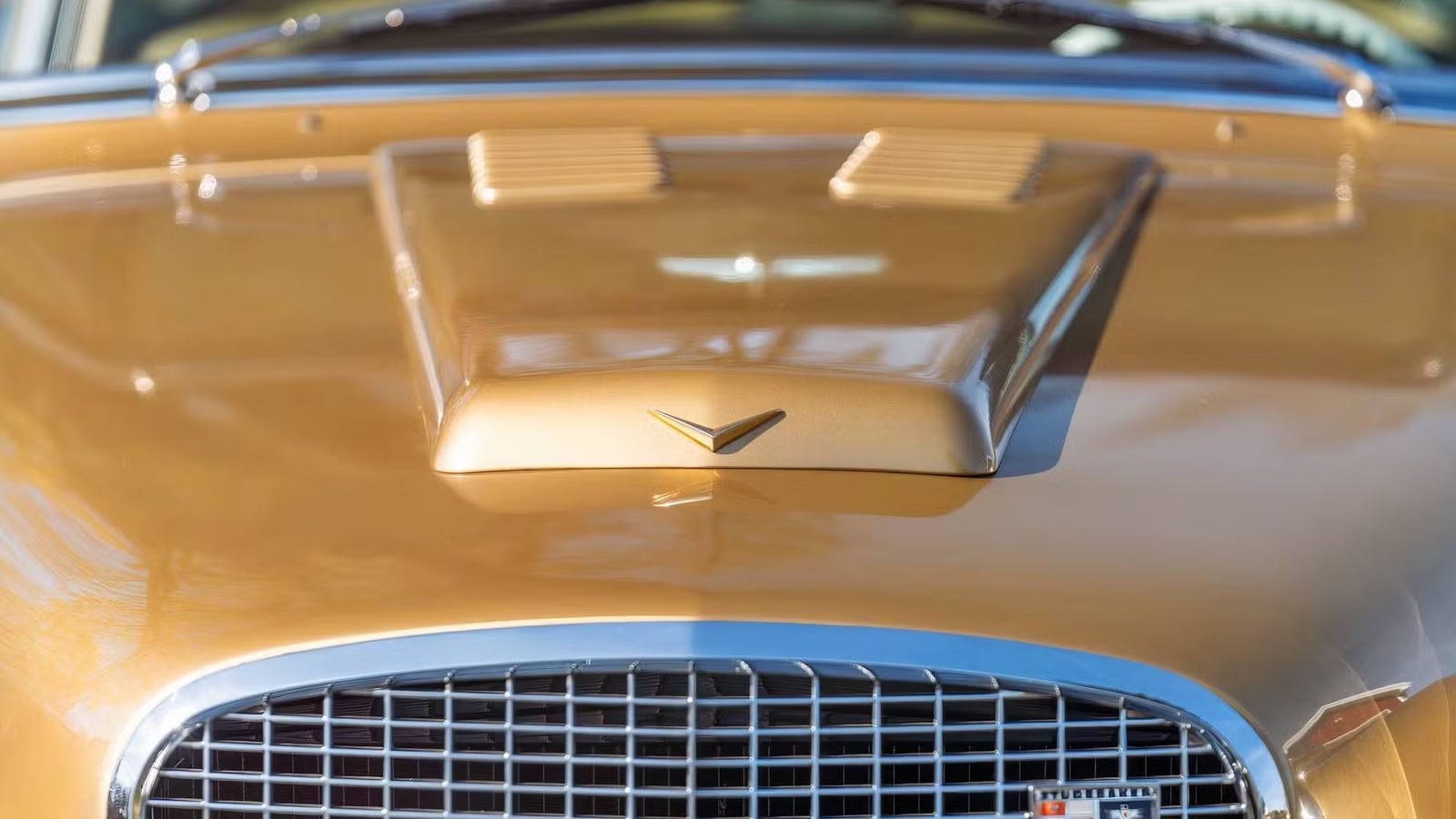
Studebaker Golden Hawk, A Full Size Sports Coupe Ahead Of Its Time

In 1954, the luxury brand Packard Motor Company decided to buy the Studebaker Corporation and merge the two automakers into the Studebaker-Packard Corporation. The ill effects of this merger are worthy of their own story. But financial woes aside, this merger did provide the automotive world with the Hawk series in 1956. It was a four-model lineup of full-size two-door coupes sharing the same 120-inch wheelbase. For comparison, a 1964 Pontiac GTO has a wheelbase of about 115 inches.
The Studebaker Hawk series consisted of the Flight Hawk, the Power Hawk, the Sky Hawk, and the top-of-the-line Golden Hawk. These cars stood out with signature styling that seemed to combine full-size presence with sports car sleekness, featuring a low stance, fiberglass rear fins, and a direct, upright front grille. Premium models like the Sky and Golden Hawk included pillarless hardtops.
In 1956, the Studebaker Golden Hawk’s top-performing powertrain was a Packard-developed 352 V8 making a respectable 275 hp. But in 1957, the Packard V8 was no longer available to Studebaker, forcing the company to use its own smaller-displacement V8. Yet this smaller engine would produce the same horsepower as the big Packard thanks to Studebaker’s engine build quality and a supercharger.
The Engine That Made Studebaker’s Golden Hawk Fly

Studebaker is not as well-known or popular as Detroit’s Big Three. Yet Studebaker can trace its mechanical roots back to the American Civil War, when it produced wagons and buggies for the Union Army. When World War II demanded America’s involvement, Studebaker built nearly 200,000 21/2-ton 6×6 trucks called the Studebaker US6.
Studebaker knew how to build robust machines. In 1951, Studebaker designed its post-war overhead-valve 232 V8 engines to handle compression ratios as high as 13:1, in anticipation of new high-octane fuels and speculation about high-compression demands. When that didn’t happen, Studebaker was left with a V8 built like a brick house. It used 18 bolts — more than its competitors — to secure each cylinder head, solid lifters instead of hydraulic ones, and a gear-driven camshaft instead of a timing chain.

When it came time to build a new high-performance V8 for the 1957 Golden Hawk, Studebaker knew what needed to be done. By then, the 232 V8 from 1951 had evolved to 259 and was bored out to 289 for 1957. Naturally aspirated, the 289 V8 could produce 210 hp, but that wasn’t enough to keep up with the competition. So, Studebaker added a belt-driven, centrifugal McCulloch supercharger. This upgrade added 5 psi of boost to force air through a sealed two-barrel Stromberg carburetor, generating 275 hp.
In 1957, the supercharged Studebaker Golden Hawk could fly from 0 to 60 in 7–8 seconds and reach speeds over 120 mph. This put it in the same league as the dual-quad 270 hp variant of the 283ci V8 Corvette C1, with room for five passengers instead of two.
Studebaker produced 4,356 Golden Hawks in 1957, including a few Golden Hawk 400 variants that featured full-leather interiors. Today, a Golden Hawk can demand a pretty penny from collectors. According to Hagerty, the most recent 1957 Studebaker Golden Hawk sold on Bring a Trailer in June 2026 for $54,600. Prices for these cars range from $32,900 for good condition, $63,000 for excellent condition, and over $94,000 for pristine, concours-level condition. The most expensive Studebaker Golden Hawk sold within the last three years, at the time of this publication, sold for a whopping $148,500.
Studebaker’s Performance Legacy, Going Out With A Bang

The last Studebaker rolled off an assembly line in 1966, making it 60 years since the company closed its doors for good. Long since gone but not entirely forgotten, thanks to the machines they left behind. Machines like the 1957-1958 Golden Hawk, whose high-compression V8 comprised the mechanical formula Pontiac’s John Z. DeLorean would use to create the GTO in 1964. That car would be the unofficial first shot, igniting the horsepower wars that engulfed the Big Three in a V8 arms race until the early 1970s.
While Studebaker didn’t directly compete in the muscle car craze, it left on a high note. The Studebaker Avanti was the last hurrah of power for the brand. Debuting in 1962, the Avanti used the same concept as the Golden Hawk, incorporating European styling with American muscle to build a sleek full-size sports coupe.

The 1962 Avanti featured the R1, a 289 V8 producing 240 hp. By 1962, there was a Paxton-supercharged variant of the 289 V8 called the R2, producing 290 hp. However, Studebaker continued tinkering with the Avanti’s engine, developing the R3, a 289 V8 bored out to 304 with a supercharger, producing a claimed 335 hp. By this time, Studebaker was struggling and made only 10 R3-spec Avanti models before production ended in December 1963.
Nevertheless, cars like the Golden Hawk and Avanti prove that Studebaker had the engineering know-how and experience to compete with the Big Three from Detroit where it mattered most: on the street.
Source: Hagerty, Studebaker

Related posts



Latest Post


No Comments