
The Italian Superbike Whose Name Defied The 186-MPH Gentleman’s Agreement
The late 1990s were a bit mad for superbikes. Every new arrival seemed to bring more power, less weight and a speedometer that went a little further than the last one. Then entered the Suzuki Hayabusa, which hit 194 mph in testing, comfortably beating Honda’s Blackbird by more than 10 mph. Kawasaki was next, with rumor mills churning that its ZX-12R could crack the 200 mph barrier.

That was when things got a little too serious. The biggest motorcycle makers more or less agreed to call it a day at 186 mph, or 300 Km/h. There was no official announcement or handshake for the cameras, but the top-speed battle had suddenly hit a wall. For the next few years, that number became an unwritten limit for road-going superbikes.
Not everyone got the memo, though. While the Japanese manufacturers settled into an uneasy truce, a small Italian outfit decided there was still plenty of fun to be had on the other side of 186 mph.
When 186 MPH Became The Unwritten Limit

The so-called gentlemen’s agreement was never an actual agreement on paper. Honda openly said its bikes would stay below 186 mph, while Suzuki and Kawasaki kept quiet about any such understanding. To this day, none of the manufacturers has officially confirmed that a pact ever existed.
There was a reason to take the heat off, though. The Busa and talk of 200-mph superbikes had started attracting attention from European politicians. The idea of these superbikes wasn’t going down too well with everyone. There were growing concerns over speeding and illegal street racing, and there were even talks of keeping these missiles out of certain markets altogether.
Keeping things below 300 Km/h voluntarily was a lot easier than waiting for governments to step in and do it for them.
Kawasaki was already gearing up to take on the Hayabusa with its ZX-12R when the heat started coming from regulators. The bike’s launch was reportedly held up while engineers worked on an ECU speed limiter to keep it under the 186 mph mark. The funny bit? Even with the limiter, it hit around 187 mph in testing.
Outside Japan, even BMW is said to have supported the idea of putting a cap at 186 mph but MV Augusta, meanwhile, was not known to be part of the arrangement. And that little detail would become rather important.
The Italian Superbike That Put 312 On Its Fairing

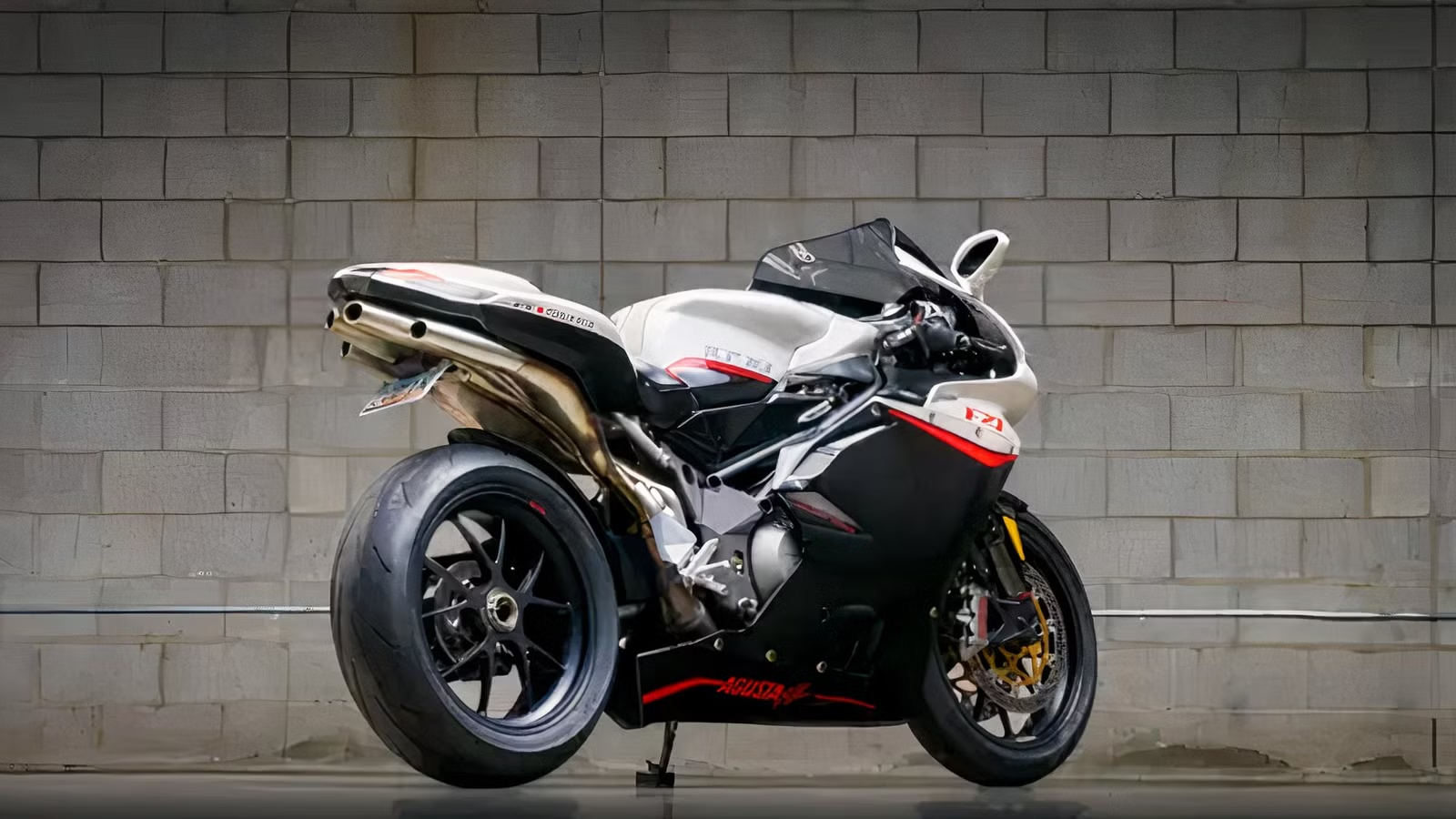
MV Agusta decided to pull an MV Agusta. In 2007, the Italian manufacturer debuted the F4 R 312 at Monza. This rocket went on sale as a 2008 model. Even the name made it clear MV wasn’t here to play along. That 312 wasn’t a random number because the brand claimed the bike could do 312 Km/h, or 194 mph.
It was reportedly meant to be called the F4 1000 RR. Then an MV test rider hit 312 Km/h during high-speed testing at Nardo, and suddenly the name didn’t seem quite good enough. To be honest, the 312 badge was a pretty clever PR move. Instead of letting the number sit somewhere on a spec sheet, MV put it everywhere. Fairing, tail, model name. There was no missing it. And with the number sitting on the tail, it almost looked like MV was leaving a target for the other manufacturers to aim at. Turns out “312” wasn’t a model name at all. It was a giant “look what we did” and a challenge to the rest of the world.
What MV Agusta Changed To Chase 312 Km/h (193 MPH)

The F4 R 312 was based on the F4 1000 R, but MV did more than slap a new badge on the fairing and call it a day. The 998cc inline-four got some serious attention, with output climbing to a claimed 183 hp at 12,400 rpm and 115 Nm at 10,000 rpm. That’s 9 hp more than the 1000 R, and the engine still met Euro 3 emissions norms.
MV went hunting for those extra horses with larger 30 mm titanium intake valves, revised camshafts with 1.1 mm more lift: together helping the engine to gulp down air and fuel at high RPMs. Combine that with 48mm throttle bodies and shorter intake trumpets, and the 998cc mill squeezed out 9 more horses right at the top of the powerband. It was a proper engine job and the intention was clear.
Besides, it also featured a Magneti Marelli ECU that handled the engine electronics, including MV’s EBS engine-braking system. This used a bypass valve on the second cylinder’s intake to let some air through when the throttle was closed, helping keep the rear wheel from hopping around under hard deceleration. Handy when you’re riding a bike that clearly prefers being ridden with some enthusiasm.
MV left the chassis, suspension and brakes largely alone, carrying them over from the 1000 R. The aerodynamic changes were modest as well, including a slightly taller screen to give the rider a bit more protection when tucked in at speed.
The 193 MPH Claim Was Not That Simple

This is where things get a little messy. Independent testers couldn’t quite get the F4 R 312 to live up to its name. One test recorded 176 mph (284 km/h) on a bike with just 350 miles on the clock, with a slight headwind to contend with. Another managed 182 mph on a two-mile runway, also into a headwind. The closest of the English language tests came in at 185.4 mph, or 298.4 km/h.
Those are serious numbers by any measure. But none of them says 312. MV had its own figures to point to as an Italian motorcycle magazine reported a speed of 193.24 mph (310.99 km/h) at Nardo, while other accounts linked the 312 claim to a modified F4 that reportedly crossed 311 km/h in satellite-verified testing.
There was another catch. The production bike was reportedly homologated at 301 km/h, the same figure as the F4 1000 R. So, despite what the number on the tail might suggest, the official paperwork didn’t quite back up the bragging rights. To be fair, 312 was MV’s best test-track flex, not standard everyday speed. Most independent tests clocked it at 176 to 185 mph. Seriously impressive anyway, just a tiny bit below the badge on the side.
But that’s kind of missing the point. MV slapped a number on that bike that made the whole industry stop and look. For a tiny Italian brand going toe-to-toe with the biggest players out there, that was a huge win on its own.
A $25,000 Italian Statement To The Japanese Giants

At $24,995 in the US and €21,790 in Germany, the F4 R 312 was pure rich-guy toy money compared to the Hayabusa or ZX-14, which were way cheaper and capped by the same gentleman’s agreement.
MV was never going to out-sell them, and they knew it. The whole draw was an Italian brand staring down the Japanese heavyweights and saying, “You stopped at the limit. We didn’t.” They basically took a quiet agreement, turned it into prime marketing, and seasoned it with pure Italian attitude.
The Bike That Made The Speed War Interesting Again

The F4 R 312 didn’t kill the gentlemen’s agreement. But it showed that the ceiling wasn’t some law of physics. It was a choice.
Fast-forward to 2009: the badge landed on the 1,078cc F4 RR 312 with 190 hp, and the whole “gentlemen’s rule” started falling apart. It wasn’t long before BMW’s S 1000 RR clocked 188 mph. Ducati found its own way around the 186 mph ceiling with the 1199 Panigale R. The speedo would happily show your speed up to 186 mph, but beyond that the numbers disappeared, replaced by dashes. And lastly, Kawasaki just said “forget it” and debuted the track-only Ninja H2R with 249 mph.
Plus, the political heat that sparked the 186-mph cap in the first place had blown over. So no, the F4 R 312 didn’t win some epic speed war. Its stats weren’t always beating the competition, and hitting 312 km/h had plenty of fine print. But that was never magic anyway.
For a brief moment, the giant motorcycle brands all agreed that 186 mph was the line. Then a small Italian shop walked up, slapped “312” on its superbike, and reminded the world that the finish line was totally fake. Turns out, restarting an arms race only takes one incredibly cheeky number.

Related posts


Latest Post


No Comments