
The Chevy Inline-Six GM Choked From The Factory To Focus On Its V8s
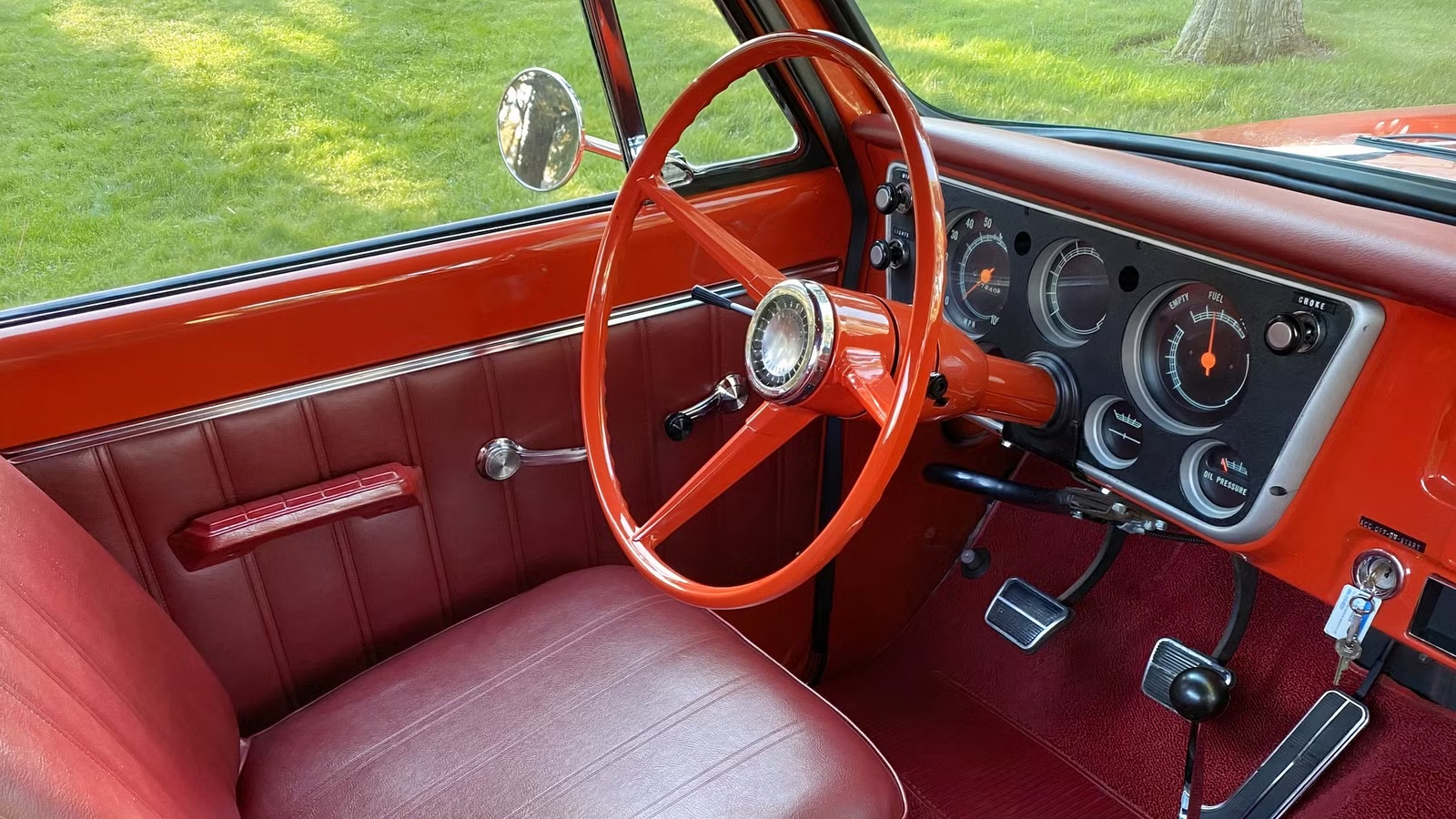
Chevrolet built an engine with the fewest possible moving parts, a reputation for surviving abuse, enough engine-bay room for real upgrades, and a long-stroke version that made peak torque at just 1,600 rpm. It had all the ingredients of a legend. Then GM’s 350 V8 arrived one year later, overshadowing this workhorse for five decades. But enthusiasts are finally catching on to the true potential of this unassuming, Bowtie-wearing hero.
The I6 Is Your Favorite Motorhead’s Favorite Motor For A Reason

A straight-six engine (often called an inline-six or I6) may be every motorhead’s favorite motor. Why? These engines are often easy to work on, easy to modify, reliable, and torquey. It doesn’t hurt that for decades, I6 engines were the default entry-level powerplant in millions of cars and trucks. They got generations of budding enthusiasts started on wrenching.
The inline-six signature is its simple layout. Instead of an exotic V or W shape with multiple banks of cylinders joined at the crankshaft, it has a single bank of six cylinders. This straightforward engine has one cylinder head, not two. That means fewer moving bits to break. And compared with a V8, it also has two fewer pistons, rods, spark plugs, and combustion chambers.

For decades, I6 engines were the entry-level option under hoods engineered for V8s. That left a ton of room on either side of the engine to reach in and make repairs. Alternatively, you could fill that space with speed gear such as long headers, intake upgrades, EFI hardware, or even turbochargers. The tall, narrow package also allowed some inline-sixes to use long strokes.

Chevy’s Small Block Cast A Very Long Shadow

The 350-cubic-inch small-block V8 is far from the most powerful engine GM ever made. But it morphed into the most important engine family in the automaker’s history. Chevrolet debuted the first 350 V8 in the 1967 Camaro, offered it in the 1968 Nova, and spread it widely through the lineup by 1969. Though the engine evolved into a modern, fuel-injected unit, the block and 350-cubic-inch displacement survived in GM production trucks, vans, and SUVs of the early 2000s. It continues to soldier on as service engines and Chevrolet Performance crate engines.
That is an almost absurd run, and the broader small-block family makes the point even louder. GM says it has built more than 100 million small-block V8s, while Flint alone built more than 40 million small-blocks by 1999. Today, a Chevy 350 is still one of the cheapest V8s to buy and modify. Finding a core is easy enough. Finding parts and know-how to wake it up is not much harder.

Many GM fans default to swapping a modestly built 350 into every project. And not just because it is cost-effective. It is a genuinely fantastic engine that deserves its fanbase. But the long shadow of Chevy’s small-block engine family hides some of GM’s other engine families that also deserve attention. Once every old truck or budget classic is treated as a 350 swap waiting to happen, the weird stuff gets forgotten.
The 250 And 292 Chevy Inline-Six Never Got Their Due From The Factory

General Motors introduced its 292-cubic-inch inline-six across Chevrolet and GMC trucks for the 1963 model year. Chevrolet marketed it as a High-Torque Six, and the name fit. In its original tune, the 292 used a 3.875-inch bore, a 4.125-inch stroke, and an 8.0:1 compression ratio to make 165 gross horsepower at 3,800 rpm with 280 lb-ft of torque at just 1,600 rpm.
The 250-cubic-inch Turbo-Thrift six arrived for 1966 as a smaller, broader-use engine. It used the same 3.875-inch bore, but a shorter 3.530-inch stroke and upped the ante with an 8.5:1 compression ratio. In 1966 passenger-car trim, it made 155 gross horsepower at 4,200 rpm and 235 lb-ft at 1,600 rpm. It later spread through many of the cars and trucks gearheads remember fondly: Camaro, Nova, Chevelle, El Camino, full-size Chevrolets, C/K pickups, G vans, Suburbans, and many corresponding GMC nameplates.

Compared with the first 350’s 295 gross horsepower and 380 lb-ft, the inline-six ratings looked humble. By 1970, Chevrolet had turned the 350 into a full engine family, from mild two-barrel versions to the LT-1, which made 360 hp in the Z/28 Camaro and 370 hp in the Corvette. But raw factory ratings are not always the whole truth. Retired Buick engineer Dennis Manner said the 1970 Buick 455 Stage 1 made 372 hp at 5,200 rpm on the dyno, but was officially rated at 360 hp. His explanation was wonderfully blunt: “The shipping weight of the car was 3,603 pounds, and we wanted to get it into a class that factored 10-to-1 pounds per hp.”
That quote does not prove Chevrolet secretly underrated the 250 and 292. It does prove that GM-era horsepower numbers were subject to manipulation.

In the case of the Chevy six, a high output claim was clearly not the top priority. These engines had six cylinders sharing only three intake ports. In plain English, every two cylinders had to share a breathing snorkel. Then Chevrolet ran head-bolt bosses through those shared intake passages, further slowing down the fuel-air mixture.
Chevrolet’s 250 And 292 I6 Had Better Bones Than GM Let On

Enthusiasts developed a brilliantly simple fix for the I6’s compromised head design. Lump-port plates reshape the intake floor and help the air-fuel mixture get around the bolt obstruction instead of crashing into it. 12Bolt’s published flow testing shows the difference clearly: a stock head with a 1.72-inch intake valve flowed 168.5 cfm at .500-inch lift, while the same port design with a bolt-in HI-FLOW lump and 1.84-inch valve flowed 215.6 cfm at .500 and 226 cfm at .600.
Tuning a GM I6 for street power does not have to be difficult, either. Hot rodders often port and polish the head, add headers, improve the intake, step up carburetion or swap to EFI, and choose an aggressive cam. One popular move is swapping the old points ignition for a High Energy Ignition-style electronic setup that GM introduced in 1975; 12Bolt lists Chevy inline-six HEI distributors at $125–$200. It also lists bolt-in lump kits at $100, camshaft options around $200–$500, and performance intakes in the $425–$600 neighborhood. A modestly built I6 can be had for very little money.
On the other hand, this engine’s performance ceiling is wonderfully absurd. A 1936 Chevy pickup with a turbocharged Chevy inline-six reportedly made 1,320 hp on FuelTech’s hub dyno. What is even more remarkable is that the engine’s stock block could handle all that power.
A 350 Swap Is Basic, A Built I6 Can Be Cheaper And Cooler

The 292 I6 probably should not replace the 350-cubic-inch V8 as the default engine swap for GM enthusiast builds. Dropping a “big-block six” under the hood is a unique choice, best suited to a unique hot rod project. But a built High-Torque Six could conceivably make as much power as some mild 350s, and it will stop GM fans in their tracks at car shows because it is not the same small-block everyone has already seen a thousand times.
What if your vintage Chevy or GMC already has a 292, or even a 250, under the hood? A 1975 C10, for example, came standard with a 250-cid inline-six while the 350 small-block was the next engine choice. All your GM friends may assume you’ll drop a 350 into the thing, but an inexpensive and unique option would be building the I6 instead.

A built I6 keeps the classic’s personality intact while turning a forgotten budget-friendly workhorse into the kind of build people hear about before they ever see it in person. Another 350 swap will always work. But the more memorable enthusiast choice may be leaving the overlooked inline-six in place, fixing what GM overlooked, and making your truck sound like no one else’s.
Sources: SAE Mobilus, 12Bolt.com, Chevrolet Newsroom, GM Heritage, Chevrolet Performance, and RPO Archive

Related posts





Latest Post




No Comments