
Harley-Davidson’s Abandoned Porsche Prototype That Was Far Ahead Of Its Time
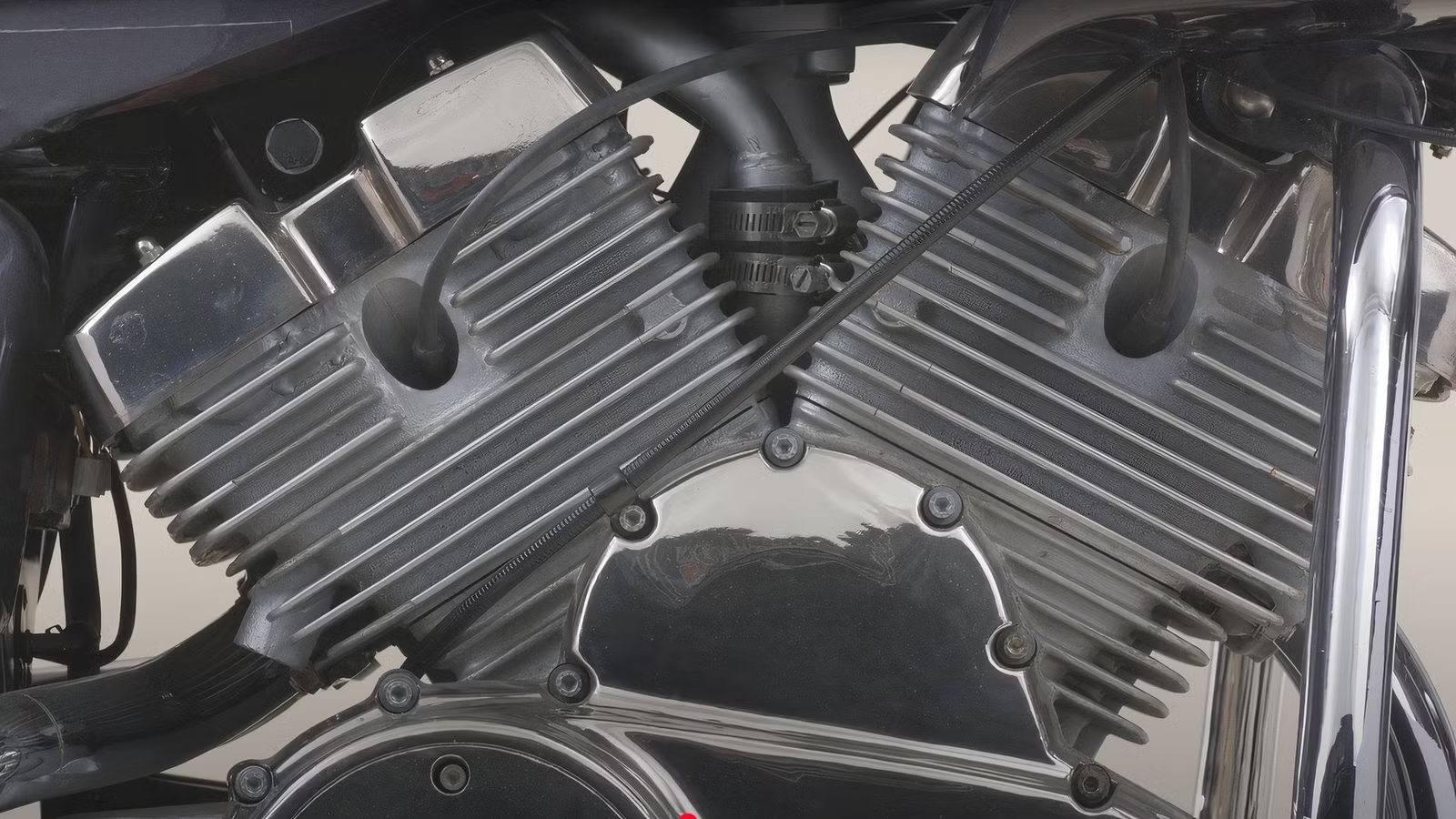
What if Harley-Davidson had gone liquid-cooled decades before the V-Rod? It nearly happened. Deep in the early 1980s, the Motor Company was quietly developing a top-secret prototype aimed at power-hungry performance riders — a project so ambitious it required outside engineering help from one of Europe’s most respected names. That project was called Nova, and its story is one of the most fascinating what-ifs in American motorcycle history.

Developed in conjunction with Porsche, the bike boasted liquid-cooling and a modular V engine that was far ahead of its time. Ultimately, however, it was abandoned in favor of a redesigned air-cooled twin. While many motorcyclists consider the resulting Evolution to be the engine that saved Harley from going belly-up, we can’t help but wonder what would have been had the Nova prototype actually hit production.
Harley Tapped Porsche For Project Nova
Japanese Competition Necessitates A New Line
Back in the 1970s, Japanese motorcycles were flooding the U.S. market, with Honda, Kawasaki, Suzuki, and Yamaha all battling for a larger piece of the pie. The intense rivalry bred rapid technological development and competitive pricing, giving rise to a class of wildly popular two-wheelers known as the Universal Japanese Motorcycle (UJM). Plagued by quality issues following the AMF buyout and put at a significant disadvantage by tightening emissions regulations, Harley-Davidson desperately needed a model that could turn things around.

The higher-ups decided to invest in two development initiatives: a family of bikes powered by an updated V-Twin and an all-new high-performance line centered around an advanced liquid-cooled powerplant. It was the latter of these efforts that came to be known as Project Nova. Even with support from its parent company, however, Harley-Davidson couldn’t afford to keep the engineering in-house. The MoCo considered suppliers from Austria and England and chose Porsche because of its design expertise, engineering prowess, and manufacturing experience.
A Liquid-Cooled V4 With The Potential To Be More

At the time, Harley-Davidson’s smallest air-cooled V-Twin (the Sportster) displaced 1,000cc, so the Nova line was intended as a means to break into the 500–1,000cc segment. Accordingly, the 60-degree V-cylinder arrangement was developed to be highly modular, incorporating a shared stroke of 58mm and varying bores to yield individual cylinders of 200 or 250cc. As a twin, the Nova could displace as much as 500cc, but when configured in banked V4 and V6 arrangements, that figure could stretch to 1,000cc and 1,500cc respectively.
Nova Engine By The Numbers
- 58mm stroke
- 66mm and 74mm bores
- 200cc and 250cc cylinders
- V-Twin, V4, and V6 configurations
- 500cc up to 1,500cc displacement
Harley-Davidson focused its development on the 800cc V4 Nova, as it made for an ideal middle ground, and the 750cc class was especially popular at the time. Though the bike’s target market was accustomed to seeing radiators mounted in front of the engine, Willie G. Davidson was insistent on keeping the appearance clean. For this reason, the Nova’s radiator was relocated under the seat along with the fuel tank, and a dummy tank was used to conceal an airbox and a cooling fan. Beyond more efficient heat transfer, the arrangement also allowed for a lower center of gravity.
Evolution Eclipsed The Nova’s Potential
Over the course of 1979 and 1980, Harley-Davidson built a number of prototypes — from full-faired touring bikes to stripped-back naked bikes — putting the Nova through its paces at Talladega, Alabama as well as Weissach, Germany for a planned 1981 launch. Despite a reported 2,000 hours of engine testing, 100,000 miles of seat time, and more than $15 million in development costs, the model would not arrive that year. Instead, Vaughn Beals and other executives instigated a buyout from AMF.
The move saw Harley-Davidson become a privately held company once again, but it also meant the brand was now saddled with significant bank debt. Faced with a choice between continued investment in Project Nova and further development of the Evolution engine, the higher-ups determined that the latter was the safer bet. After all, air-cooled V-Twins were Harley’s bread and butter, promising a much more immediate cash flow compared to a new venture in a fiercely competitive market segment.
The V-Rod Saw The Collaboration Come To Life

Even though Project Nova was eventually abandoned, that wasn’t the end of the story for Harley-Davidson and Porsche. With the connections forged during the V4’s development, Mike Hillman helped facilitate a second collaborative effort in the early 2000s: the V-Rod.
2002 Harley-Davidson VRSC V-Rod Specs
|
Engine |
Revolution 60-Degree V-Twin |
|---|---|
|
Displacement |
1,131cc |
|
Bore |
100 mm |
|
Stroke |
72 mm |
|
Compression Ratio |
11.3:1 |
|
Power |
115 hp |
|
Torque |
74 lb-ft |
Harley-Davidson
By choosing to develop the Evolution engine rather than build the Nova, Harley-Davidson had clawed itself out of a perilous financial situation. However, by the 1990s, models like the Harley-Davidson Sportster and the Dyna were showing their age, and the Motor Company once again needed a fresh performance offering to set itself apart. Engineers tapped Porsche to help design a powerplant based on the 60-degree V-Twin found in the VR1000 race bike. The resulting Revolution engine featured a 1,131cc displacement, and its short stroke and liquid cooling allowed for more horsepower and a higher rev ceiling. Upon its debut, the V-Twin was rated at 115 horsepower at 8,250 rpm, with a 9,000-rpm redline.
Harley-Davidson V-Rod Innovations

- Hydroformed perimeter frame
- Underseat fuel tank
- Faux tank air cleaner
- Lightweight aluminum swingarm
With Porsche helping to refine the engine, Harley focused on the rest of the chassis. The Motor Company equipped the VRSC V-Rod with a hydroformed perimeter frame and a lightweight aluminum swingarm for improved handling. Like the 1980s Nova before it, the bike received an underseat fuel tank and a hidden airbox — though this time it wore a radiator up front.
In subsequent road-going models like the Street Rod, the V-Rod received further sporting upgrades through inverted forks, mid-mounted controls, Brembo brakes, and a steeper rake. Harley continued to build on the original across a number of iterations, enlarging the displacement to 1,247cc and even creating a track-only V-Rod drag bike named “The Destroyer” that was capable of running blistering quarter-mile times. Ultimately, the model was discontinued in 2017.
Harley’s Revolution Max Revisits Liquid-Cooling
A Revolution In Variable Valve Timing

Harley-Davidson’s Revolution Max is an all-new design that’s incorporated as a stress member of the chassis, but the engine follows the same liquid-cooled 60-degree V-Twin formula as its V-Rod predecessor. It first hit the road in 2021 on the Pan America platform, bringing with it dual overhead camshafts and variable valve timing — a significant step for a brand that doesn’t tend to rock the boat.
Since then, Harley has continued to expand its Revolution Max offerings. With the Revolution Max 1250T in the Sportster S, the brand redefined the model’s potential. At 121 horsepower and 93 pound-feet of torque, it’s the most potent expression of a Sportster to date.
|
Harley-Davidson Nightster |
Harley-Davidson Sportster S |
Harley-Davidson Pan America Special |
|
|---|---|---|---|
|
Engine |
Revolution Max 975T |
Revolution Max 1250T |
Revolution Max 1250 |
|
Displacement |
975cc |
1250cc |
1250cc |
|
Bore |
97mm |
105mm |
105mm |
|
Stroke |
66mm |
72.3mm |
72.3mm |
|
Compression Ratio |
12.0:1 |
12.0:1 |
13.0:1 |
|
Power |
91 hp |
121 hp |
150 hp |
|
Torque |
72 lb-ft |
93 lb-ft |
95 lb-ft |
Harley-Davidson
In the sub-1,000cc segment, models like the Harley-Davidson Nightster and the Nightster Special feature the Revolution Max 975T. At 975cc in displacement, the V-Twin produces 91 horsepower and 72 pound-feet of torque. As one of the most accessible models in the Motor Company’s lineup, it’s designed to draw new riders into the brand.
Milwaukee 117 Breaks The Mold

Even beyond the Revolution Max engines, Harley-Davidson’s lineup is increasingly embracing liquid cooling. The brand’s Milwaukee-Eight 117 V-Twin — found on models like the Street Glide and the Road Glide — uses a central radiator for improved low-speed and hot-weather performance. The discontinued Street 500 and 750’s Revolution X also incorporated liquid cooling, and the Milwaukee-Eight 114 engine in the current Ultra Limited features both air and liquid cooling. It may have taken the better part of four decades, but the echoes of Harley-Davidson’s Project Nova can be seen throughout the lineup today.
Sources: Harley-Davidson, Hagerty

Related posts


Latest Post


No Comments