
The Ford 300 Inline-Six Just Humiliated The Barra With 702 LB-FT On Pump Gas
Ford has no shortage of engines that can drop into whatever project you have sitting in your garage and put up big power. There are generations of small-block and big-block V8s to choose from, never mind the modern Coyote motors that can spice up your build in a way that makes you thankful that Ford is willing to take the heart of the Mustang and sell it to you in a wooden box. Now take that and add in Mopar being willing to hook you up with a Hellcat-level V8 without a Dodge wrapped around it, and Chevy shipping so many feisty small blocks that “LS swap” has become borderline mundane. Suddenly we’re living in a world where it takes something properly special to even raise an eyebrow in certain jaded circles apparently numb to objectively impressive performance.

That’s where something like the Ford Barra comes in: capable of serious output on factory parts, yet developed on another continent so that it has remained just exotic enough to catch the attention of the kind of person who’d have the gall to be bored by “just another Coyote engine” under the hood. There’s maybe a bit of poetry in such a capable piece of hardware being challenged by a fellow Ford motor that has a reputation less for big horsepower numbers and more for keeping the odometer spinning.
Ford Built The 300 To Work, Not To Win Dyno Contests
The Ford 300 is almost aggressively uninteresting. Ford’s 300-cubic-inch engine showed up in its trucks in the 1960s and was the quietly capable powerplant for much of the F-Series lineup that dominated American roads and jobsites. This was an engine built around doing truck things, far more interested in credible (but not extreme) low-end torque with no particular interest in being dialed up to racetrack specifications.

The numbers tell the same story. The early 300 was rated at 170 gross horsepower and 283 lb-ft of torque, and decades later raw horsepower had by no means tried to become the engine’s calling card. Still, Ford had delivered a big, simple inline-six that developed a reputation for durability and gave project builders nearly five liters of displacement to work with. Some would sensibly drop that package into an old F-350 flatbed where it was probably very much at home, but it was only a matter of time before automotive mad scientists started pushing the limits of what it could do.
PowerNation Turned A Ford 300 Into A 702-LB-FT Monster
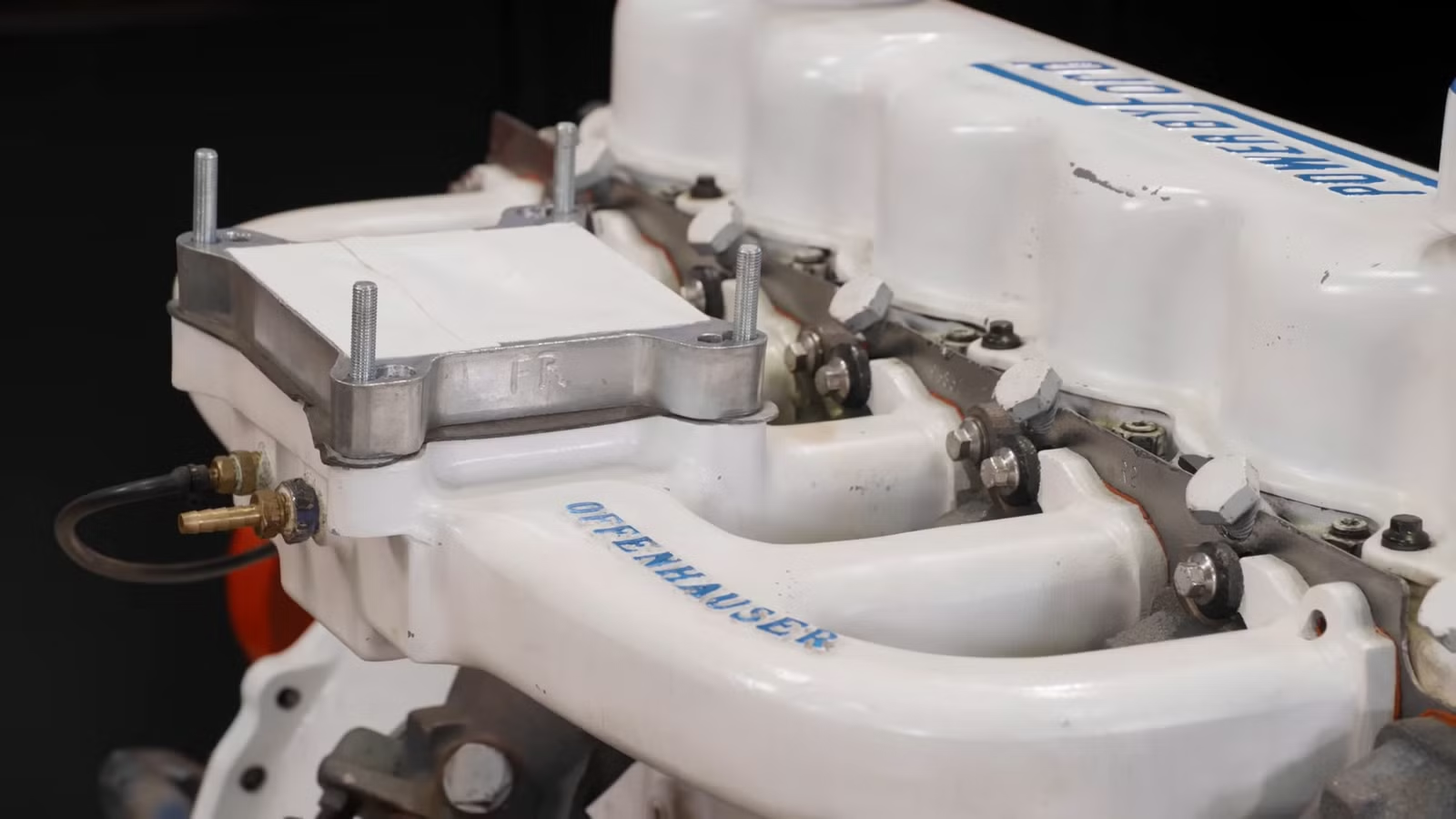
Pat Topolinski and Frankie Forman of Engine Power already had some experience with the old workhorse 300, but for this project they treated it as an opportunity to see just how hard the 300 could go. This wasn’t about bolting on a turbo and seeing which internals would fail first. It was a ground-up attempt at exploring the upper limits of torque possible with a fully rebuilt bottom end, including a forged crankshaft, rods, and pistons. They also added a CNC-ported cylinder head, upgraded valvetrain, custom EFI, and everything in between that it takes to make all of it work together.
Throwing the finished product onto the dyno revealed the kind of numbers that can make you second guess anyone who ever said they needed to head Down Under to source a Ford motor that could get the job done.
The Dyno Went From 334 To 702 LB-FT

Before jumping to adding boost, Forman and Topolinski gave their upgraded 300 a chance to show what it could do breathing on its own. The naturally aspirated pull produced 300 horsepower and 334 lb-ft of torque, already a perfectly credible result from a beefed-up straight six that hadn’t been dropped in a production truck since last millennium. More importantly, it provided a baseline for comparison once the turbo entered the conversation.
At 12 psi of boost, the motor put out 555 horsepower and 623 lb-ft of torque. This was, again, a solid result. It just wasn’t one that had much to say about where the 300’s capability ceiling might be. Cranking up the boost to 16.5 psi delivered a final result of 601 horsepower and 702 lb-ft of torque, enough to send the Barra back to kangaroo country.
What It Took To Make That Number

Crossing the 700 pound-feet threshold wasn’t accomplished just by leaving Ford’s bottom-end internals alone and crossing their fingers. The build included reinforcing the top of the block and adding a forged crankshaft, Molnar H-beam forged connecting rods, and custom DSS Racing forged pistons. The result was a 9.2:1 compression ratio and a solid foundation on which to start adding boost.
As for the other end of the motor, there was plenty going on there, too. A CNC-ported ProMaxx cylinder head was added, along with a custom-ground Comp Cams camshaft, upgraded valve springs, and ARP studs. The motor also got hydraulic roller lifters and a high-volume Melling oil pump that kept everything appropriately slippery. Keeping all of this working together meant a custom EFI setup that wouldn’t be confused with anything coming out of an old F-Series pickup.
And then there’s the turbo. They used a Turbonetics Sylvia 7268 turbocharger on a Stainless Headers manifold with boost managed by twin Turbosmart 45-mm wastegates. Clearly, 702 lb-ft didn’t happen by accident. This was a serious performance engine that just happened to be built on a pretty humble foundation.
A Turbo Kit Is Only Part Of The Bill

For something like this, it turns out that the cost of the boost itself is just a down payment, and without the other parts of the build, it’s likely you will just be building an overpriced “boom” that may or may not give you a chance to see what the dyno said before it all goes sideways. For some perspective on what this kind of project can cost, Summit Racing offers separate Ford 300 parts bundles for the turbo setup, top end, and short block. When The Drive priced all three in 2023, the turbo package alone was $2,818.36, while the grand total came to $7,783.09.
Those of you playing along at home will note that even this nearly $8,000 figure doesn’t give us a price tag for duplicating the engine we’ve been talking about. There’s still machine work, fabrication, tuning, labor, and plenty of smaller hardware involved in turning a pile of parts into something that can survive 16.5 psi on a dyno. So this absolutely isn’t a matter as simple as bolting a $3,000 turbo setup onto an old Ford inline-six, or even going on an $8,000 shopping spree at Summit Racing. It’s a complex build where the only real financial saving grace is that the motor you started with probably didn’t break the bank.
The Ford 300’s Sleeper Appeal Comes With A Price

Ultimately, is this a story of an old Ford 300 really putting the fan-favorite Barra’s tail between its legs? It depends on how you look at it, but at the very least the comparison requires a kangaroo-sized asterisk. Part of the Barra’s appeal is that it came out of the box making big power, rated at about 436 horsepower and 425 lb-ft of torque in 2016. But we’re talking about factory setups that showed up in Australian-market Fords, which would be the equivalent of the 300 as it appeared in an F-150 from the mid-’90s. If a team of knowledgeable YouTube maniacs with an axe to grind gave a similar treatment to the Barra, the dyno could perhaps push even higher than this one.
While maybe that means that America hasn’t actually been hiding a legendary motor in boring work truck builds all these years, it’s also a heck of a fun exercise to see what real commitment and no small amount of dollars can do to a motor that otherwise wouldn’t have given anyone a reason to look twice.
Sources: PowerNation, Engine Swap Depot, The Drive, Ford Australia

Related posts




Latest Post


No Comments