
The Forgotten Maserati GT Hiding A Quad-Cam V8 For Ferrari Pocket Change

During the mid ’70s, Maserati was producing some interesting cars. If you needed four doors, there was the Quattroporte, while another practical alternative was the 2+2 Khamsin, designed by none other than Marcello Gandini from Bertone who was also responsible for the Lamborghini Countach.
If you were a sports car fanatic, there were two options from Maserati: the V8-powered Bora and the V6-engined Merak, which shared much of its DNA with the Bora. But there was one other model that is often overlooked by enthusiasts.
Maserati Needed A New Car Fast
Keep in mind that during 1973 and 1974, the oil crises hit the automotive industry hard, and the effect lingered for a couple of years. After Citroën let go of Maserati, it was taken over by a government holding company and Alessandro de Tomaso. De Tomaso decided to use the Longchamp model from the De Tomaso range as a platform for a new Maserati. The aim was to increase sales as quickly as possible.
The name of this new model came from the South African racing circuit outside Johannesburg where Pedro Rodriguez was victorious at the 1967 Grand Prix driving his Cooper T81, which was powered by a Maserati engine.

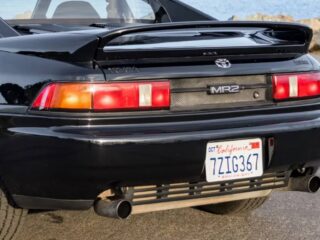
The Japanese Sports Car The Collector Market Forgot To Inflate
Thought you’d missed the boat when it comes to JDM classics? Think again.
Its Origins Are More Complicated Than Most People Realize

Several measures were taken to make sure this was a true Maserati, and the Maserati Indy’s replacement was designed in only three months. Like the Longchamp, it featured a steel unibody, while the Kyalami’s styling was handled by Pietro Frua. Instead of the pushrod Ford V8 engine that was used in the De Tomaso, the Kyalami featured an alloy, dual overhead camshaft V8 Maserati engine.
Although the quad-cam Maserati V8 was significantly lighter than the Ford V8, it had a tighter fit underneath the hood, which led to several mechanical changes to make it fit. Even the power steering system had to be relocated.
The Engine Is Pure Maserati

In true patriotic style, and given the performance on offer, it is understandable that this “new” Maserati could not be fitted with a Ford V8 engine. Called the Tipo AM 107.21.42, the engine was 4,136 cc in size and offered two valves per cylinder. It was also fitted with four Weber 40 DCNF-6 downdraft carburetors, and the result was a compression ratio of 8.5:1. Peak power was 266 bhp at 6,000 rpm and 289 lb-ft at a lower 3,800 rpm. A ZF five-speed manual gearbox was available and it was also fitted with a limited-slip differential. All of this combined led to a true 2+2 high-performance GT.
One of the most notable upgrades came in 1978, when Maserati upgraded the engine. Called the Tipo AM 107.23.49, the engine displacement increased to 4.9 liters, while four Weber 42 DCNF-6 carburetors were installed, resulting in 276 bhp at a lower 5,600 rpm, while the torque figure remained unchanged, but now at a lower 3,000 rpm — perfect for touring. The five-speed manual transmission remained, albeit as an option, while a three-speed automatic came as standard equipment.
The Fastest Car From The ‘60s That Came Equipped With A Manual Gearbox
It arrived in the middle of the golden era of muscle cars and outran them all with a V12, three pedals, and a stick.
Pietro Frua Gave It A New Identity

Pietro Frua was responsible for the designs of cars for Maserati, Glas, and BMW, as well as Renault and AC cars. Although it is clearly evident that the Kyalami was based on the Longchamp, the number of changes to the exterior styling helped set it apart.
Notable exterior upgrades included the use of double, twin-circular front headlights and a chin spoiler. The Kyalami also featured several chrome bits around the exterior of the car, including a significant full-width stainless steel trim piece at the rear.
It Was Built To Cross Continents In Comfort

The cabin of the Kyalami featured sumptuous wide ribbed seats covered in Connolly leather. Even the dashboard was covered in leather. The 2+2 seating arrangement, along with the trunk, allowed this to be a true GT car, complete with the torque on offer from both V8 engines.
Both front and rear seats also offered armrests and headrests, not a given in all cars at the time. In the driver’s seat, the instruments and controls to the right of the dashboard were also tilted toward the driver, all in an effort to put the focus on the driver.
The Biggest Engine Delivered Serious Performance

Analyzing the performance of this 4.9-liter V8, one quickly sees that the Maserati’s performance was perfectly in line with, and in some cases better than, that of its competitors at the time. Mercedes-Benz’s best-selling 450 SLC was fitted with a slightly smaller 4.5-liter V8 engine, which only produced 217 horsepower and 265 lb-ft. Its top speed was said to be 210 km/h, roughly 150 mph, and its acceleration time to 100 km/h was 9.3 seconds. 0 to 60 mph was achieved in 7.6 seconds.
Another new contender that surfaced from Porsche was the 928. Also offering a V8, although 4.5 liters in size, it produced 237 bhp and 258 lb-ft. Acceleration was brisker than the Mercedes-Benz at 7.2 seconds to 60 mph and a top speed of 157 mph.
The Italian Exotic That Both Fan Bases Ignore

Sometimes when a car is a mix of two brands, enthusiasts frown upon it — and that has been the case with the Kyalami. This GT sits in an unusual position in the collector’s market, where Maserati enthusiasts often overlook it because of its De Tomaso origins, while De Tomaso fans see it as too much of a Maserati.
However, if you look at the facts and the numbers, this is still a collectible car. Apart from the performance on offer and the solid styling, only around 200 of these cars were built between 1976 and 1983. Compared to other Maseratis of the era, of which many more were produced, there were even twice as many De Tomaso Longchamps built. Although a car like the Ferrari 308 GTB is a pure sports car and was manufactured much longer (until 1985) than the Kyalami, over 12,000 of them were produced. Most enthusiasts have not even seen a Kyalami in real life, further adding to this car’s mystique.
The Affordable Exotic With Ferrari Looks And Honda Running Costs
This mid-engine sports car delivers Ferrari-style looks and exotic performance without the supercar price tag or maintenance drama.
This Might Be The Cheapest Way Into A Quad-Cam Italian V8

If you consider the values of other V8-engined Italian cars from the era in which only 200 or fewer were built, you would usually be in for quite a price. But with the Kyalami, that is not the case. Low production numbers, the option of manual or automatic gearboxes, decent performance, a luxurious interior, and a level of practicality mean the Kyalami truly ticks several boxes for many enthusiasts.
Classic.com gives the Kyalami an average price right around $50,000. All things considered, in terms of pricing, rarity, and performance, this is one of the cheapest ways to own a quad-cam Italian V8. Along the way, you will also undoubtedly have the only one of its kind at a car meeting.
Sources: Classic.com, Fastest Laps

Related posts





Latest Post




No Comments