
The Hot-Rod Six Chevy Buried To Protect Its Small-Block Camaros
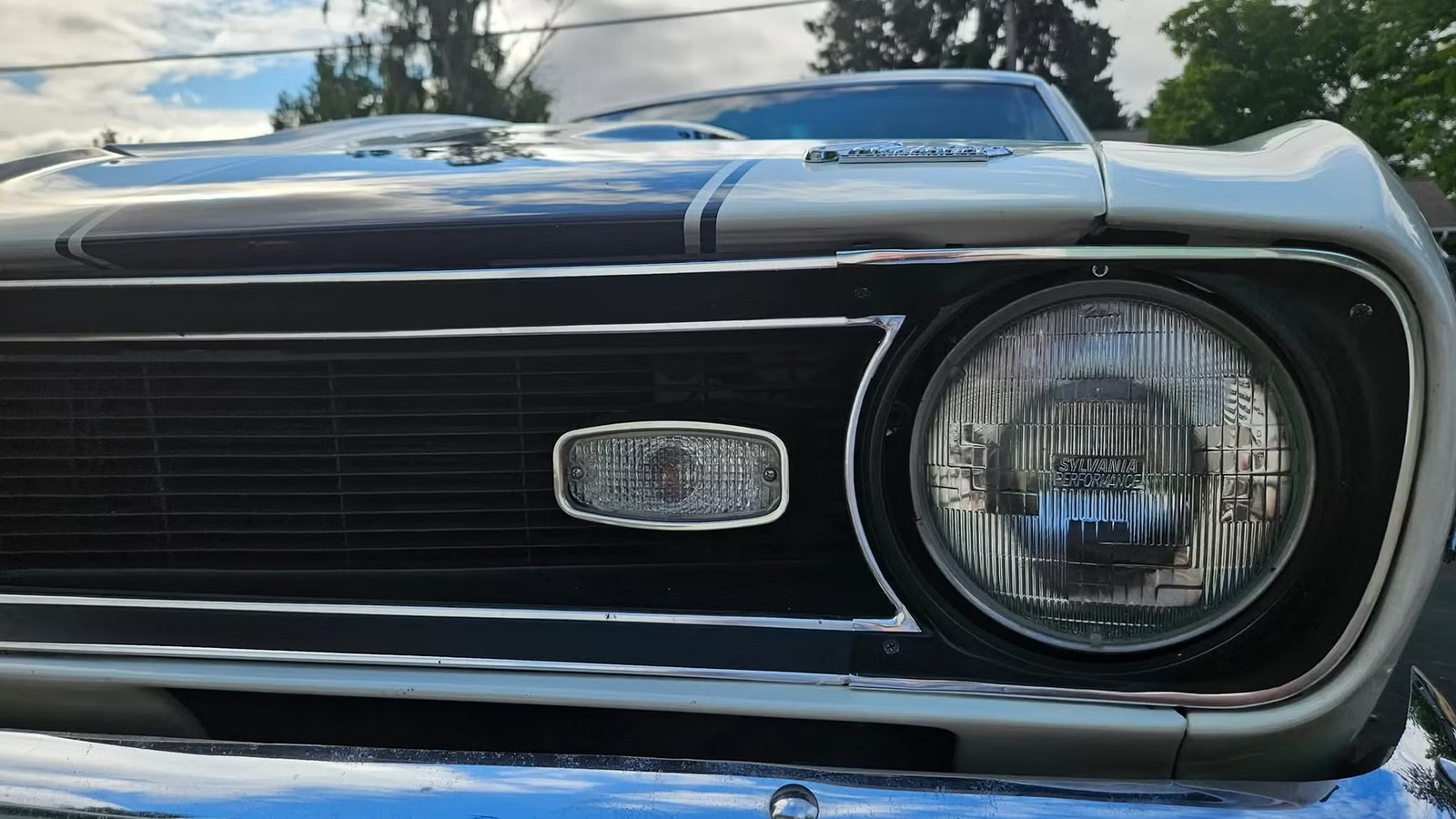
In 1967, General Motors launched the first-generation Chevrolet Camaro to battle its arch rival, the Ford Mustang; pony cars at the time were defined by fast V8s. Yet thousands of buyers left GM showrooms with inline-six-equipped Camaros designed for economical commuting. Little did they know, Chevrolet had a six-cylinder masterpiece in its pocket. GM used the torque monster engine in its pickup line. Legend has it that GM kept the six-cylinder powerhouse away from the sporty Camaro to keep the V8 hierarchy alive on American streets.
The Bargain 1967 Camaro Time Forgot

While the V8-equipped Camaros grabbed the magazine covers, production lines told a different story. Many buyers left the dealer lot with a basic inline-six instead of the V8. Chevrolet offered two six-cylinder choices: the base 230-cubic-inch L6, which produced 140 horsepower, and the 250-cubic-inch L22, which produced 155 horsepower. GM built over 20,000 units of the 230ci and about 38,000 units of the 250ci. These engines delivered great gas mileage and kept production costs low, but they were slow and ultimately left buyers wanting more, with no path to the more expensive V8 version.
But for General Motors, the base six-cylinder options weren’t just economy choices: together, they accounted for over 28% of all 1967 Camaro sales. By securing this massive baseline volume from the simple inline-six, Chevrolet generated the profit margins needed to fund chassis development and tooling for the Camaro’s higher-tier performance V8 program. But was there a middle ground between the base inline-six and the performance V8?
The Indestructible Workhorse Hidden In Plain Sight


Well, yes — a Chevrolet inline-six sat just across the assembly plant from the Camaro. Introduced in 1963, the 292 inline-six was a heavy-duty workhorse engine designed for Chevrolet and GMC pickup trucks, medium-duty haulers, and delivery vans, but GM reserved it for large vehicles rather than the passenger cars it offered then.
While smaller passenger-car inline-six engines used light-duty castings and standard components, the 292 featured a heavy-duty, high-nickel iron block casting, extra-thick walls, ultra-stiff main caps, and heavy-duty forged steel crankshafts. That extra stroke and structure meant the 292 was built to pull heavy loads up steep inclines from a dead stop, while generating massive low-end torque.
The Performance Inline Six Camaro That GM Never Built

When an automaker with a wide selection of cars, like General Motors, has all the engineering prowess to build a revolutionary performance machine but chooses not to, enthusiasts feel like a great opportunity has been lost. Something similar could be said about the 292 engine, as dropping the commercial-grade inline-six into the 1967 Camaro required almost no extra custom work; it needed no chassis changes, and the engine shared the front mounting locations and key dimensions with the standard passenger-car inline-sixes.
Beyond identical mounts, the 292 also retained the passenger-car starter orientation, oil pan sump clearance, and flywheel ring-gear count. A production-line swap required no frame modification, stock exhaust header re-routing, or custom steering linkage. The barrier to a factory high-performance straight-six Camaro was never a technical limitation; it was likely just a corporate decision to satisfy the bottom line and preserve the mighty V8.
The Ultimate Factory Sleeper On Paper

Had Chevrolet offered a high-output version of the 292 in the first-generation Camaro, it would have completely rewritten the rules of entry-level muscle. With its massive 4.12-inch stroke, a performance-tuned 292 would have delivered immediate off-the-line torque, easily rivaling baseline 283 and 307 V8 models while offering superior front-to-rear chassis balance. Yet GM leadership refused to explore the 292’s potential, instead limiting it to commercial fleets.
What Made The 292 Unstoppable On The Strip

While GM officially never used the 292 inline-six in its passenger cars, the drag racers, land-speed record chasers, and dirt-track builders — essentially the automotive enthusiast community — took matters into their own hands. Over the decades, the 292 inline-six earned a legendary reputation among grassroots engine builders as an ultimate sleeper engine, thanks to its low-end grunt and easy tunability, proving capable of going toe-to-toe with the classic-era V8s and even expensive V8 builds.
Eventually, custom hot-rodders accomplished what GM never did — putting a fully built 292 straight-six into a lightweight first-generation Camaro. Fitted with modifications such as a custom Lump Port intake and aftermarket cross-flow cylinder heads, a hot-rodded 292 could take on stock 327 and 350 small-block V8 Camaros in the quarter mile. It gave the 1st-generation Camaro a powerhouse hot-rod inline-six engine it truly deserved.
Small-Block DNA In An Inline Casting

Engine builders realized Chevrolet had unintentionally given the 292 major structural advantages by borrowing engineering DNA from its small-block V8. For instance, the 292 used the same rod journal diameters, lifter sizes, and valvetrain geometry as GM’s small-block V8 family, which let enthusiasts easily swap high-performance V8 valve springs, roller rocker arms, and custom hardware onto the six-cylinder head without making it an expensive affair.
Its commercial roots meant the early 292s had heavy-duty forged steel crankshafts and extra-thick connecting rods, resulting in a bulletproof rotating assembly capable of withstanding extreme RPMs and very high cylinder pressures. Furthermore, the 292’s large displacement exceeded that of several small-block V8s of its era, including the classic 283 V8. Later, modern forced-induction builders embraced the platform’s durability and turned it into a formidable engine, thanks to its thick cylinder walls and wide bore spacing, which let them bolt massive turbochargers onto modified blocks capable of producing anywhere from 600 to over 1,000 hp.
The Turbo-Six Prequel GM Refused To Build

At the time, General Motors had invested heavily in promoting the V8 engine as the absolute pinnacle of American performance. The small-block V8 was GM’s crown jewel, generating massive profit margins and defining iconic brand and flagship models like the Camaro SS, Chevelle, and Corvette.
Allowing a six-cylinder engine to match or exceed entry-level V8 performance would have shattered the public perception of GM’s engine structure. To keep the V8 supreme, the inline-six had to stay docile in the passenger cars. GM intentionally limited the base 230 and 250 so they could never threaten sales of the 283, 327, or 350 V8s.
GM’s decision ultimately represented one of the greatest missed opportunities of the muscle car era. Decades later, vehicles like the Buick Grand National, Ford Falcon Barra, and modern twin-turbo straight-sixes proved non-V8 muscle cars could capture performance enthusiasts worldwide. The 292 Camaro remains the ultimate missing prequel to today’s high-output turbo-six machines — a truly legendary hot-rod concept that got buried in a pickup truck bed.
Source: Chevrolet

Related posts





Latest Post


No Comments