
The 652cc Kawasaki ADV That Outlasts Ténéré And KTM Rivals For Thousands Less
Adventure bikes supposedly exist to carry riders beyond cities, dealerships, and dependable phone signals. Yet many of the category’s most desirable machines now arrive with increasingly elaborate electronics, premium suspension components, multiple software-controlled riding modes, and servicing requirements that can become expensive once the warranty ends. More capability is rarely a bad thing, but traveling by motorcycle has somehow become more complicated before the trip has even started.
ADVs Have Become Better At Nearly Everything Except Being Affordable

The middleweight adventure class has steadily moved upward in power, suspension performance, electronics, and price. Yamaha’s Ténéré 700 starts at $10,999, while the more specialized KTM 890 Adventure R carries a $16,299 sticker price. Both are significantly more capable off-road than the motorcycle at the center of this story, especially when the terrain becomes fast, technical, or deeply unpleasant.
Of course, that capability isn’t free. Riders still need to add luggage, protection, navigation equipment, tools, riding gear, and enough money to actually leave home. A $10,999 motorcycle can quickly become a $15,000 travel build, while the KTM can sail beyond $18,000 without requiring much imagination. For riders who mostly cover pavement, fire roads, gravel highways, and moderate trails, that raises an awkward question: How much motorcycle do they genuinely need before the machine starts consuming the travel budget?
The Best Adventure Bike Isn’t Always The Best Motorcycle On Paper


Bike comparos naturally reward horsepower, low curb weight, sophisticated suspension, strong brakes, and aggressive off-road performance. Those qualities are easy to measure and immediately obvious during a test ride. Long-term overland ownership rewards less glamorous things, including fuel capacity, comfort, predictable maintenance, affordable replacement parts, and the ability to diagnose a problem far from a dealership with a polished showroom and branded espresso machine.
More Electronics Can Mean More Capability, But Also More Dependency

Modern traction control, selectable riding modes, cornering ABS, quickshifters, TFT displays, semi-active suspension, and smartphone integration can meaningfully improve safety, comfort, and performance. Pretending otherwise would be lazy nostalgia. The KTM’s configurable electronics and off-road ABS, for example, give skilled riders much more control when pushing through loose terrain than a basic system ever could.
The tradeoff is dependency. More systems can raise the purchase price, complicate troubleshooting, and create repairs that require diagnostic equipment or trained technicians. That doesn’t automatically make an electronically advanced motorcycle unreliable, but it does change how an owner interacts with it. Riders traveling remotely may reasonably prefer a machine with fewer menus, sensors, motors, and software decisions standing between a mechanical problem and a workable roadside solution.
The Kawasaki KLR650 Outlasts Its Premium Rivals For Thousands Less

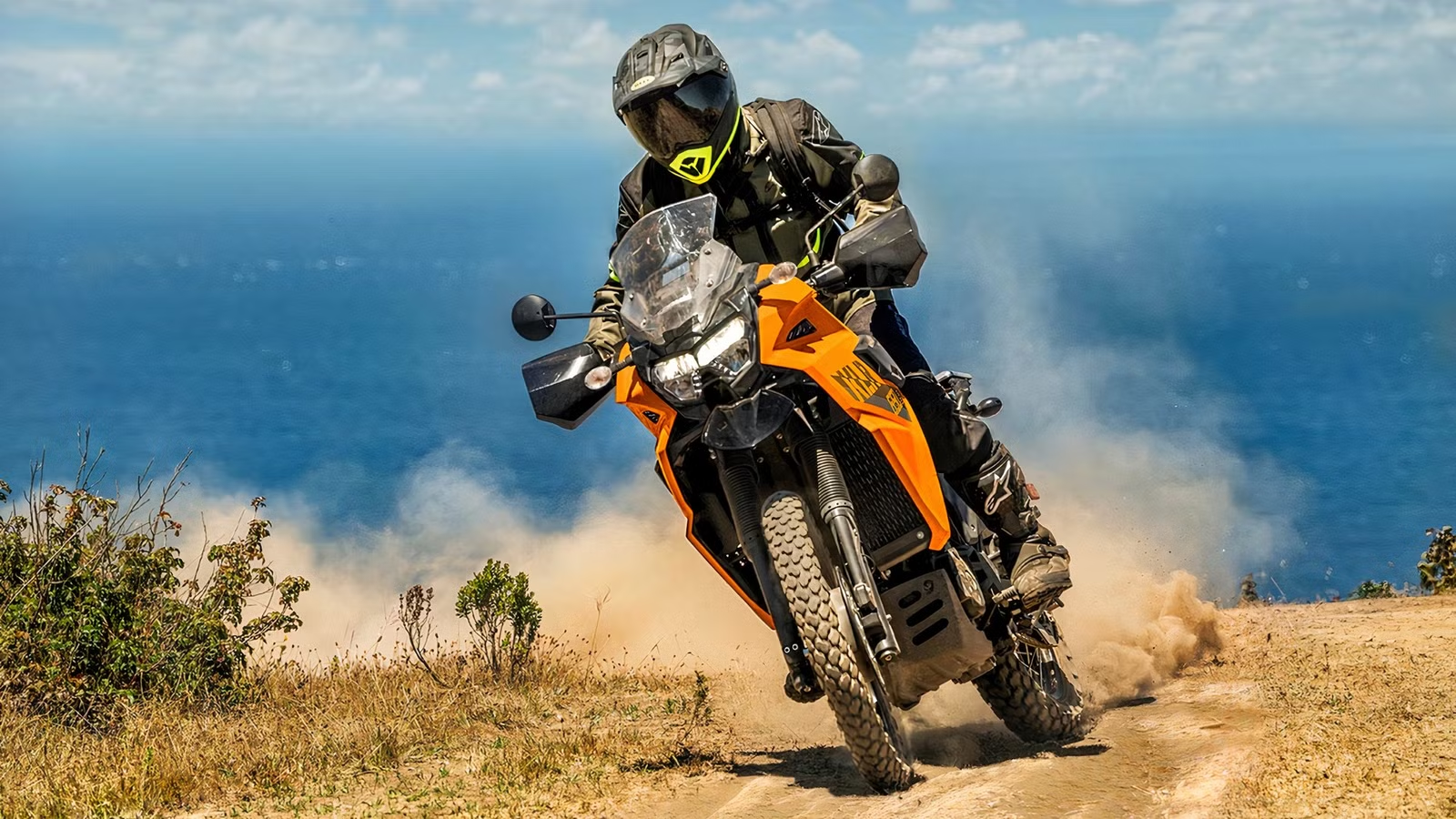
That bike is, of course, the Kawasaki KLR650. This appears to have watched the adventure-bike electronics arms race from a plastic lawn chair. Its liquid-cooled, fuel-injected 652cc DOHC single-cylinder engine drives the rear wheel through a five-speed transmission and sealed chain. Kawasaki doesn’t publish an official horsepower or torque figure, which suits a motorcycle whose performance conversation usually begins and ends with whether it eventually reached the destination.
The current KLR650 starts at $6,999, and gets you a tubular semi-double-cradle steel frame, a 41mm telescopic fork with 7.9 inches of travel, and a preload- and rebound-adjustable Uni-Trak rear shock offering 7.3 inches. A 21-inch front wheel and 17-inch rear use tube-type tires, while braking comes from a single 300mm front disc and 240mm rear disc.

The standard bike can be ordered with or without ABS. Its dashboard is a basic digital unit rather than a full-color TFT, and there’s no traction control, cruise control, quickshifter, smartphone pairing, or collection of riding modes. There is, however, a large adjustable windscreen, hand guards, an aluminum rear carrier, a generator rated to support accessories, and a comfortable upright riding position designed around long hours rather than short bursts of off-road theatrics.
The KLR650 Is Slow, Heavy, And Completely Uninterested In Apologizing

It’s important to acknowledge that the KLR650’s shortcomings are not misunderstood advantages. The non-ABS base model weighs 456.2 pounds ready to ride, while adding ABS raises that figure to 460.6 pounds. The Adventure ABS reaches 487.1 pounds after gaining factory side cases, LED auxiliary lights, engine guards, DC and USB power outlets, and its additional trim equipment. That’s substantial mass for a single-cylinder motorcycle, especially when it’s tipped over on an uneven trail.
Its five-speed gearbox also leaves riders wishing for another ratio during sustained high-speed highway work. The non-switchable ABS is less flexible in loose terrain than the configurable systems used by more expensive competitors. Deep sand, mud, steep climbs, and tight singletrack expose the KLR’s weight and modest performance quickly. Buyers aren’t purchasing secret superiority. They’re accepting clear limitations because the motorcycle costs dramatically less and asks less of them over a long ownership period.
A Large Fuel Capacity Changes Where The KLR650 Can Take You
The centerpiece of the KLR650’s travel capability is its 6.1-gallon fuel tank. Depending on speed, load, terrain, and weather, that gives the economical single-cylinder engine the potential to cover roughly 300 miles between stops. Even when conditions pull the real figure below that mark, the available range remains useful in rural regions where gas stations are scarce, closed, or represented by a hand-painted sign beside someone’s house.
Its 60.6-inch wheelbase, 30-degree rake, 4.8 inches of trail, and substantial curb weight create stability on highways and broad gravel roads. The standard model has 8.3 inches of ground clearance and a 34.3-inch seat, while the broad saddle, windscreen, fairing, and relaxed riding position help reduce fatigue. It won’t dance through rough terrain like a lighter dual-sport, but it settles into loaded touring with the temperament of a farm tractor that has somehow obtained license plates.
The Weight Becomes Less Of A Problem Once The Motorcycle Is Loaded

An empty-bike comparison doesn’t fully represent adventure-touring travel. Camping equipment, tools, spare tubes, water, clothing, food, and luggage can add dozens of pounds to any motorcycle. Once every machine is loaded, the KLR’s weight disadvantage becomes less dramatic, while its long chassis, large tank, broad seat, rear rack, and predictable power delivery become more valuable. The same mass that causes problems in single tracks can help the bike remain settled through crosswinds, broken pavement, and fast gravel.

Shorter riders can choose the KLR650 S, which lowers the seat to 32.1 inches and reduces ground clearance to 7.3 inches through revised suspension. Its wheelbase also shortens slightly to 59.6 inches, while curb weight remains 456.2 pounds without ABS or 460.6 pounds with it. A heavy motorcycle that allows the rider to place both feet securely on the ground can be easier to manage than a lighter machine with a much taller seat.
The KLR650 Leaves Money For The Adventure
The KLR650’s real advantage is the amount left in the owner’s bank account. The $4,000 difference from a Ténéré 700 could fund luggage, tires, upgraded footpegs, suspension work, protection, fuel, lodging, and several weeks on the road. Compared with the 890 Adventure R, the $9,300 gap could pay for a complete travel build and still leave enough money to cross a meaningful portion of a continent.
The platform also benefits from decades of owner experience, aftermarket development, and widely shared mechanical knowledge. Its weak points are thoroughly documented, and common upgrades can be handled in a home garage rather than unlocked through software or dealership labor. Kawasaki’s broad dealer network and the KLR’s long production history also improve the odds of finding parts or someone familiar with the machine when a trip goes sideways.
Source: Kawasaki

Related posts

Latest Post


No Comments