Why Sharing A Toyota Camry Powertrain Made This Lexus Nearly Depreciation-Proof
8 minutes reading
Tuesday, 14 Jul 2026 15:01 0 160 autotech
Luxury cars are known for their steep depreciation, particularly the flagship full-size luxury sedans. Give them a pure electric drivetrain or take away what the brand stood for, and you can expect their value to drop faster than their 0–60 mph times. Just look at the Mercedes-Benz EQS, which once held the unflattering title of having the worst one-year depreciation in the industry.
But there are luxury sedans that defy the odds. The outlier in this stereotype? The Asian luxury brands, particularly Lexus. Lexus is Toyota’s luxury brand, and Toyota is also known for its strong resale values. But apart from the Toyota connection, what are the other factors that make Lexus have better resale values, and why do European luxury models depreciate more rapidly? That’s exactly what we’re here to analyze.
Prestige-wise, the European luxury brands may have an advantage over Lexus, but it seems that isn’t necessarily helping their resale values. Here’s why.
Complexity And Reliability Affect Resale Value
Close up of the 31-inch theater screen in the back of the 2023 BMW 760iBMW
The main driver of depreciation among the European luxury sedans is their mechanical and technological complexity. If you go for the flagship luxury sedans with advanced suspension, big displacement V-8s and V-12s, and their motorized luxury features like the 31.3-inch 8K ultra-wide display of the BMW 7 Series, don’t expect these vehicles to be easy to maintain. They’re great to experience when new, but no mechanic would be happy to work on these vehicles as they age.
There are European luxury cars that hold their value well, though still not as much as an equivalent Lexus. According to iSeeCars, a five-year-old 2021 BMW 3 Series has an average resale value of $25,250 – a depreciation rate of 46.8 percent. That’s a little faster than the segment average of 45.6 percent depreciation, but among German luxury sedans, the 3 Series is one of the most resilient. The current G20 generation of the BMW 3 Series is fairly reliable by German car standards, but a five-year-old 2021 Lexus IS will still last longer and is easier to maintain. This is why it has only depreciated by 32.1 percent in five years—the absolute best in its class.
In the luxury segment, heritage plays a big role in a vehicle’s appeal. One of the absolute most resilient vehicles in terms of resale value, according to iSeeCars, is the Porsche 718 and 911—pretty much everyone’s dream sports car. The 911, in particular, isn’t just an icon. It’s also relatively reliable and has strong parts support, which is why it’s still fairly common to see air-cooled 911s during car meets. If a vehicle is both reliable and very iconic, you get a car like the Porsche 911, but what about a vehicle that lacks heritage and, worse, even diverges away from what the brand stands for?
Enter the luxury electric vehicle (EV) segment. Porsche is a brand primarily built around the internal combustion engine (ICE), and it’s what the brand’s customers are looking for. Take that away, and you’re alienating a core customer base. That’s exactly what’s happening right now with the Porsche Taycan. iSeeCars says that a five-year-old 2021 Porsche Taycan will depreciate by more than half, at 55 percent, which, to be fair, is slightly slower than the large luxury electric car segment’s 59.5 percent. EVs are evolving rapidly, and if it’s made by a company whose customer base prefers ICE or, at the very least, hybrids, then you’ve got a vehicle that lacks heritage, is barely desired by the brand’s customers, and gets easily outdated. For the used buyer aspiring to own a Taycan, though, its rapid depreciation is probably good news.
When Mass Market Roots Become Appealing
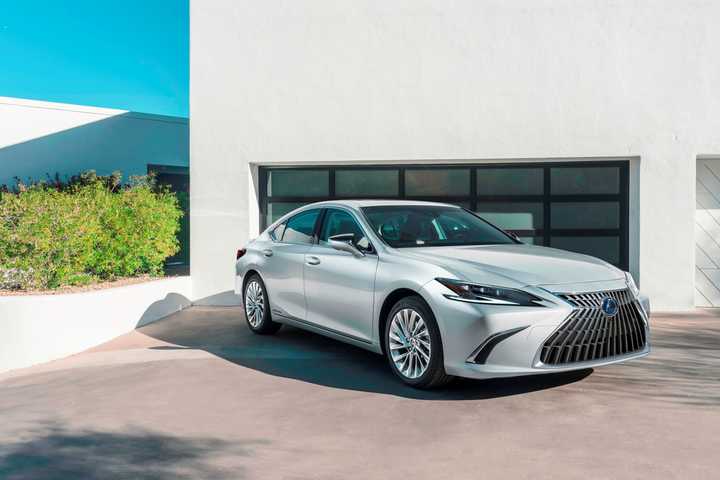
Beauty shot of a parked silver 2025 Lexus ES 300hLexus
On the other hand, you’ve got the Lexus ES 300h, whose close relationship with the Toyota Camry Hybrid is an asset when it comes to the used market. You see, the ES 300h never really brought anything new to the table, whether it’s in terms of features or performance. What it offered was plenty of luxury and comfort, while being opulent enough to drive without sacrificing reliability.
Cheap To Repair, Easy To Maintain
2020 Lexus ES 300h engineLexus
The outgoing seventh-generation (2019-2025) Lexus ES shares the same fourth-generation 2.5-liter Toyota Hybrid System as the Camry Hybrid. This includes the 2.5-liter A25A-FXS Dynamic Force four-cylinder engine with D-4S direct and port injection, along with its electric motors and nickel-metal hydride (NiMH) or lithium-ion batteries if it’s a 2021 or newer model year. With this powertrain being fitted to a plethora of Toyota and Lexus models and not just the Camry Hybrid, parts have become incredibly common and thus, more affordable.
For the hybrid battery’s cost, a genuine Lexus-branded NiMH battery is quoted at $3,365.69 (or $2,780.06 with the ongoing sale). This listed price is from Lexus OEM Parts, a Lexus-certified online parts shop operated by RevolutionParts. This, however, does not yet include labor costs and their related parts, such as brackets or housings, assuming these also need replacement. If you prefer to go to a Lexus dealer that also offers installation, Lexus of Tulsa says that battery replacement costs (in general, for both NiMH and lithium-ion) hover around the $2,000 to $8,000 mark. Independent repair shops offer even lower prices. The Hybrid Geek states that an ES 300h’s hybrid battery costs, along with mobile installation, cost just $2,395, though this is for an older generation (2012-2015) ES 300h.
Low Battery Replacement Risk
Rear shot of a silver 2025 Lexus 300hLexus
Fortunately, the ES 300h is an affordable car to maintain for 10 years. CarEdge says that its 10-year ownership cost is at $5,952, and with a very low 15.63 percent chance of an expensive repair. For reference, a BMW 3 Series will cost $14,345 to own in 10 years, and comes with a 41.71 percent chance of a major repair. It’s only in the worst-case scenario of an $8,000 replacement and installation bill at a Lexus dealer that the ES 300h nearly matches the BMW 3 Series. Besides, in the BMW 3 Series, that’s the average price you’ll pay, not to mention quadruple the chance of a major repair within 10 years, while for the ES 300h, that’s only a worst-case, less likely scenario.
So what are the odds that a hybrid battery replacement will happen within 10 years of an ES 300h’s life? Well, getting a five-year-old 2021 ES 300h means your vehicle has benefited from Lexus extending its warranty from eight years or 100,000 miles to 10 years or 150,000 miles. Beyond the tenth year, the odds of replacement are still extremely low within five years. According to Lexus of Clearwater, hybrid batteries last an average of 15 years or 150,000 miles. And to add more confidence to the longevity of the ES 300h’s hybrid battery, The Car Care Nut in a 2025 video said at the time that the youngest Toyota that he serviced for a hybrid battery replacement was a 12-year-old 2013 Avalon with 197,000 miles. The mechanic already considers that younger than usual for a Toyota or Lexus hybrid that he usually takes in for a hybrid battery replacement.
The Confidence Is Reflected In Its Resale Value
Tracking shot of a Silver 2025 Lexus ES 300h in the cityLexus
And finally, to seal the deal, a used car’s value is largely determined by how much life the next owner can extract from a vehicle. As you’ll see here, the high resale value of the ES 300h is a testament to the confidence that the industry has in its reliability, including its hybrid battery’s life span.
Long Useful Life, High Resale Values
The interior of a silver 2025 Lexus ES 300hLexus
Profile shot of 2025 Lexus ES interior showing front and rear seatsLexus
According to iSeeCars, a five-year-old 2021 Lexus ES 300h depreciates by 39.6 percent on average. This slow depreciation is a testament to the confidence that the industry has in the ES 300h. iSeeCars has also determined that the ES 300h has an average lifespan of as much as 14.7 years or 163,586 miles, while it has a 25.4 percent chance of reaching 200,000 miles. Going back to the BMW 3 Series, which is perhaps one of the least complex German luxury cars, even iSeeCars thinks it has a lower average life span of 11.2 years or 120,662 miles, and just a 5.6 percent chance of reaching 200,000 miles.
The Future Of The ES Hybrid
Front 3/4 shot of 2026 Lexus ES 350h parkedLexus
The good news is that, if you’re keen on going to a brand-new ES, then that same level of confidence still applies here. The new 2026 Lexus ES 350h may have a radically new body style and a more modern interior, but the sixth-generation Toyota Hybrid System doesn’t stray too far away from the ES 300h’s fourth-generation system. Through stronger electric motors and more energy-dense batteries, the overall recipe hasn’t been reinvented too much. As a result, the incrementally improved system allows for more electric-dominant and efficient driving, while still preserving the reliability and durability that the ES hybrid has always stood for.










No Comments