
The Plymouth Performance Wagon Nobody Remembers
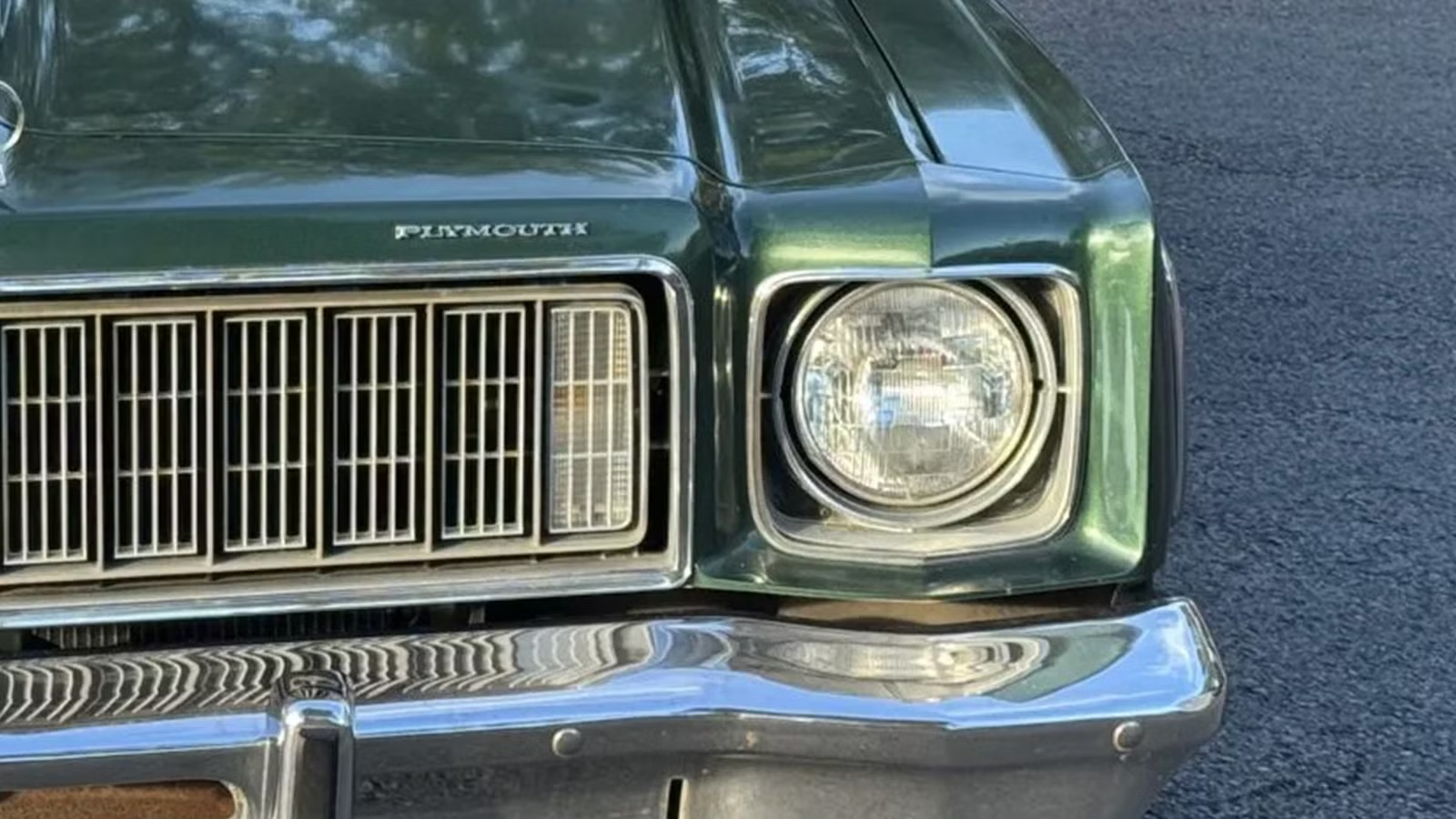
The high-performance wagon is a type of car that always seems to strike a chord with true gearheads. After all, nobody can really argue with all the benefits they bring. They’re fast and practical, and you don’t really have to compromise on either side of that to get a really fun car. While many of those surprisingly fun, fast estates have been made in Europe or Japan, a decent amount have also come from North America.
Full-Sized Station Wagons Are An Iconic Product Of The American Auto Industry

There aren’t many types of American Cars that are more beloved by enthusiasts than the classic station wagon. In the days before minivans and SUVs, these cavernous estate cars were how big families got around everywhere. Much like the big estate cars on the other side of the Atlantic, American station wagons were also good haulers for budding entrepreneurs who had wares to sell. While these cars looked like boring family transports on the outside, on the inside that wasn’t always the case.
Several American Station Wagons Got Very Powerful Engines

As a quirk of the times many of these station wagons were built in, a lot of them had some seriously powerful engine options on the order forms. Many of these crazy engines were not too far removed from the ones that were used in the top muscle cars of their day. That gave these old-school American wagons proper big-block muscle car performance, at least in a straight line.

Some of these hyper-powered wagons ended up becoming famous. To name just two examples, the Chevrolet Kingswood 427 and the Ford Country Squire 427 have both become collector’s pieces thanks to their rarity and their huge power outputs. But there’s one high-powered big-block wagon that’s fallen by the wayside. It comes from the Mopar side of things instead of Ford or General Motors, and it hides a fantastic secret under the skin.
The Plymouth Fury Sport Suburban 440 Is A Rare Sports Wagon Everyone’s Forgotten About

You might not have heard of the Plymouth Fury Sport Suburban 440 before now. The Plymouth Fury Sport Suburban is generally a forgotten American station wagon, anyway. The 440 version is a rarity even among that. A big part of the reason why it’s so rare is the engine that’s under the hood. It’s a version of one of the most special engines ever to come out of Detroit. Why is it so special? Well, we’re about to explain.
It Has The Same Engine That Was Used In Mopar’s Most Legendary Muscle Cars
As we’ve already mentioned, quite a few classic American station wagons got the option to have big-block muscle car engines. That’s absolutely the case for the Plymouth Fury Sport Suburban 440. As the “440” in the name suggests, it’s got Mopar’s legendary 440 cubic-inch V8. This is the same engine that powered variants of the top Dodge and Plymouth muscle cars, including the Dodge Charger R/T, and homologation specials like the Dodge Charger Daytona and the Plymouth Superbird.
While its power was a bit strangled in the Fury Sport Suburban 440 compared to its heyday, this big-block monster still had a lot of get-up-and-go. It was rated from the factory at 250 horsepower and 350 lb-ft of torque. While that might seem unimpressive compared to the numbers the 440 engine made at its peak, that’s still nothing to be sniffed at for a mid-1970s American station wagon.
Other Variants Of The Fury Sport Suburban Weren’t Slouches, Either

While the 440 was the power monster of the Fury Sport Suburban range, the other variants weren’t exactly short on power themselves. Below the 440, you could get the Sport Suburban with a 360 or a 400 V8. The 360 engine was rated at 175 hp and 285 lb-ft of torque, while the 400 engine was rated at 190 hp and 330 lb-ft of torque. Again, those numbers seem pretty unimpressive compared to what V8-powered cars were achieving during the golden era of the American auto industry. But those are still good numbers for a malaise-era automobile!.
It Needed Its Big Engine To Fulfill Customer Demands

Why did big station wagons like the Plymouth Fury Sport Suburban carry on having big-block engines well into the malaise era? After all, sports cars had largely dropped them in the name of efficiency. There also wasn’t any real point in sportier models having them when they had to be strangled so hard to meet emissions regulations. There was a good reason why these big station wagons kept on having the big-block engines, though.
In the days before turbocharging was mainstream, there really was no replacement for displacement when it came to torque. Big-block engines are incredibly torquey, and that kind of torque is something that really comes in handy for a family hauler. These big station wagons were expected to tow trailers and RVs around, and/or take a whole family and all their luggage long distances at highway speeds. In those situations, you need all the pulling power you can get. Therefore, torque becomes king, and the substantial torque needed for these tasks is something a conventional small-block V8 simply cannot provide.
Sources: Plymouth

Related posts

Latest Post


No Comments