
The Chevrolet Engine That Revs Like A Superbike
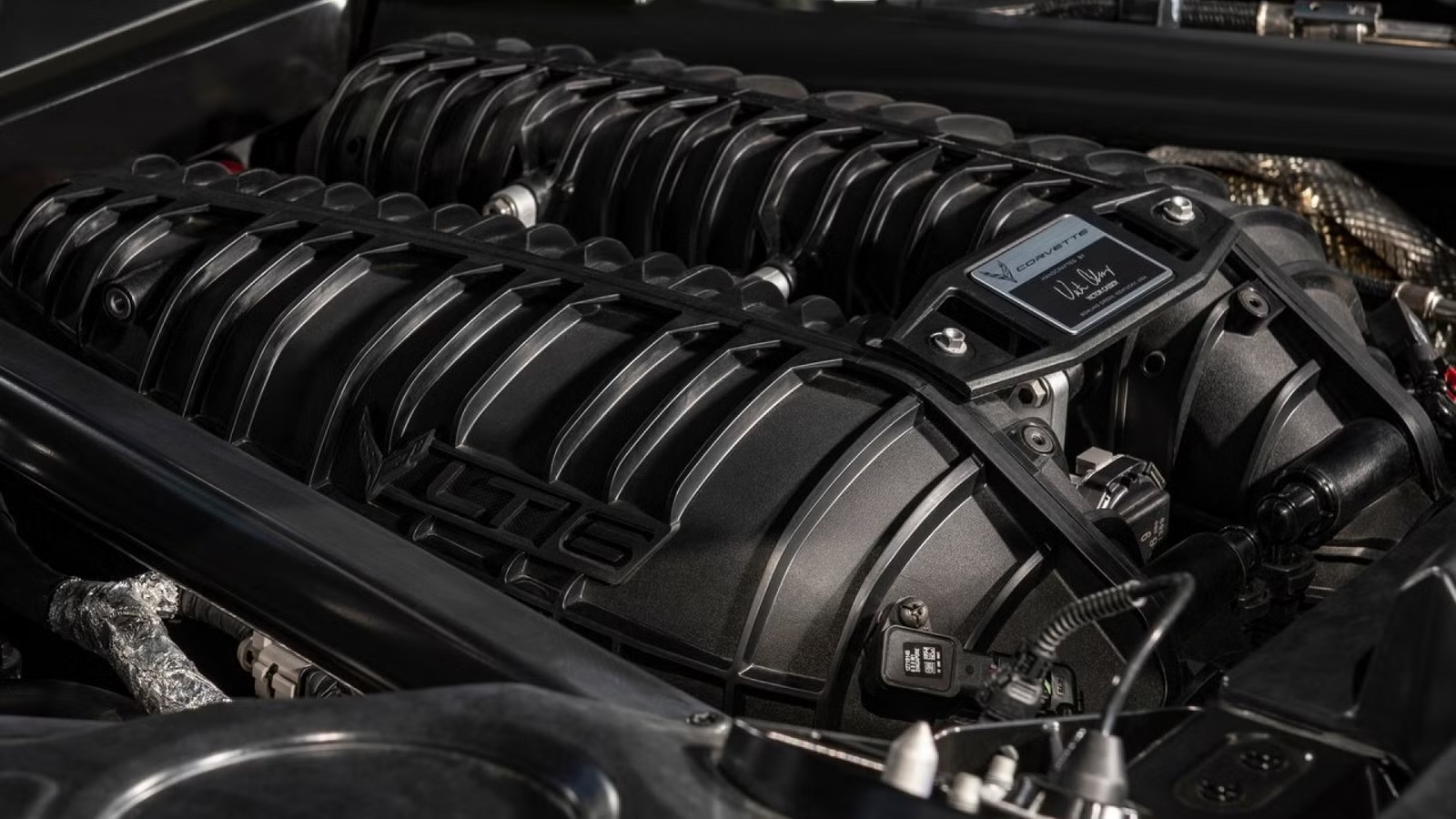
Few automakers have built a reputation on engine craft the way Chevrolet has. From the original small-block to the modern LS family, Chevy has spent decades proving that American iron can punch well above its weight. But every so often, the engineers in Warren do something genuinely unexpected — something that doesn’t just compete with the best engines from Europe or Japan, but outright challenges them on their own terms. The LT6 “Gemini” V8 is exactly that kind of engine: a naturally aspirated, flat-plane-crank masterpiece that screams to 8,600 rpm and redefines what a production American V8 can be.

Chevrolet Has A History Of Making Brilliant V8 Engines

Over the years, Chevrolet has become synonymous with making great V8 engines. They often end up being powerful, reliable workhorses that can power all sorts of different vehicles. Many of those have included sports cars and muscle cars. They’ve also varied a lot in size and design. Most people will know about the original Chevy small-block V8 and the more modern equivalents from the LS family. But there are some more weird and wonderful V8s that Chevrolet has slipped into its cars over the years. One of the weirdest, most wonderful, and most impressive of them was placed into a variant of Chevrolet’s greatest sports car.
Many Of Those Great V8s Have Been Put In The Corvette

There’s probably no car more synonymous with the greatness of the Chevrolet V8 than the Chevrolet Corvette. Every single generation of the Corvette has used various Chevy V8s — ranging from the original small-block, through the big-block monsters of the ’60s and ’70s, all the way to the turbocharged and supercharged fire-breathers of more recent times. One of those high-performance engines is perhaps the single craziest engine family General Motors has ever conceived. While it may be an all-American V8, its character is closer to a thoroughbred European unit: it revs almost to the stratosphere, and it provided the foundation for the powertrain of the most powerful Corvette ever built.
The Chevrolet LT6 “Gemini” V8 From The C8 Corvette Z06 Is A Flat-Plane Monster That Loves To Rev

|
Type |
Displacement |
Power |
Torque |
|
Flat-plane V8 |
5.5-liters |
670 hp |
460 lb-ft |
The powerplant of the C8 Chevrolet Corvette Z06, the Gemini is unlike any V8 Chevrolet has ever made before. Rather than chasing massive power through sheer displacement, Chevrolet took a different route — a flat-plane crank design. A flat-plane crank gets its name from the way its crank pin journals are arranged 180 degrees apart from each other, giving the crank a flat “I” shape when viewed end-on. It’s a configuration typically found in inline-four engines, which makes the Gemini LT6 a rare and notable example of it appearing in a V8. When a flat-plane crank is used in a V8, it produces a more even firing order than a conventional cross-plane V8, effectively making the engine behave like two inline-four engines joined together, alternating between cylinders on the left and right banks in perfect sequence.
That flat-plane crank design not only makes it an incredibly powerful engine, but also one that absolutely loves to rev. It’s easily the highest-revving production American V8 in recent years, topping out at 8,600 rpm — near-superbike territory, from the kind of engine you’d normally associate with lower-revving muscle cars.
It’s A Clean Sheet Design That’s Completely Unique From Other General Motors V8s
One of the most impressive things about the Gemini V8 is that it was a total clean-sheet design. It shares absolutely nothing in common with Chevrolet’s regular LS-line of V8 engines, or the twin-turbocharged Blackwing V8. While that meant the extra effort of developing it completely from scratch, the payoff is an engine perfectly tailored to what Chevrolet wanted from the Corvette Z06. Chevy clearly set out to build something closer in spirit to a high-revving European V8 — capable of matching the lower tier of European supercars for outright power. That’s exactly what the Gemini delivered.
It’s One Of The Most Powerful Naturally Aspirated V8s Of All Time

The LT6’s 670 horsepower and 460 pound-feet of torque may not seem that impressive when stacked against today’s most powerful supercars. But those supercars rely on forced induction to reach those figures. The Gemini LT6 produces all of its power without turbochargers or superchargers of any kind, making it one of the most powerful naturally aspirated V8s ever built. It surpasses the last great naturally aspirated V8 GM produced — the 7.0-liter LS7 found in the C6 Corvette Z06 — and it also outguns the 6.2-liter M159 V8 used in the Mercedes-Benz SLS AMG Black Series.
A Modified Version Of It Is Used In The Race Version Of The Corvette
As you’d expect from such a racy engine, the Gemini LT6 isn’t just for road cars. It was actually first developed to power the Corvette C8.R race car, which has been an incredibly competitive force in sports car racing since 2020. Originally built to the LMGTE specification, it was later adapted for GT3 rules — being renamed the Z06 GT3.R in the process — following the switch to those regulations in the World Endurance Championship and the IMSA Sports Car Championship.
Corvette race cars have long ranked among the most successful in GT-class competition, and both the C8.R and the Z06 GT3.R have upheld that tradition. The C8.R secured 18 class wins in the IMSA Sports Car Championship between 2020 and 2023, while the Z06 GT3.R has continued adding to the tally from 2024 onwards.
The Engineering Secrets Keeping the LT6 Alive

Achieving an 8,600 rpm redline is only half the challenge. Chevrolet also had to ensure the engine wouldn’t shake itself apart or starve of oil under the extreme forces generated on a racetrack.
Flat-plane crank V8s are inherently prone to high-frequency secondary vibrations that can destroy internal components. Chevrolet addressed this with specialized engineering solutions that prioritize both track reliability and long-term durability.
Neutralizing Violent Secondary Vibrations

A flat-plane crank fires evenly between cylinder banks, but the pistons don’t travel at identical speeds at the top and bottom of their strokes. This mismatch generates severe secondary vibrations that grow exponentially with engine speed.
To counter this, the LT6 uses an oversquare architecture (4.104-inch bore x 3.15-inch stroke) that limits peak piston speed, reducing the physical momentum and kinetic energy of the reciprocating assembly. Lightweight forged aluminum pistons and ultra-light titanium connecting rods further help minimize vibrational forces.
A Six-Stage Dry Sump Lubrication System

The Corvette Z06 is built to be driven hard on track, which introduces another potential weakness. High-speed cornering generates massive lateral G-forces that can push oil away from the pickup tube in a conventional wet-sump system, risking oil starvation and catastrophic engine damage. The LT6 counters this with an advanced lubrication system drawn from racing practice.
A complex six-stage dry-sump system continuously scavenges oil from multiple points throughout the engine and stores it in a separate reservoir, ensuring a consistent oil supply even under extreme cornering loads.
The “Lashed-for-Life” Valvetrain

Historically, high-performance engines targeting high rpm have relied on mechanical (solid) lifters to avoid the valve float common in hydraulic lifters. GM’s “lashed-for-life” configuration delivers the raw performance of a racing valvetrain with the zero-maintenance convenience of a standard street engine.
Rather than conventional hydraulic lifters, the LT6 uses rigid mechanical finger followers that handle an 8,000+ rpm redline without issue. To minimize wear, these components are treated with a hard Diamond-Like Carbon (DLC) coating that further extends their service life.
The Twin-Turbocharged LT7 Was Developed In Tandem With The LT6

|
Type |
Displacement |
Power |
Torque |
|
Twin-turbocharged flat-plane V8 |
5.5-liters |
1,064 hp |
828 lb-ft |
If the name “Gemini” hadn’t already given it away, the LT6 isn’t the only Chevrolet V8 to use the flat-plane crank layout. The twin-turbocharged LT7 V8 that powers the Chevrolet Corvette ZR1 and forms part of the hybrid powertrain in the Chevrolet Corvette ZR1X was developed alongside the LT6 and shares the same fundamental architecture. The key difference is the addition of twin turbochargers, which push the LT7 to 1,064 horsepower and 828 lb-ft of torque. In the ZR1X, that output is supplemented by a hybrid system derived from the Corvette E-Ray, lifting total power to an astonishing 1,250 horsepower — making the ZR1X the most powerful Corvette ever produced and the fastest American-built street-legal car ever made.
Sources: Chevrolet, IMSA, Mercedes-Benz

Related posts






Latest Post


No Comments